World Heritage Identification Number: 1446
World Heritage since: 2015
Category: Cultural Heritage
WHE Type: Archaeological Sites
Transboundary Heritage: No
Endangered Heritage: No
Country: 🇯🇴 Jordan
Continent: Asia
UNESCO World Region: Arab States
Map
The Baptism Site “Bethany Beyond the Jordan” (Al-Maghtas): A Holy Landmark of Christian History
The Baptism Site “Bethany Beyond the Jordan” (Al-Maghtas), inscribed as a UNESCO World Heritage Site in 2015, stands as a significant landmark in the annals of Christian history. Situated on the eastern bank of the River Jordan, approximately nine kilometers north of the Dead Sea, this archaeological site holds immense spiritual and historical significance for millions of Christians worldwide.
More to come…UNESCO Description of the World Heritage Site
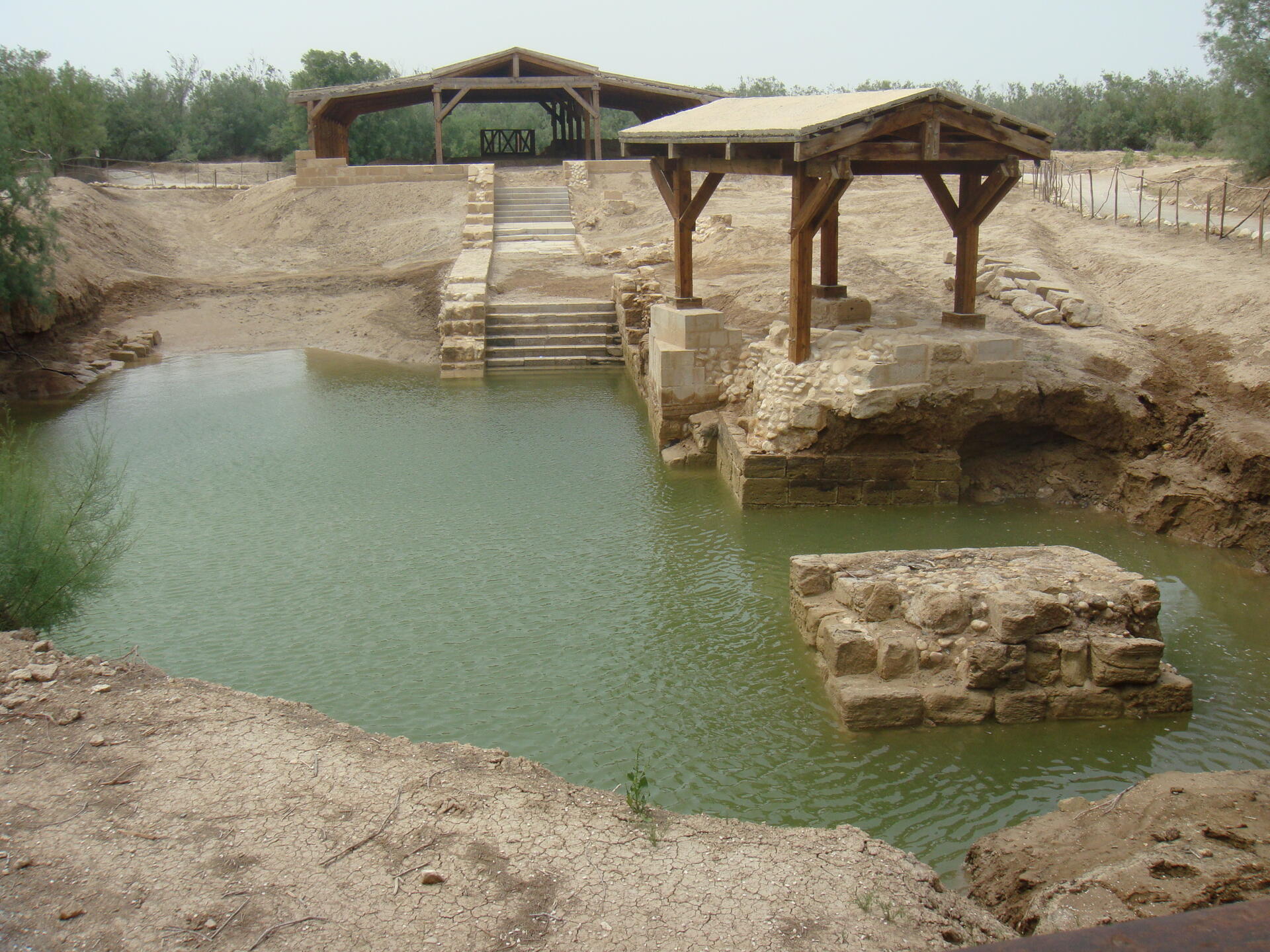
Situated on the eastern bank of the River Jordan, nine kilometres north of the Dead Sea, the archaeological site consists of two distinct areas: Tell Al-Kharrar, also known as Jabal Mar-Elias (Elijah’s Hill) and the area of the churches of Saint John the Baptist near the river. Situated in a pristine natural environment the site is believed to be the location where Jesus of Nazareth was baptized by John the Baptist. It features Roman and Byzantine remains including churches and chapels, a monastery, caves that have been used by hermits and pools in which baptisms were celebrated, testifying to the religious character of the place. The site is a Christian place of pilgrimage.
UNESCO Justification of the World Heritage Site
Criterion (iii): “Bethany beyond the Jordan” represents in an exceptional way the tradition of baptism, an important sacrament in Christian faith, and with it the historic and contemporary practice of pilgrimage to the site. This tradition is illustrated by the archaeological evidence, which references the practice of baptism since the 4th century. The majority of Christian connotations accepted that Bethany beyond the Jordan is the authentic location of Jesus of Nazareth’s baptism, a conviction which strongly characterized historic and present practice of the cultural tradition.
Criterion (vi): The Baptism Site, “Bethany Beyond the Jordan” (Al-Maghtas) is directly associated with the Christian tradition of baptism. The property is of highest significance to the majority of Christian denominations as the baptism site of Jesus of Nazareth and since millennia has been a popular pilgrimage destination. Its association to this historic event, believed to have taken place in the property, and the contemporary rituals which are continued at the Baptism Site illustrate the direct association with the Christian tradition of baptism.
Encyclopedia Record: Al-Maghtas
Al-Maghtas, officially known as Baptism Site "Bethany Beyond the Jordan", is an archaeological World Heritage Site in Jordan, on the east bank of the Jordan River, reputed to be the location of the Baptism of Jesus by John the Baptist and venerated as such since at least the Byzantine period. The place has also been referred to as Bethabara and historically Bethany.Additional Site Details
Area: 294.155 hectares
Number of Components: 1
(vi) — Directly associated with events or living traditions
Coordinates: 31.8372222222 , 35.5527777778
World Heritage Research
Discover scientific research and academic studies that deepen our understanding of Baptism Site “Bethany Beyond the Jordan” (Al-Maghtas) from its history and significance to its conservation, management, and contemporary challenges.
-
Tourism, Security, and Sacred Space at Bethany Beyond the Jordan
At Bethany Beyond the Jordan, a UNESCO World Heritage Site marking Jesus of Nazareth's baptism site, sacrality is not merely inherent but actively shaped by tourism, commodification, and security infrastructure. This study reveals that ritual encounters are organized through tourist spaces, while the commodification of sites and souvenirs, alongside state security practices tied to border geopolitics, co-creates perceptions of sacredness. Through semiotic analysis grounded in first-person observation, the research demonstrates how these forces—tourism, security, governance, and materiality—intertwine with power dynamics, redefining sacred spaces in the Holy Land as contested sites rather than neutral pilgrimage destinations.
Stockwell, O. (2026). Tourism, Security, and Sacred Space at Bethany Beyond the Jordan. Southern Anthropological Society Proceedings, 50(1). https://doi.org/10.56702/mpmc7908/saspro5001.4
View Publication Record | Read Publication -
Assessment of radon exhalation rate and radium content in soil samples from east west bank, palestine
Soil samples from the eastern West Bank, including the UNESCO World Heritage Site 'Baptism Site “Bethany Beyond the Jordan” (Al-Maghtas)', reveal significant variations in radon concentration and radium content, with Al-Maghtas showing particularly high levels. Radon concentrations ranged from 169.3 to 6184.4 Bq/m³, while effective radium content varied between 8.2 and 301.2 Bq/kg. The study also identified notable radon exhalation rates, with averages reaching up to 543 mBq/m²h (19.5 mBq/kg/h). These findings suggest potential health risks in certain areas and provide a baseline for monitoring radiation levels over time. The research employed comparative analysis against similar studies to assess the implications of these radiological characteristics.
Khalilia, W., Mashal, L., Faugno, A., Thabayneh, K., & al-Wahish, A. (2024). Assessment of radon exhalation rate and radium content in soil samples from east west bank, palestine. Nuclear Technology and Radiation Protection, 39(4), 300–311. https://doi.org/10.2298/ntrp2404300k
View Publication Record | Read Publication -
The Discovery of Byzantine Laura of St Mary the Egyptian in Site of Jesus Baptism
Recent excavations at the UNESCO World Heritage Site 'Baptism Site “Bethany Beyond the Jordan” (Al-Maghtas)' have uncovered unique archaeological remains linked to St. Mary of Egypt, a revered figure in early Christianity. These discoveries, located near the Church of John the Baptist and close to the eastern bank of the Jordan River, provide tangible evidence of her monastic life and death in this region. The findings shed light on the Byzantine Laura (a monastic community) associated with St. Mary, offering insights into the evolution of early Christian monasticism and its architectural expression. This study bridges archaeological evidence with historical narratives, enhancing our understanding of the site's significance during the formative period of Christianity.
Waheeb, M. (2019). The Discovery of Byzantine Laura of St Mary the Egyptian in Site of Jesus Baptism. Annals of Archaeology, 2(1), 1–9. https://doi.org/10.22259/2639-3662.0201001
View Publication Record | Read Publication -
Site of Jesus Baptism: From Discovery to World List Heritage
The Baptism Site 'Bethany Beyond the Jordan' (Al-Maghtas) has been confirmed as the actual location where Jesus of Nazareth was baptized by John the Baptist, a discovery supported by extensive archaeological evidence and recognized by UNESCO in 2015. Excavations conducted between 1996 and 2002 uncovered three distinct areas: Tell al-Kharrar (Elijah's Hill), the Monastery with its Large Pool, and the Churches of St. John the Baptist. These findings include architectural remains such as churches, mosaic floors, caves, and water systems dating back to the Byzantine Period, which were built to commemorate sacred events for early Christian communities. The site holds immense religious significance, attracting pilgrims since the 1st century AD and serving as a continuous destination for baptism rituals. To preserve its sanctity, visitor numbers are controlled, and facilities like a Visitor's Centre, restaurant, parking, and new churches have been developed sensitively by the Jordan Ministry of Tourism and Department of Antiquities.
Waheeb, M. (2019). Site of Jesus Baptism: From Discovery to World List Heritage. International Journal of Archaeology, 7(1), 1. https://doi.org/10.11648/j.ija.20190701.11
View Publication Record | Read Publication -
Mountain of Transfiguration & New Discoveries in Site of Jesus Baptism / Jordan River
Recent archaeological discoveries at the UNESCO World Heritage Site 'Baptism Site “Bethany Beyond the Jordan” (Al-Maghtas)' have shed new light on the potential location of the Transfiguration of Christ. Systematic surveys and excavations, conducted since 1997 on the eastern bank of the Jordan River, have uncovered monasteries, churches, water installations, caves, and footpaths. These findings provide compelling evidence for the proposed or actual site of this significant biblical event, marking a pivotal moment in Gospel narratives as Jesus prepared for his journey to Jerusalem. The research highlights the importance of these discoveries in understanding the historical and religious context of the region.
Waheeb, M. (2019). Mountain of Transfiguration & New Discoveries in Site of Jesus Baptism / Jordan River. American International Journal of Contemporary Research, 9(2). https://doi.org/10.30845/aijcr.v9n2p3
View Publication Record | Read Publication -
The Discovery of Gharabaa Byzantine Caravanserai, Near Site of Jesus Baptism-Jordan River
Recent archaeological field surveys near the UNESCO World Heritage Site of Bethany Beyond the Jordan, Jordan River, have uncovered significant Byzantine-era architectural remains identified as Gharabah caravanserai. This discovery includes two large interconnected water pools linked by a canal and a complex structure comprising multiple rooms and associated facilities, providing crucial insights into lost pilgrim stations along the historical route from Jerusalem to Mount Nebo during the 4th–6th centuries AD. The findings were derived through systematic excavations, data analysis, and comparative studies, linking Gharabah to other newly identified stations on this major Byzantine pilgrimage path.
Waheeb, M. (2017). The Discovery of Gharabaa Byzantine Caravanserai, Near Site of Jesus Baptism-Jordan River. International Journal of Archaeology, 5(3), 19. https://doi.org/10.11648/j.ija.20170503.11
View Publication Record | Read Publication -
Ancient Water System in Tel Mar Elyas during the Byzantine Period: A Study
Recent archaeological surveys and excavations at Tel Mar Elyas (Bethany Beyond the Jordan) have revealed a sophisticated Byzantine-period water system, including pools, cisterns, wells, and aqueducts, providing insights into early Christian ecology and history in eastern Jordan. The study confirmed that the main settlement of Bethany was located near the head of Wadi Kharrar, approximately 1.5 kilometers east of the Jordan River. Excavations uncovered a 1st-century AD settlement with plastered pools likely used for baptism, as well as late Byzantine structures (5th-6th century AD) such as churches and monasteries that served pilgrims. Additionally, the research documented an ancient pilgrimage route linking Jerusalem to Mt. Nebo via Bethany, including several Byzantine churches and monastic sites. The findings highlight the region's significance during the Byzantine period and emphasize the need for preserving its fragile water system installations.
Waheeb, M., & Ghazawi, R. A. (2015). Ancient Water System in Tel Mar Elyas during the Byzantine Period: A Study. Journal of Human Ecology, 49(3), 327–333. https://doi.org/10.1080/09709274.2015.11906852
View Publication Record | Read Publication