World Heritage Identification Number: 1575
World Heritage since: 2018
Category: Natural Heritage
WHE Type: Natural Landscapes & Geographic Features
Transboundary Heritage: No
Endangered Heritage: No
Country: 🇿🇦 South Africa
Continent: Africa
UNESCO World Region: Africa
Map
Unraveling the Geological Secrets of the Barberton Makhonjwa Mountains
The Barberton Makhonjwa Mountains, nestled in northeastern South Africa, have captivated scientists and researchers for decades due to their exceptional significance in understanding Earth's history. Inscribed as a UNESCO World Heritage Site in 2018, this region represents a unique window into the planet's earliest chapters, offering insights into various geological phenomena that shaped our world.
More to come…UNESCO Description of the World Heritage Site
Situated in north-eastern South Africa, the Barberton Makhonjwa Mountains comprises 40% of the Barberton Greenstone Belt, one of the world’s oldest geological structures. The property represents the best-preserved succession of volcanic and sedimentary rock dating back 3.6 to 3.25 billion years and forms a diverse repository of information on surface conditions, meteorite impacts, volcanism, continent-building processes and the environment of early life.
UNESCO Justification of the World Heritage Site
Criterion (viii): The property is a unique remnant of the ancient Earth’s crust, containing among the oldest, and best-preserved sequence of volcanic and sedimentary rocks on Earth. These highly accessible ancient exposures present a continuous 340-million-year sequence of rocks, starting 3 600 million years ago. Their physical, chemical and biological characteristics provide an unparalleled source of scientific information about the early Earth ‒ including the origin of continents, deposits of the hottest lavas ever to flow on Earth, repeated meteorite bombardments, anoxic oceans and atmosphere ‒ that formed the environment in which primitive unicellular life first appeared on our planet. The outstanding value of these rocks lies in the large number of sites and features that, when combined, provide a unique, and as yet only partially explored, scientific resource.
Encyclopedia Record: Makhonjwa Mountains
The Makhonjwa Mountains or Barberton Makhonjwa Mountains are a range of small mountains and hills that covers an area of 120 by 60 kilometres, about 80% in Mpumalanga, a province of South Africa, and the remainder in neighbouring Eswatini. It constitutes 40% of the Barberton Greenstone Belt.Additional Site Details
Area: 113,137 hectares
Number of Components: 1
Coordinates: -25.9738888889 , 31.0138888889
IUCN World Heritage Outlook
The 2025 Conservation Outlook on Barberton Makhonjwa Mountains reports the following assessment:
Source: International Union for Conservation of Nature (IUCN) · View assessment
Image
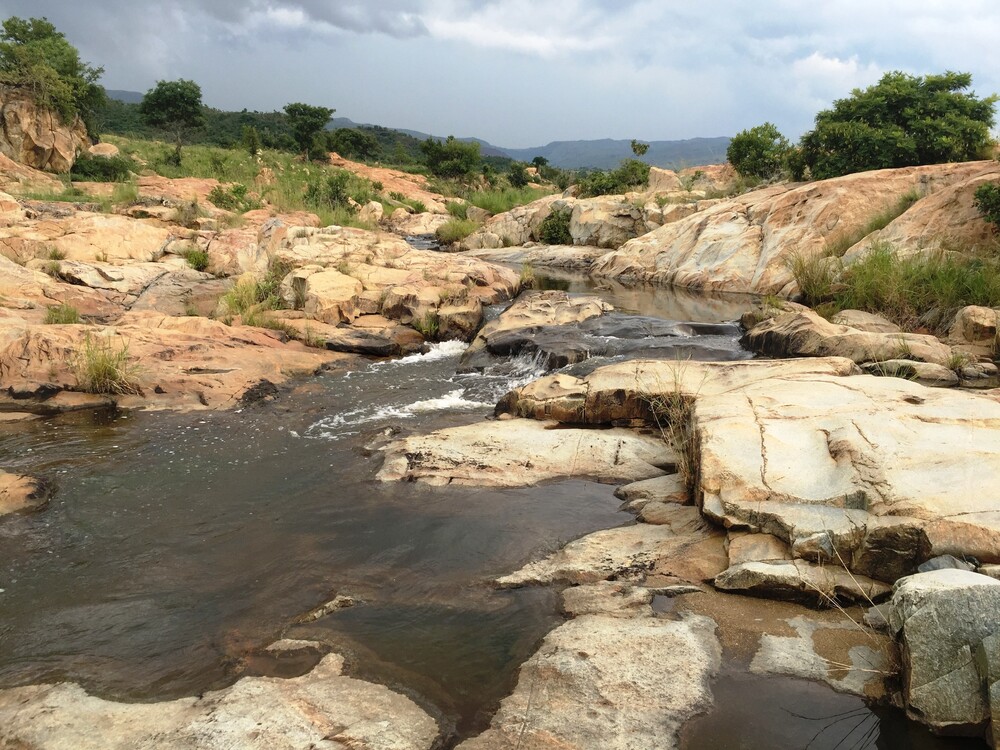
© Dion Brandt. Used with permission.
World Heritage Research
Discover scientific research and academic studies that deepen our understanding of Barberton Makhonjwa Mountains from its history and significance to its conservation, management, and contemporary challenges.
-
Drilling Into Ancient Rock to Learn About Earth’s Past
Ancient sedimentary rocks in the Barberton Makhonjwa Mountains, dating back 3.2 billion years, offer rare insights into Earth's early conditions, including temperature, climate, and volcanic activity that shaped life's emergence. These rocks, typically buried under younger layers or obscured by vegetation, are often tilted or flipped, complicating access. Researchers employed innovative sideways drilling to traverse multiple vertical layers, revealing critical data about Earth's distant past. This approach allows scientists to reconstruct ancient environments, including beaches, rivers, and meteorite impacts, providing a window into the planet's formative era.
Mashele, P., & Heubeck, C. (2024). Drilling Into Ancient Rock to Learn About Earth’s Past. Frontiers for Young Minds, 12. https://doi.org/10.3389/frym.2024.1252881
View Publication Record | Read Publication -
BASE (Barberton Archean Surface Environments) – drilling Paleoarchean coastal strata of the Barberton Greenstone Belt
The BASE (Barberton Archean Surface Environments) drilling project successfully recovered an unweathered, continuous core from the Paleoarchean Moodies Group in South Africa's Barberton Greenstone Belt, providing a high-resolution record of Earth's surface conditions around 3.2 billion years ago. The project, which drilled eight inclined boreholes totaling 2903 meters, revealed unexpected oxidative weathering depths, intense fracturing, and thicker banded-iron formations (BIFs) than anticipated. These findings offer unprecedented insights into early Earth's coastal environments, including alluvial, fluvial, tidal, and prodeltaic settings, preserved in sedimentary strata such as conglomerates, sandstones, siltstones, shales, and rare BIFs. The project also included extensive sampling of mine adits and a water tunnel, along with downhole geophysical logging and public engagement initiatives tied to the UNESCO World Heritage Site.
Heubeck, C., Beukes, N., de Kock, M., Homann, M., Javaux, E. J., Kakegawa, T., Lalonde, S., Mason, P., Mashele, P., Paprika, D., Rippon, C., Tice, M., Tucker, R., Tucker, R., Ndazamo, V., Christianson, A., & Kunkel, C. (2024). BASE (Barberton Archean Surface Environments) – drilling Paleoarchean coastal strata of the Barberton Greenstone Belt. Scientific Drilling, 33(2), 129–172. https://doi.org/10.5194/sd-33-129-2024
View Publication Record | Read Publication -
Operational Report about drilling in the Moodies Group of the Barberton Greenstone Belt (BASE – Barberton Archean Surface Environments)
The BASE (Barberton Archean Surface Environments) drilling project successfully recovered unweathered, continuous core samples from the Paleoarchean Moodies Group in the Barberton Greenstone Belt, South Africa. These strata, among Earth's oldest well-preserved sedimentary records, offer a high-resolution snapshot of surface conditions and processes dating back approximately 3.2 billion years. The project achieved its drilling objectives by extracting 2903 meters of core from eight inclined boreholes, revealing diverse lithologies including conglomerates, sandstones, shales, and banded-iron formations (BIFs). Unexpectedly deep oxidative weathering and intense fracturing were observed, along with thicker BIFs than anticipated. Additionally, samples from two mine adits and a water tunnel provided further insights into the upper Moodies Group's stratigraphy. The project integrated geophysical logging, core processing, and an extensive education program to engage local stakeholders and relate findings to the recently established Barberton-Makhonjwa Mountains World Heritage Site.
Heubeck, C., Beukes, N., Homann, M., Javaux, E. J., Kakegawa, T., Lalonde, S., Mason, P., Tice, M., Mashele, P., Paprika, D., Rippon, C., Tucker, R., Tucker, R., Ndazamo, V., Christianson, A., & Kunkel, C. (2024). Operational Report about drilling in the Moodies Group of the Barberton Greenstone Belt (BASE – Barberton Archean Surface Environments) . Helmholtz Centre Potsdam - GFZ German Research Centre for Geosciences. https://doi.org/10.48440/ICDP.5069.001
View Publication Record | Read Publication -
Geologic framework and first results from ICDP BASE drilling in the Moodies Group (~3.22 Ga), Barberton Greenstone Belt, South Africa
The Barberton Makhonjwa Mountains host some of Earth's oldest well-preserved sedimentary strata, the Moodies Group (~3.22 Ga), offering a unique window into early Archean surface processes and microbial life conditions. The ICDP BASE Project drilled eight inclined boreholes (November 2021–July 2022) through these steeply inclined strata, yielding an unweathered, continuous core record of up to 3.7 km thickness. This high-resolution sedimentary archive—complemented by tunnel sampling and surface mapping—preserves evidence of tidal deltas, coastal plains, microbial mats, and early diagenetic features, providing unprecedented insights into Paleoarchean environmental dynamics. The project's extensive core repository (Berlin) and public exhibition in Barberton highlight its dual role as a scientific endeavor and educational resource.
Heubeck, C., & Beukes, N. (2023). Geologic framework and first results from ICDP BASE drilling in the Moodies Group (~3.22 Ga), Barberton Greenstone Belt, South Africa. https://doi.org/10.5194/egusphere-egu23-17266
View Publication Record | Read Publication -
Paleoarchean bedrock lithologies across the Makhonjwa Mountains of South Africa and Swaziland linked to geochemical, magnetic and tectonic data reveal early plate tectonic genes flanking subduction margins
Research on the Barberton Makhonjwa Mountains reveals that plate tectonics and associated processes were established by 3.2–3.6 billion years ago, challenging earlier assumptions about Earth's early geodynamic behavior. The study integrates geological mapping, geochemistry, magnetism, and thermochronology to demonstrate similarities between Paleoarchean subduction zones and modern Western Pacific-like systems. Key findings include robust rates of horizontal and vertical tectonic processes that align with those observed in contemporary oceanic and orogenic terrains, providing critical constraints for testing Paleoarchean geodynamic models over a span comparable to the Phanerozoic eon.
de Wit, M., Furnes, H., MacLennan, S., Doucouré, M., Schoene, B., Weckmann, U., Martinez, U., & Bowring, S. (2018). Paleoarchean bedrock lithologies across the Makhonjwa Mountains of South Africa and Swaziland linked to geochemical, magnetic and tectonic data reveal early plate tectonic genes flanking subduction margins. Geoscience Frontiers, 9(3), 603–665. https://doi.org/10.1016/j.gsf.2017.10.005
View Publication Record | Read Publication