World Heritage Identification Number: 973
World Heritage since: 2000
Category: Cultural Heritage
WHE Type: Historic Cities & Urban Areas
Transboundary Heritage: No
Endangered Heritage: No
Country: 🇸🇰 Slovakia
Continent: Europe
UNESCO World Region: Europe and North America
Map
Bardejov Town Conservation Reserve: A Medieval Gem in Eastern Slovakia
The Bardejov Town Conservation Reserve, inscribed as a UNESCO World Heritage Site in 2000, stands as a testament to the rich history and architectural prowess of medieval Europe. Situated in the picturesque region of Šariš, within the foothills of the Beskyd Mountains, this charming town boasts a unique blend of historical preservation and contemporary life, with a current population of approximately 32,000 residents.
More to come…UNESCO Description of the World Heritage Site
Bardejov is a small but exceptionally complete and well-preserved example of a fortified medieval town, which typifies the urbanisation in this region. Among other remarkable features, it also contains a small Jewish quarter around a fine 18th-century synagogue.
UNESCO Justification of the World Heritage Site
Criterion (iii): The fortified town of Bardejov provides exceptionally well-preserved evidence of the economic and social structure of trading towns in medieval Central Europe.
Criterion (iv): The plan, buildings and fortifications of Bardejov illustrate the urban complex that developed in Central Europe in the Middle Ages along the great trade routes of the period.
Encyclopedia Record: Bardejov
Bardejov is a town in northeastern Slovakia. It is situated in the Šariš region on a floodplain terrace of the Topľa River, in the hills of the Beskyd Mountains. It exhibits numerous cultural monuments in its completely intact medieval town center. The town is one of UNESCO's World Heritage Sites and currently maintains a population of about 32,000 inhabitants.Additional Site Details
Area: 23.6 hectares
Number of Components: 1
(iv) — Outstanding example of a type of building or landscape
Coordinates: 49.2927777778 , 21.2755555556
Image
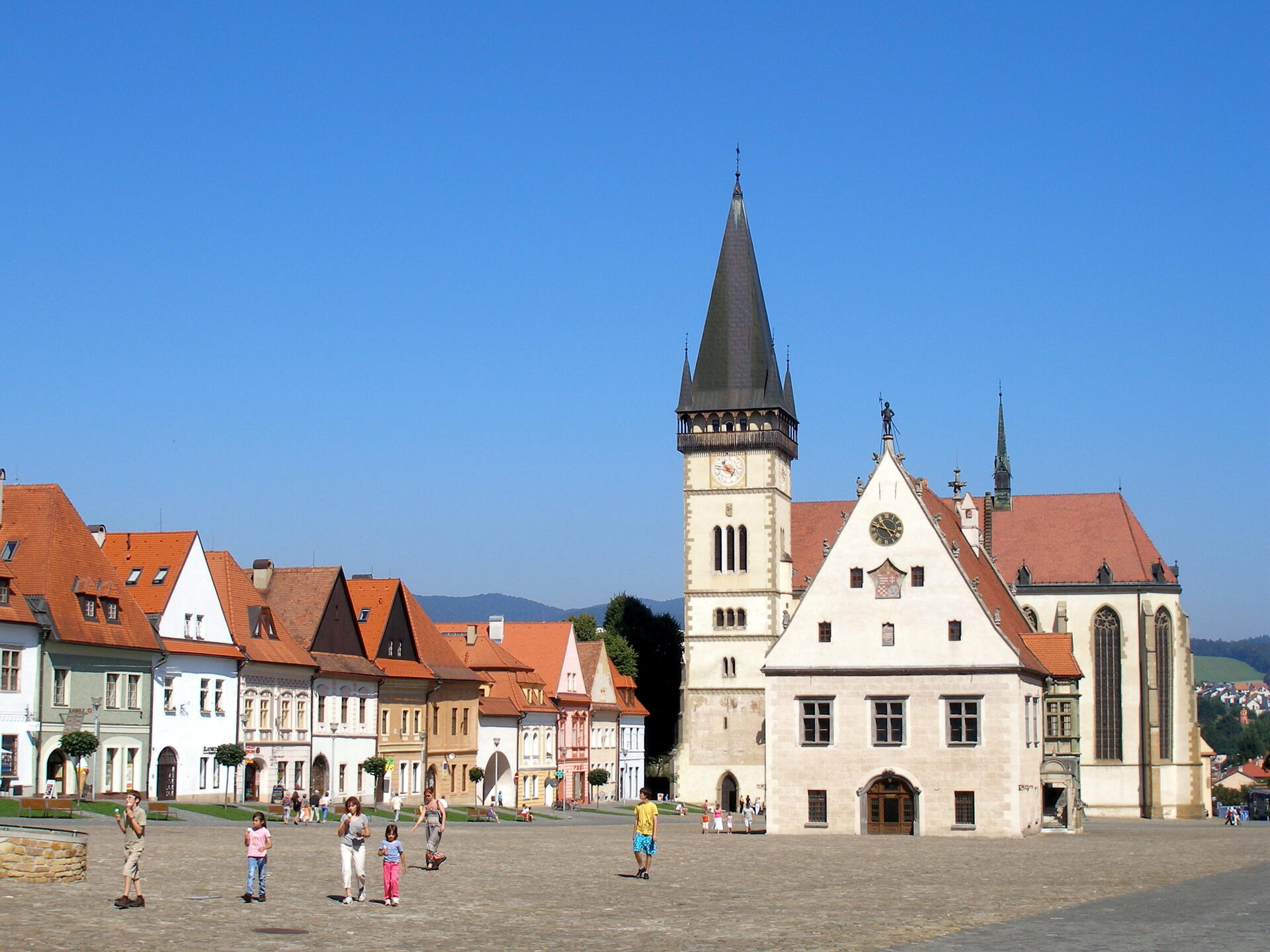
© Doko Ing. Mgr. Jozef Kotulič, CC BY-SA 3.0 Resized from original. (This derivative is under the same CC BY-SA license.)
World Heritage Research
Discover scientific research and academic studies that deepen our understanding of Bardejov Town Conservation Reserve from its history and significance to its conservation, management, and contemporary challenges.
-
Registers of citizenship as a source of urban migration in late medieval Bardejov
Late medieval citizenship registers from Bardejov reveal significant patterns of urban migration, offering unprecedented insight into the movement and integration of newcomers. The study identifies key factors influencing citizenship acquisition, including place of origin and occupation, while also highlighting the challenges in interpreting these records due to their fragmentary nature. A notable focus is on the migration of scholars, particularly those who transitioned into notarial roles, providing a unique lens on the intellectual mobility within the town. This research contributes to understanding urban dynamics during this period by leveraging historical documents to trace career trajectories and social integration processes.
Fedorčákvá, M. (2025). Rejestry obywatelstwa jako źródło migracji miejskiej w późnośredniowiecznym Bardejowie. Saeculum Christianum, 32(2), 112–125. https://doi.org/10.21697/sc.2025.32.2.9
View Publication Record | Read Publication -
Historik Ferdinand Uličný a dejiny stredovekého Bardejova
A recent reassessment of historian Ferdinand Uličný's contributions to medieval Bardejov studies reveals that his foundational work from the late 1960s established enduring research themes, while later debates—particularly over King Béla IV’s 1247 charter for the Cistercians—challenged some of his interpretations. Pavol Hudáček’s broader source analysis now offers new perspectives on Bardejov’s early history and the contested charter, highlighting the evolving nature of medieval Slovak historiography.
Fedorčáková, M. (2024). Historik Ferdinand Uličný a dejiny stredovekého Bardejova. Historik, Archivár a Univerzitný Profesor Ferdinand Uličný ´90. https://doi.org/10.33542/hau-0292-3-9
View Publication Record | Read Publication -
Episcopal Power and Authority in Communication with the City of Bardejov in the Late Middle Ages
A study reveals how bishops of Eger exerted power and authority over the medieval town of Bardejov through tithes, judicial cases, and symbolic rituals. The research demonstrates that disputes over tithe collection were common between parish priests, town representatives, and bishops, often resolved through episcopal machinery. Additionally, ecclesiastical courts occasionally overshadowed town law in judicial matters, while episcopal presence in religious ceremonies reinforced their authority. The study also highlights the role of episcopal vicars in representing the bishop's power, providing insight into the complex interplay between ecclesiastical and municipal governance during this period.
Fedorčáková, M. (2023). Episcopal Power and Authority in Communication with the City of Bardejov in the Late Middle Ages. Mesto a Dejiny, 12(2). https://doi.org/10.33542/cah2023-2-02
View Publication Record | Read Publication -
Spory o česť, rituály násilia a konflikty v stredovekom Bardejove
A study of medieval Bardejov reveals that conflicts over honor and dishonor were prevalent among town citizens, guild members, and clerics, often escalating from slander to violence. Preserved 'threatening letters' provide unique insights into the strategies used by conflicting parties, including town authorities, to issue warnings and state intentions of harm. The research combines analysis of legal sources with judicial practice to explore the role of violence in everyday life and the tactics employed by authorities to mitigate conflicts. This dual approach offers a nuanced understanding of crime dynamics and authority responses in late medieval urban settings.
Fedorčáková, M. (2022). Spory o česť, rituály násilia a konflikty v stredovekom Bardejove. Forum Historiae, 16(2). https://doi.org/10.31577/forhist.2022.16.2.3
View Publication Record | Read Publication -
Hydraulic Review of the Flood Protection Measures in Bardejov
A hydraulic review reveals that the current flood protection measures in Bardejov, Slovakia, are insufficient to mitigate even historical flood events like the 2010 disaster. Using mathematical modeling of open channel flow—both steady and unsteady—researchers assessed the impact of existing phase I protections on proposed phases II and III, which extend upstream and downstream. The study, conducted in HEC-RAS software, identified critical gaps in flood defense along the Topľa River, particularly in areas not yet addressed by ongoing projects. Proposed adjustments to these measures were validated through simulations, demonstrating their potential to control extreme flooding. This work underscores the need for comprehensive, multi-phase flood infrastructure to safeguard Bardejov's central residential area.
Šoltész, A., Cubanová, L., Mydla, J., Cerveňanská, M., & Baroková, D. (2021). Hydraulic Review of the Flood Protection Measures in Bardejov. IOP Conference Series: Materials Science and Engineering, 1203(3), 32095. https://doi.org/10.1088/1757-899x/1203/3/032095
View Publication Record | Read Publication -
Communication between the Towns and the County Authority: The Free Royal Towns and Šariš County at the Beginning of the 16th Century
A study reveals that the free royal towns of Šariš, notably Bardejov and Prešov, developed intricate communication channels with the county authority during the early 16th century. These towns, having become feudal landowners, maintained close ties with the county nobility through both official documents and private letters, often penned by noble judges. Verbal communication was also significant, with emissaries—frequently former or acting noble judges from neighboring villages—acting as envoys to the towns. This practice allowed towns to leverage the legal expertise of these individuals, who were subsequently employed as town lawyers. The research highlights how these dual channels of communication facilitated both official and personal exchanges, shaping the relationship between the towns and the county authority during this period.
Kádas, I. (2020). Communication between the Towns and the County Authority: The Free Royal Towns and Šariš County at the Beginning of the 16th Century. Mesto a Dejiny, 9(2). https://doi.org/10.33542/cah2020-2-02
View Publication Record | Read Publication