World Heritage Identification Number: 677
World Heritage since: 1993
Category: Cultural Heritage
WHE Type: Religious Sites & Sacred Architecture
Transboundary Heritage: No
Endangered Heritage: No
Country: 🇵🇭 Philippines
Continent: Asia
UNESCO World Region: Asia and the Pacific
Map
Baroque Churches of the Philippines: A Unique Blend of Cultures and Architecture
The Baroque Churches of the Philippines, inscribed as a UNESCO World Heritage Site in 1993, stand as a testament to the rich cultural fusion that characterizes the Southeast Asian nation. These four churches, each unique in its design and history, showcase a remarkable blend of European Baroque architecture with indigenous Filipino and Chinese influences.
More to come…UNESCO Description of the World Heritage Site
These four churches, the first of which was built by the Spanish in the late 16th century, are located in Manila, Santa Maria, Paoay and Miag-ao. Their unique architectural style is a reinterpretation of European Baroque by Chinese and Philippine craftsmen.
UNESCO Justification of the World Heritage Site
Criterion (ii): The group of churches established a style of building and design that was adapted to the physical conditions in the Philippines which had an important influence on later church architecture in the region.
Criterion (iv): The Baroque Churches of the Philippines represent the fusion of European church design and construction using local materials and decorative motifs to form a new church-building tradition.
Encyclopedia Record: Baroque Churches of the Philippines
The Baroque Churches of the Philippines are a collection of four Spanish Colonial-era baroque churches in the Philippines, which were included in UNESCO's World Heritage List in 1993. The churches are also considered as national cultural treasures of the country.Additional Site Details
Area: Not available
Number of Components: 4
(iv) — Outstanding example of a type of building or landscape
Coordinates: 14.59 , 120.97
Image
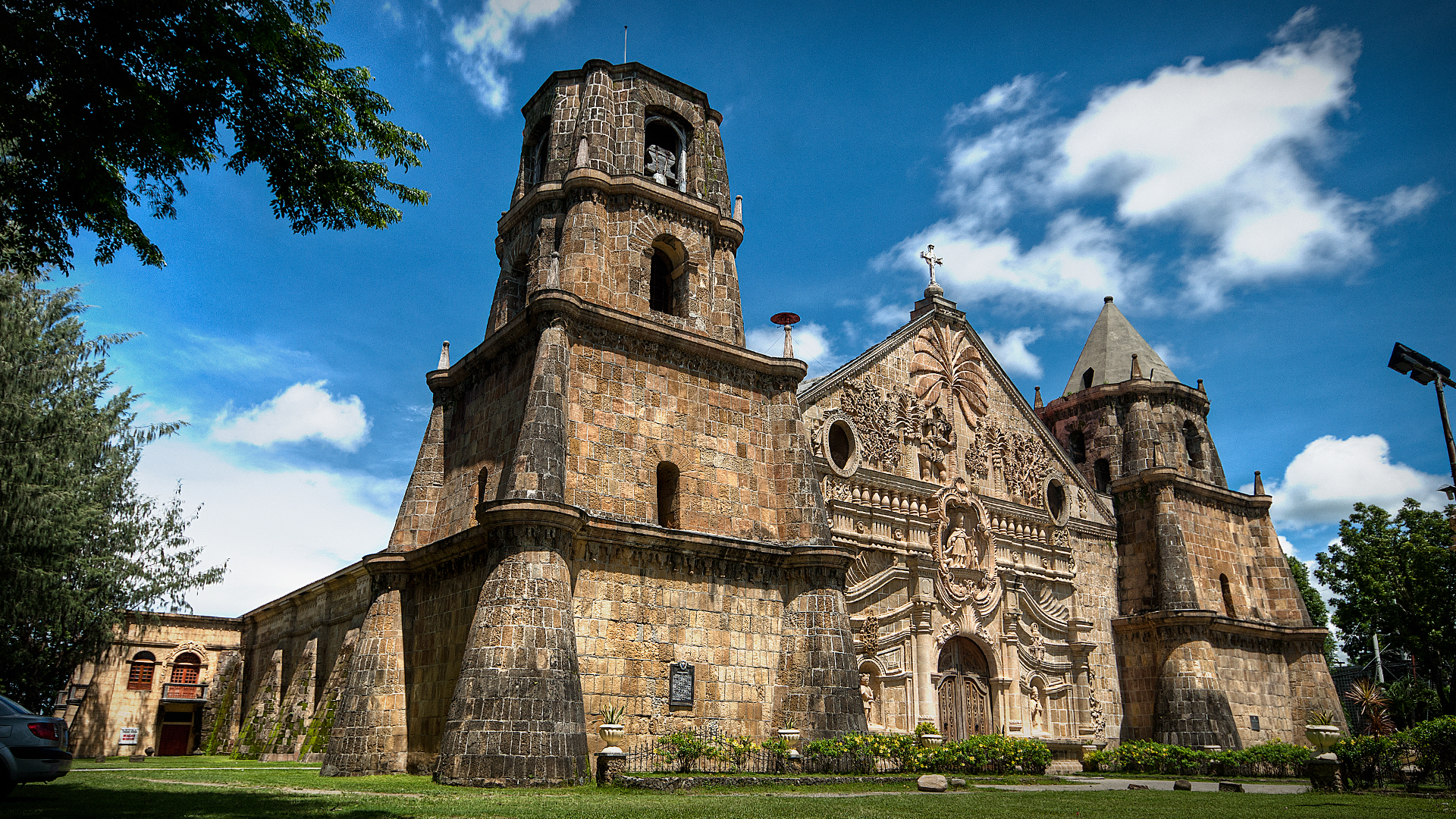
© Alienscream, CC BY-SA 3.0 Resized from original. (This derivative is under the same CC BY-SA license.)
World Heritage Research
Discover scientific research and academic studies that deepen our understanding of Baroque Churches of the Philippines from its history and significance to its conservation, management, and contemporary challenges.
-
Preliminary Fragility Assessment of a 19th-Century Baroque Church Bell Tower Using Multiple Time History Analyses
A preliminary fragility assessment reveals that the 19th-century Baroque bell tower of Pulilan, Bulacan’s Diocesan Shrine and Parish of San Isidro Labrador is highly vulnerable to seismic damage. Using Linear Time History Analysis (LTHA) with scaled ground motion records, researchers found that even moderate peak ground accelerations (PGAs) could lead to structural compromise, surpassing the 50% probability threshold at the Life Safety limit. The study integrated material properties of concrete and adobe into a 3D structural model in Midas Gen, providing critical insights for heritage preservation. These findings underscore the need for retrofitting measures to protect this UNESCO World Heritage Site from potential seismic threats.
Clemente, J. DG., Uy, F. A., & Baylon, M. B. (2025). Preliminary Fragility Assessment of a 19th-Century Baroque Church Bell Tower Using Multiple Time History Analyses. International Journal of Civil Engineering, 12(5), 197–209. https://doi.org/10.14445/23488352/ijce-v12i5p115
View Publication Record | Read Publication -
Physics-Based Simulation of Seismic Collapse in Heritage Masonry Churches of Bohol, Philippines
Physics-based simulations reveal that Baroque masonry churches in Bohol, Philippines, remain structurally intact under Intensity VIII earthquakes but experience progressive collapse at higher intensities (IX and X), mirroring damage observed during the 2013 Bohol earthquake. The study leveraged open-source Blender software with the Bullet Constraints Builder (BCB) add-on to model seismic response with reduced computational demands compared to traditional finite element methods. This approach offers a rapid, data-efficient tool for assessing structural vulnerability and failure mechanisms in heritage masonry, supporting disaster risk reduction and preservation efforts in seismically active regions.
Reymarvelos M. Oros, & Joel G. Opon. (2025). Physics-Based Simulation of Seismic Collapse in Heritage Masonry Churches of Bohol, Philippines. Proceedings of International Exchange and Innovation Conference on Engineering & Sciences (IEICES), 11, 427–434. https://doi.org/10.5109/7395552
View Publication Record | Read Publication -
The Decorative Art in Filipino Catholic Church Architecture and Its Representation of Spanish Colonial Culture
Filipino Catholic church architecture from the Spanish colonial period (1565–1898) represents a unique fusion of European and indigenous artistic traditions, serving as both symbols of Spanish authority and enduring expressions of local craftsmanship. This study reveals how Filipino artisans, trained under Spanish supervision, adapted baroque, rococo, and neoclassical styles to incorporate indigenous motifs and materials, creating intricate facades, grand altarpieces, elaborate woodwork, and vibrant ceiling paintings. These churches not only reinforced religious doctrine but also became focal points for community life, fostering a hybrid Filipino identity. The analysis of key decorative elements—such as facade ornamentation, retablos, and ceiling art—demonstrates their dual role as symbols of colonial power and local resilience.
VILLENA, A. (2024). The Decorative Art in Filipino Catholic Church Architecture and Its Representation of Spanish Colonial Culture. Studies in Art and Architecture, 3(4), 17–22. https://doi.org/10.56397/saa.2024.12.03
View Publication Record | Read Publication -
Tangibility-Intangibility on UNESCO World Heritage Baroque Philippine Churches: the Spirit of Place and Its Collective Memory
UNESCO World Heritage-listed Baroque churches in the Philippines, including those in Manila, Santa Maria, Paoay, and Miagao, represent a unique fusion of European Baroque style with local Chinese and Philippine craftsmanship from the 16-18th centuries. These structures, characterized by monumental designs to withstand intruders or natural harm, symbolize the blending of Western influences with regional materials and motifs, creating an innovative architectural tradition. The study highlights how these churches embody both tangible and intangible heritage elements, reflecting the spirit of place and collective memory among churchgoers, inhabitants, and visitors. The Miagao facade, in particular, underscores a distinct regional interpretation of Christianity and saint veneration. This research reinterprets sacred buildings through the lens of tangibility-intangibility, offering insights into how cultural heritage is perceived and preserved.
Lee-Niinioja, H. S. (2021). Tangibility-Intangibility on UNESCO World Heritage Baroque Philippine Churches: the Spirit of Place and Its Collective Memory. SPAFACON 2021: Papers from the SEAMEO SPAFA International Conference on Southeast Asian Archaeology and Fine Arts, 13-17 December 2021, 241–253. https://doi.org/10.26721/spafa.pqcnu8815a-20
View Publication Record | Read Publication -
Paradise in Stone: Representations of New World Plants and Animals on Spanish Colonial Churches in the Philippines
Eighteenth-century Filipino architects and stonemasons incorporated elaborate stonework depicting New World plants and animals into church façades, reflecting local aesthetics and interest in exotic flora and fauna. This architectural innovation, evident in sites like the baroque church of Miag-ao in Iloilo, serves as a visual celebration of naturalia introduced to the Philippines through commercial exchanges during Spanish colonial rule. The study examines how these representations transcend mere ornamentation, offering insights into cultural innovation and the fusion of local and imported elements in Filipino art.
Reyes, R. A. G. (2018). Paradise in Stone: Representations of New World Plants and Animals on Spanish Colonial Churches in the Philippines. Art, Trade, and Cultural Mediation in Asia, 1600–1950, 43–74. https://doi.org/10.1057/978-1-137-57237-0_3
View Publication Record | Read Publication -
Religious tourism and the new evangelization: theory and best practice in the pastoral promotion of the Church’s cultural heritage
Religious tourism can effectively serve the Catholic Church's mission of new evangelization, blending cultural heritage preservation with faith communication. The study presents two key strategies: framing religious tourism within an evangelizing context and reframing secular mass tourism through a Christian anthropological lens. Best practices from six international case studies—including the UNESCO-listed Baroque Churches of the Philippines—demonstrate how the Church leverages its artistic heritage to engage both pilgrims and tourists, fostering spiritual growth while addressing contemporary travel trends.
Tan, J. (2018). Religious tourism and the new evangelization: theory and best practice in the pastoral promotion of the Church’s cultural heritage. Church, Communication and Culture, 3(3), 283–309. https://doi.org/10.1080/23753234.2018.1547117
View Publication Record | Read Publication -
Heritage Management: The Case of Two Baroque Churches in Ilocos Region, Philippines
While adequate laws exist to protect the UNESCO-listed Baroque churches of Paoay and Sta. Maria in the Philippines, enforcement remains inconsistent, particularly due to local government funding constraints. The study reveals that parish priests play a pivotal role in preservation success, underscoring their need for conservation expertise. Management is shared among task forces, municipal governments, homeowners associations, NGOs (Paoay), or heritage district councils (Sta. Maria). Though local governments are supportive, financial limitations hinder Sta. Maria's compliance with protection requirements.
Lamarca, F. J. (2017). HERITAGE MANAGEMENT: THE CASE OF TWO BAROQUE CHURCHES IN ILOCOS REGION, PHILIPPINES. Journal Sampurasun : Interdisciplinary Studies for Cultural Heritage, 2(2), 177. https://doi.org/10.23969/sampurasun.v2i2.161
View Publication Record | Read Publication