World Heritage Identification Number: 722
World Heritage since: 1995
Category: Cultural Heritage
WHE Type: Agriculture Landscapes, Parks & Gardens
Transboundary Heritage: No
Endangered Heritage: No
Country: 🇵🇭 Philippines
Continent: Asia
UNESCO World Region: Asia and the Pacific
Map
The Rice Terraces of the Philippine Cordilleras: A Testament to Ancient Knowledge and Cultural Harmony
The Rice Terraces of the Philippine Cordilleras, inscribed as a UNESCO World Heritage Site in 1995, stand as a testament to the ancient wisdom, cultural traditions, and harmonious relationship between humans and their environment among the indigenous Ifugao people of the Philippines. These remarkable terraces, located in the mountainous region of the Cordillera Central on the island of Luzon, represent the longest continuous human settlement in Southeast Asia, dating back approximately 2,000 years.
More to come…UNESCO Description of the World Heritage Site
For 2,000 years, the high rice fields of the Ifugao have followed the contours of the mountains. The fruit of knowledge handed down from one generation to the next, and the expression of sacred traditions and a delicate social balance, they have helped to create a landscape of great beauty that expresses the harmony between humankind and the environment.
UNESCO Justification of the World Heritage Site
Criterion (iii): The rice terraces are a dramatic testimony to a community's sustainable and primarily communal system of rice production, based on harvesting water from the forest clad mountain tops and creating stone terraces and ponds, a system that has survived for two millennia.
Criterion (iv): The rice terraces are a memorial to the history and labour of more than a thousand generations of small-scale farmers who, working together as a community, have created a landscape based on a delicate and sustainable use of natural resources.
Criterion (v): The rice terraces are an outstanding example of land-use that resulted from a harmonious interaction between people and its environment which has produced a steep terraced landscape of great aesthetic beauty, now vulnerable to social and economic changes.
Encyclopedia Record: Rice Terraces of the Philippine Cordilleras
The Rice Terraces of the Philippine Cordilleras are a World Heritage Site consisting of a complex of rice terraces on the island of Luzon in the Philippines. They were inscribed on the UNESCO World Heritage List in 1995, the first-ever property to be included in the cultural landscape category of the World Heritage List. This inscription has five sites: the Batad Rice Terraces and Bangaan Rice Terraces, Mayoyao Rice Terraces, Hungduan Rice Terraces and Nagacadan Rice Terraces, all in Ifugao Province. The Ifugao Rice Terraces reach a higher altitude and were built on steeper slopes than many other terraces. The Ifugao complex of stone or mud walls and the careful carving of the natural contours of hills and mountains combine to make terraced pond fields, coupled with the development of intricate irrigation systems, harvesting water from the forests of the mountain tops, and an elaborate farming system.Additional Site Details
Area: Not available
Number of Components: 5
(iv) — Outstanding example of a type of building or landscape
(v) — Outstanding example of traditional human settlement
Coordinates: 16.93389 , 121.13667
Image
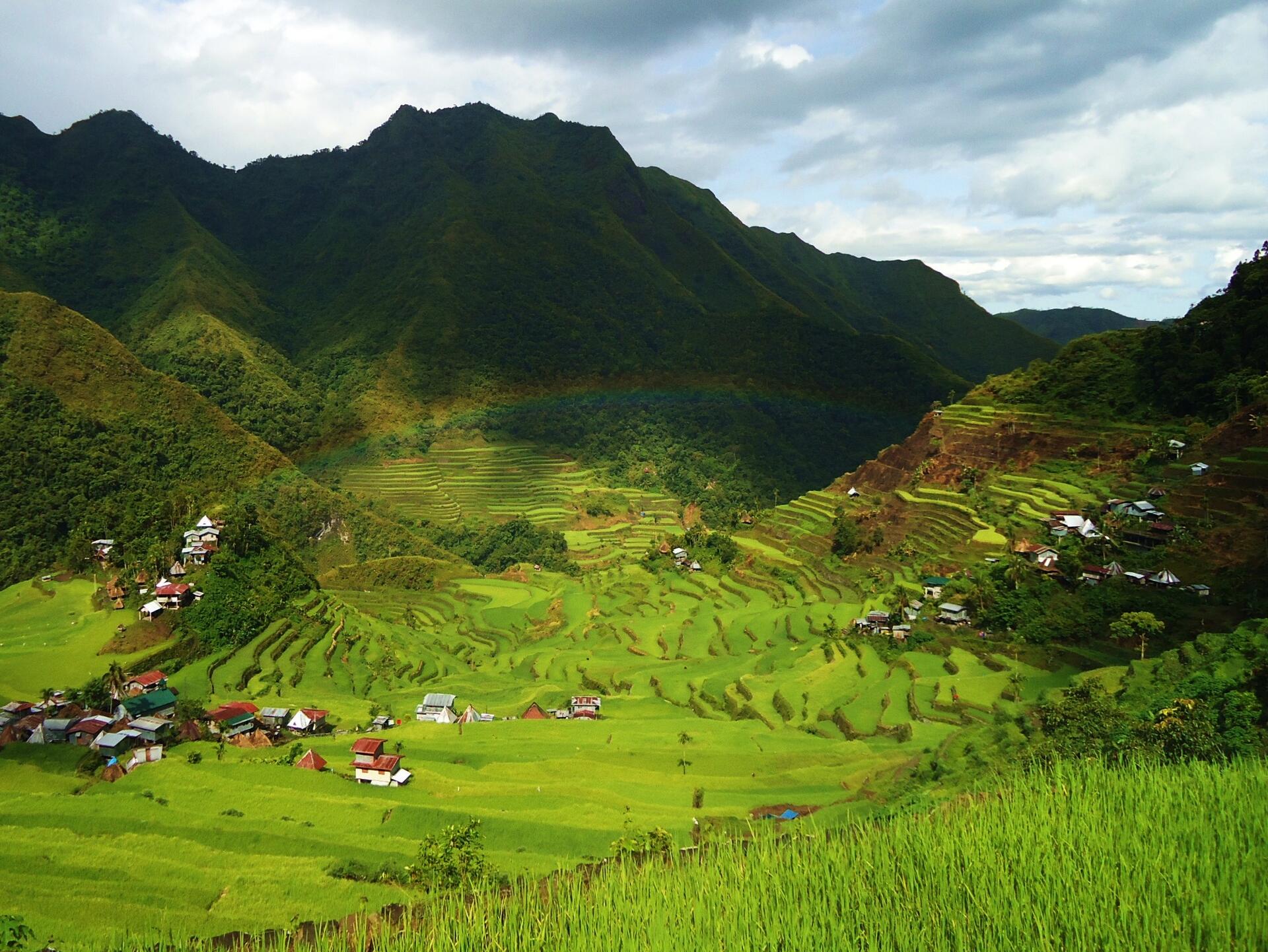
© Cid Jacobo, CC BY-SA 3.0 Resized from original. (This derivative is under the same CC BY-SA license.)
World Heritage Research
Discover scientific research and academic studies that deepen our understanding of Rice Terraces of the Philippine Cordilleras from its history and significance to its conservation, management, and contemporary challenges.
-
What Ifugao farmers, locals and the youth want: beyond tokenism in UNESCO heritage tourism and activities
Heritage tourism at the UNESCO-listed Rice Terraces of the Philippine Cordilleras, while fostering cultural pride and economic opportunities, often fails to deliver meaningful participation or equitable benefits for local communities. A study involving 250 individuals across four Ifugao municipalities revealed that while transparency in governance was highly valued, issues of fairness, accountability, and inclusivity persisted. Benefits disproportionately favored those directly tied to tourism, leaving farmers, community members, and youth with modest satisfaction. The research advocates for a non-traditional approach to tourism governance, emphasizing open planning and decision-making processes to ensure sustainability, shared benefits, and the preservation of community values without compromising authenticity for visitors.
Baguilat, I. (2026). What Ifugao farmers, locals and the youth want: beyond tokenism in UNESCO heritage tourism and activities. Leisure/Loisir, 1–36. https://doi.org/10.1080/14927713.2026.2666041
View Publication Record | Read Publication -
Multiple Values and System Mechanisms of Rice Terrace Systems from the Perspective of Heritage Comparison
Rice terrace systems, such as the Honghe Hani Rice Terraces in China and the Ifugao Rice Terraces in the Philippines, exhibit complex interconnections between multiple heritage values, including cultural landscape, agricultural production, irrigation engineering, and intangible cultural heritage. This study reveals that these systems consist of five interconnected subsystems—nature, terrace, village, irrigation, and concept—which collectively form a highly self-consistent and diverse yet unified whole. By analyzing typical cases through comparative research, the study demonstrates how rice terrace systems meet the criteria for multiple heritage classifications while maintaining their overall value integrity. The findings highlight the potential of systematic thinking in heritage protection and conservation, emphasizing the need for future research to address challenges in heritage activation, utilization, and value continuation.
YANG, Y., YU, X., JIAO, Y., & SUN, S. (2025). Multiple Values and System Mechanisms of Rice Terrace Systems from the Perspective of Heritage Comparison. Landscape Architecture, 32(3), 65–72. https://doi.org/10.3724/j.fjyl.202407160386
View Publication Record | Read Publication -
Updated Microfossil and 14C Analyses of Ifugao Rice Terraces, Philippine Cordilleras, Reveal Early Taro and Rice Cultivation, and New Parasite Discoveries1
New analyses of microfossils and radiocarbon dating from the Ifugao Rice Terraces in the Philippine Cordilleras reveal that taro (Colocasia esculenta) and rice (Oryza sativa) cultivation began at least 810–750 years ago, predating previous estimates by a century. These findings challenge the notion of post-Hispanic expansion for rice cultivation while supporting its spread during this period. Additionally, the study identifies helminth eggs, including Toxocara canis, marking the first early Philippine record of this parasite. The research combines microfossil analysis with 14C dating and helminthology to reconstruct agricultural and parasitic histories in the region.
Horrocks, M., Peterson, J., Bickler, S. H., & Presswell, B. (2025). Updated Microfossil and 14C Analyses of Ifugao Rice Terraces, Philippine Cordilleras, Reveal Early Taro and Rice Cultivation, and New Parasite Discoveries1. Pacific Science, 78(3). https://doi.org/10.2984/78.3.1
View Publication Record | Read Publication -
Conservation for Whom? Archaeology, Heritage Policy, and Livelihoods in the Ifugao Rice Terraces
Heritage conservation must prioritize adaptability and community-driven stewardship over rigid authenticity to sustain dynamic socio-ecological systems. A study of the Ifugao Rice Terraces reveals that their long-term viability depends on integrating livelihoods, functional flexibility, and local governance. Archaeological, ethnographic, spatial, and agricultural economic data show that wet-rice agriculture's expansion in the 17th century replaced earlier systems but maintained adaptive strategies, such as incorporating swidden fields and ritual practices. Contemporary shifts—like labor migration and climate variability—reflect ongoing adaptation rather than decline. Comparative analysis with other heritage sites underscores the need for conservation models that support economic viability and local authority to ensure cultural continuity in response to future challenges.
Acabado, S., Albano, A., & Martin, M. (2025). Conservation for Whom? Archaeology, Heritage Policy, and Livelihoods in the Ifugao Rice Terraces. Land, 14(9), 1721. https://doi.org/10.3390/land14091721
View Publication Record | Read Publication -
Standardizing antisickling phenylalanine peptide derivatives from philippine cordillera rice terrace paddy bund weed extracts in ifugao heritage zones
Researchers have identified and standardized phenylalanine peptide derivatives from paddy bund weeds in the UNESCO-listed Rice Terraces of the Philippine Cordilleras as potent antisickling agents. These compounds, derived from mixed weed biomass collected along Ifugao heritage zones, demonstrated significant sickling inhibition (72.4% at 200 µg/mL) with an IC50 of 52.3 µg/mL. High-performance liquid chromatography (HPLC) and mass spectrometry (LC-MS/MS) revealed two specific phenylalanine-conjugated dipeptides alongside flavonoid glycosides, establishing a quality specification for consistent batch production. This study validates traditional Ifugao practices while providing a novel pharmacological foundation for managing hyperviscosity syndromes, including sickle cell disease.
Sahoo, P. (2025). Standardizing antisickling phenylalanine peptide derivatives from philippine cordillera rice terrace paddy bund weed extracts in ifugao heritage zones. International Journal of Pharmacognosy and Pharmaceutical Sciences, 7(2), 205–208. https://doi.org/10.33545/27067009.2025.v7.i2d.278
View Publication Record | Read Publication -
Local Cuisine Attraction in the Rice Terraces of the Cordilleras: A World Heritage Site of the Philippines
Tourists visiting the UNESCO World Heritage Site of the Rice Terraces of the Philippine Cordilleras show significant willingness to consume local cuisine, particularly when they are younger and exhibit food-related personality traits such as food neophilia (willingness to try new foods) rather than food neophobia (aversion to novelty). Despite limited awareness about local dishes, these factors play a crucial role in shaping tourists' food preferences. The study, which surveyed 300 visitors through quantitative methods including questionnaires and interviews, highlights the importance of understanding demographic and psychological influences on culinary tourism experiences at World Heritage Sites.
(Ed.). (2023). Local Cuisine Attraction in the Rice Terraces of the Cordilleras: A World Heritage Site of the Philippines. Asian Journal of Research in Business and Management. https://doi.org/10.55057/ajrbm.2023.5.1.10
View Publication Record | Read Publication -
Reinforcing Philippine Cultural Landscape Values through the Schools of Living Tradition (SLTs)
The Schools of Living Tradition (SLTs) program effectively preserves and reinvents cultural landscape values amid rapid modernization, demonstrating that traditional practices can adapt to contemporary changes. Initially established to safeguard intangible heritage like the Ifugao Hudhud chanting tradition, SLTs have successfully integrated environmental imagery into crafts and textiles, preserving associative landscapes through language, color, and motifs. However, shifts in food production and education are transforming this mimicry of the landscape into a nostalgic memory, highlighting both the resilience and vulnerability of cultural heritage in dynamic environments.
Zerrudo, E. B. (2022). Reinforcing Philippine Cultural Landscape Values through the Schools of Living Tradition (SLTs). The Routledge Handbook of Cultural Landscape Heritage in the Asia-Pacific, 341–355. https://doi.org/10.4324/9781003099994-25
View Publication Record | Read Publication