World Heritage Identification Number: 1265
World Heritage since: 2007
Category: Cultural Heritage
WHE Type: Cultural Landscapes
Transboundary Heritage: No
Endangered Heritage: No
Country: 🇿🇦 South Africa
Continent: Africa
UNESCO World Region: Africa
Map
Richtersveld Cultural and Botanical Landscape: A Unique Blend of Culture and Biodiversity
The Richtersveld Cultural and Botanical Landscape, located in the north-western corner of South Africa's Northern Cape province, presents a unique blend of culture and biodiversity that has earned it a place on UNESCO's World Heritage List. This 160,000 hectare region, characterized by rugged kloofs, high mountains, and diverse landscapes, serves as a cultural landscape communally owned and managed by the indigenous Nama people.
More to come…UNESCO Description of the World Heritage Site
The 160,000 ha Richtersveld Cultural and Botanical Landscape of dramatic mountainous desert in north-western South Africa constitutes a cultural landscape communally owned and managed. This site sustains the semi-nomadic pastoral livelihood of the Nama people, reflecting seasonal patterns that may have persisted for as much as two millennia in southern Africa. It is the only area where the Nama still construct portable rush-mat houses (haru om ) and includes seasonal migrations and grazing grounds, together with stock posts. The pastoralists collect medicinal and other plants and have a strong oral tradition associated with different places and attributes of the landscape.
UNESCO Justification of the World Heritage Site
Criterion (iv): The rich diverse botanical landscape of the Richtersveld, shaped by the pastoral grazing of the Nama, represents and demonstrates a way of life that persisted for many millennia over a considerable part of southern Africa and was a significant stage in the history of this area.
Criterion (v): The Richtersveld is one of the few areas in southern Africa where transhumance pastoralism is still practised; as a cultural landscape it reflects long-standing and persistent traditions of the Nama, the indigenous community. Their seasonal pastoral grazing regimes, which sustain the extensive bio-diversity of the area, were once much more widespread and are now vulnerable.
Encyclopedia Record: Richtersveld
The Richtersveld is a desert landscape characterised by rugged kloofs and high mountains, situated in the north-western corner of South Africa’s Northern Cape province. It is full of changing scenery from flat, sandy, coastal plains, to craggy sharp mountains of volcanic rock and the lushness of the Orange River, which forms the border with neighboring Namibia. The area ranges in altitude from sea level, to 1,377 m (4,518 ft) at Cornellberg. Located in the north-western side of the Northern Cape province in South Africa, the Richtersveld is regarded as the only arid biodiversity hotspot on earth and the majority of the area is inscribed on UNESCO's World Heritage List due to its cultural values.Additional Site Details
Area: 160,000 hectares
Number of Components: 1
(v) — Outstanding example of traditional human settlement
Coordinates: -28.6 , 17.2038888888
Image
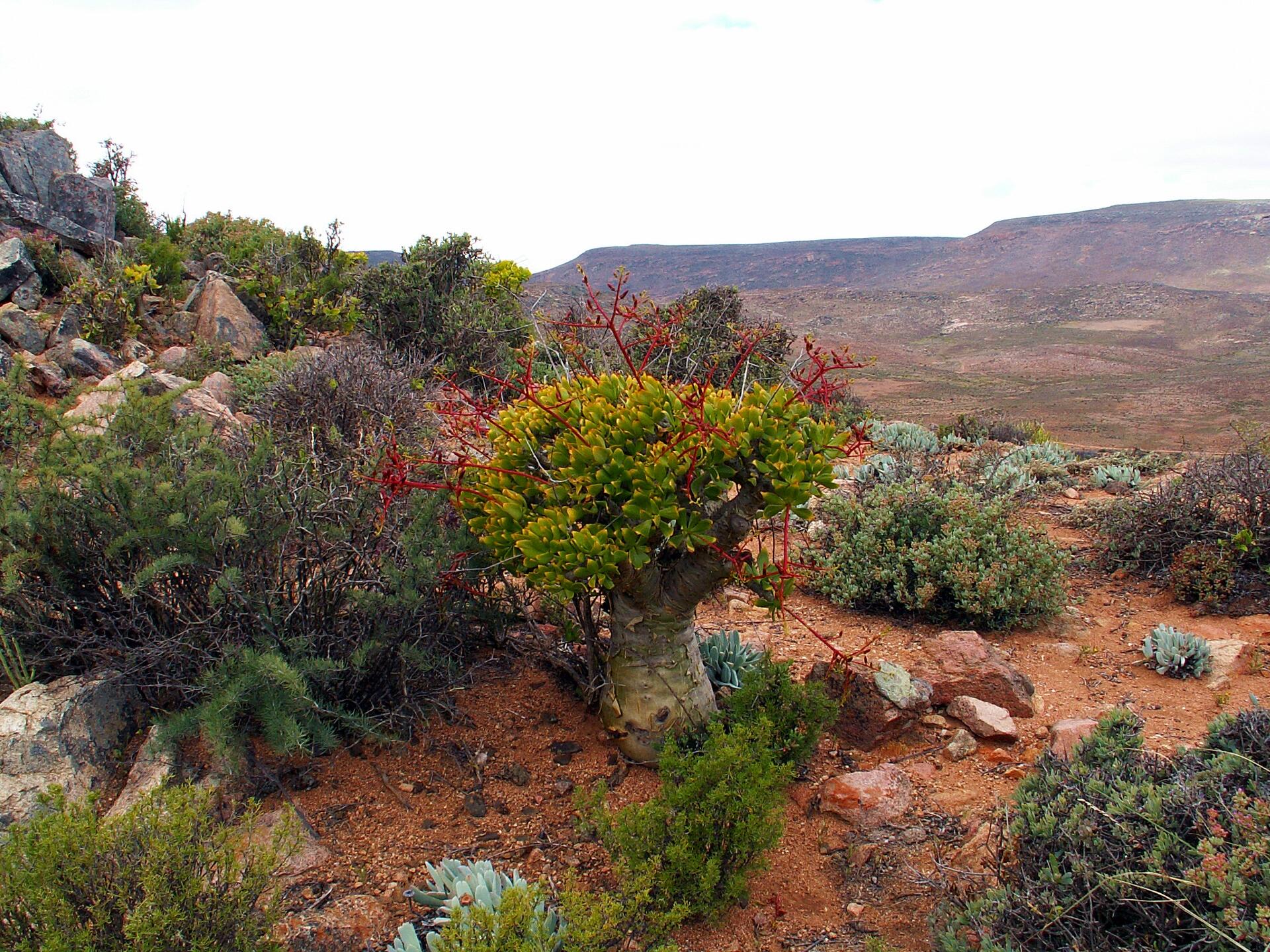
© Winfried Bruenken (Amrum), CC BY-SA 2.5 Resized from original. (This derivative is under the same CC BY-SA license.)
World Heritage Research
Discover scientific research and academic studies that deepen our understanding of Richtersveld Cultural and Botanical Landscape from its history and significance to its conservation, management, and contemporary challenges.
-
A new genus and six new species of Namaini from the Richtersveld (South Africa, Northern Cape) (Coleoptera: Curculionidae: Entiminae)
Scientists have discovered one new genus and six new species of Namaini weevils (Coleoptera: Curculionidae: Entiminae) within the Richtersveld Cultural and Botanical Landscape, a UNESCO World Heritage Site in South Africa's Northern Cape. The newly described taxa include Richtersveldiella sanparkensis, Pentamerica gazella, Namaquania hirta, Nama mirifica, Nama vanwyki, and Nama armmanshoek. These findings contribute to the understanding of biodiversity in this unique arid ecosystem, with detailed biological notes, comparative remarks, and distribution assessments provided. The study also proposes conservation status evaluations for these species, highlighting their ecological significance.
BOROVEC, R., & MEREGALLI, M. (2026). A new genus and six new species of Namaini from the Richtersveld (South Africa, Northern Cape) (Coleoptera: Curculionidae: Entiminae). Zootaxa, 5748(2), 193–214. https://doi.org/10.11646/zootaxa.5748.2.2
View Publication Record | Read Publication -
The long-term decline of a succulent tree, Aloidendron pillansii, in the hyper-arid Richtersveld region of southern Africa
Aloidendron pillansii, a Critically Endangered succulent tree in the Richtersveld Cultural and Botanical Landscape, faces severe population decline due to dual pressures: recent droughts disproportionately kill juveniles, while aging adult cohorts contribute to long-term losses. Between 2012 and 2024, juvenile numbers plummeted by 51%, largely driven by extreme drought (2017–2019) and human disturbance, whereas adult declines accelerated after 1937, reflecting senescence. Range-wide analysis reveals older populations in the north and younger ones in the south, with Cornell's Kop showing intermediate aging. Climate trends since 1979—declining rainfall, longer dry seasons, rising temperatures, and reduced vegetation productivity—threaten recovery. The study combines repeat photography, ecological monitoring, simulation modeling, and climate analysis to demonstrate how climate change and human activity are exacerbating the species' decline.
Hoffman, M. T., Carrick, P. J., Cramer, M. D., Swart, E., van Blerk, J. J., & van der Merwe, H. (2026). The long-term decline of a succulent tree, Aloidendron pillansii, in the hyper-arid Richtersveld region of southern Africa. Journal of Arid Environments, 234, 105571. https://doi.org/10.1016/j.jaridenv.2026.105571
View Publication Record | Read Publication -
Description of Gaiarana asterae gen. et sp. n. from Namaqualand-Richtersveld steppe (Lepidoptera, Lasiocampidae)
Researchers have identified and described a new genus and species of moth, Gaiarana asterae, from the Namaqualand-Richtersveld steppe ecoregion. This discovery adds to the region's rich biodiversity and is notable for its morphological similarities to the genus Trichiurana. The study provides detailed illustrations of adult specimens, their antennae, heads, legs, and genitalia, along with a map of collection sites. The findings contribute to our understanding of lepidopteran diversity in this unique steppe ecosystem, which is part of the UNESCO World Heritage Site, Richtersveld Cultural and Botanical Landscape.
Friend, H. L., Volkova, J. S., Saldaitis, A., Sulak, H., Junnila, A., Yakovlev, R. V., Knyazev, S. A., Müller, G. C., Revay, E. E., Prozorova, T. A., & Prozorov, A. M. (2026). Description of Gaiarana asterae gen. et sp. n. from Namaqualand-Richtersveld steppe (Lepidoptera, Lasiocampidae). Ecologica Montenegrina, 97, 186–201. https://doi.org/10.37828/em.2026.97.17
View Publication Record | Read Publication -
Ecological Foundations of Indigenous Pastoral Innovations for Climate Resilience: Evidence from the Succulent Karoo Rangeland, Richtersveld National Park, South Africa
Indigenous pastoral practices in the Richtersveld Cultural and Botanical Landscape demonstrate remarkable ecological resilience, challenging long-held assumptions about dryland systems. Research shows that the Nama people's annual transhumance between the Succulent Karoo uplands and the Orange River riparian zone sustains year-round forage availability, with shrub biomass peaking at 962.8 g/m² in the Succulent Karoo—nearly twelve times higher than in desert biomes—and riparian grasses reaching 600–700 g/m² during upland dormancy. Rainfall was the strongest predictor of plant biomass (R² = 0.69), while grazing pressure and landform had minimal impact, providing quantitative evidence that traditional management is ecologically adaptive rather than merely 'traditional.' The study, combining vegetation surveys, satellite data, and soil analysis from 2006–2008, offers a robust ecological rationale for policies that have historically undervalued indigenous knowledge.
Konje, M. M. (2026). Ecological Foundations of Indigenous Pastoral Innovations for Climate Resilience: Evidence from the Succulent Karoo Rangeland, Richtersveld National Park, South Africa. AgroEnvironmental Sustainability, 4(2), 187–195. https://doi.org/10.59983/s2026040209
View Publication Record | Read Publication -
Global biogeographic patterns of the genus Indigofera (Fabaceae: Indigofereae)
A comprehensive phylogenetic and biogeographic analysis of the genus Indigofera (Fabaceae) reveals that the tribe Indigofereae originated in the Africa-Madagascar region around 38 million years ago, with mainland Africa serving as the primary diversification center. The study, based on a newly assembled ITS phylogeny, identifies four main clades—Cape, Tethyan, Pantropical, and Paleotropical—with the Cape Clade being narrowly endemic to the Greater Cape Floristic Region (GCFR) of southwestern South Africa, while the others exhibit broader global distributions. Long-distance dispersals from Africa to South America, Australia, and Asia occurred during the late Miocene, facilitated by arid corridors in northeastern Africa and Arabia. The research underscores the critical role of the global Succulent biome in shaping Indigofera's biogeographic patterns, highlighting its influence on dispersal and diversification.
Du Preez, B., Schrire, B. D., Dreyer, L. L., Stirton, C. H., Chimphango, S. B. M., & Muasya, A. M. (2025). Global biogeographic patterns of the genus Indigofera (Fabaceae: Indigofereae). Brazilian Journal of Botany, 48(1). https://doi.org/10.1007/s40415-024-01045-4
View Publication Record | Read Publication -
Assessing the geological relationships between the mafic-ultramafic intrusion in the Haib area and the Vuurdood Subsuite, Richtersveld Subprovince
Research reveals a genetic link between the Kokerboom Intrusion (KI) and the Vuurdood Subsuite, both part of the Richtersveld Cultural and Botanical Landscape. The study demonstrates that pyroxenites from the KI contain magmatic sulphides with geochemical affinities to shallow plutonic and volcanic rocks associated with the Haib porphyry copper deposit, providing a mid-crustal perspective on its metallogenesis. Using lithological characteristics, mineral assemblages, major and trace element geochemistry, and U-Pb geochronology, the team established this connection, offering new insights into the geological relationships of Palaeoproterozoic porphyry copper deposits in Namibia.
Jogee, B. A., Bybee, G. M., Robb, L. J., Reid, D. L., Minnaar, H., Caricchi, L., & Bolhar, R. (2024). Assessing the geological relationships between the mafic-ultramafic intrusion in the Haib area and the Vuurdood Subsuite, Richtersveld Subprovince. South African Journal of Geology, 127(1), 55–70. https://doi.org/10.25131/sajg.127.0011
View Publication Record | Read Publication -
A checklist of indigenous flora in the Richtersveld National Park confirms high plant diversity in the arid north-western tip of South Africa
A comprehensive checklist of indigenous flora for the Richtersveld National Park, South Africa, reveals a high diversity of 1077 vascular plant taxa, including 815 dicotyledons and 246 monocotyledons. The study, based on over 3000 new herbarium vouchers and extensive specimen analysis, identified 99 indigenous families and 392 genera, with Asteraceae and Aizoaceae being the most prominent. Notably, seven species were deemed extinct—four due to diamond mining and three after recent droughts (2014–2022). The research also documented 170 taxa of conservation concern, including 29 endangered and 21 critically endangered species on the South African Red List, alongside 38 endemic and 101 near-endemic taxa. This baseline data supports targeted conservation efforts by linking species to their habitat preferences and distribution, aiding in monitoring and protection strategies for this biogeographically unique arid landscape.
van Wyk, P., Bezuidenhout, H., & Jürgens, N. (2024). A checklist of indigenous flora in the Richtersveld National Park confirms high plant diversity in the arid north-western tip of South Africa. Koedoe, 66(1). https://doi.org/10.4102/koedoe.v66i1.1822
View Publication Record | Read Publication