World Heritage Identification Number: 1221
World Heritage since: 2007
Category: Cultural Heritage
WHE Type: Infrastructure & Industry
Transboundary Heritage: No
Endangered Heritage: No
Country: 🇨🇦 Canada
Continent: Americas
UNESCO World Region: Europe and North America
Map
Navigating History: The Rideau Canal - A Unesco World Heritage Site
The Rideau Canal, a veritable testament to engineering prowess and historical significance, stretches across 202 kilometers, connecting the Ottawa River at Ottawa with the Cataraqui River and Lake Ontario at Kingston, Ontario, Canada. This architectural marvel, inscribed as a UNESCO World Heritage Site in 2007, stands as a remarkable remnant of the early 19th-century canal-building era.
More to come…UNESCO Description of the World Heritage Site
The Rideau Canal, a monumental early 19th-century construction covering 202 km of the Rideau and Cataraqui rivers from Ottawa south to Kingston Harbour on Lake Ontario, was built primarily for strategic military purposes at a time when Great Britain and the United States vied for control of the region. The site, one of the first canals to be designed specifically for steam-powered vessels, also features an ensemble of fortifications. It is the best-preserved example of a slackwater canal in North America, demonstrating the use of this European technology on a large scale. It is the only canal dating from the great North American canal-building era of the early 19th century to remain operational along its original line with most of its structures intact.
UNESCO Justification of the World Heritage Site
Criterion (i): The Rideau Canal remains the best preserved example of a slackwater canal in North America demonstrating the use of European slackwater technology in North America on a large scale. It is the only canal dating from the great North American canal-building era of the early 19th century that remains operational along its original line with most of its original structures intact.
Criterion (iv): The Rideau Canal is an extensive, well preserved and significant example of a canal which was used for a military purpose linked to a significant stage in human history - that of the fight to control the north of the American continent. The nominated property includes all the main elements of the original canal together with relevant later changes in the shape of watercourses, dams, bridges, fortifications, lock stations and related archaeological resources. The original plan of the canal, as well as the form of the channels, has remained intact. The Rideau Canal has fulfilled its original dynamic function as an operating waterway without interruption since its construction. Most of its lock gates and sluice valves are still operated by hand-powered winches. All the elements of the nominated area (canal, associated buildings and forts) are protected as national historic sites under the Historic Sites and Monuments Act 1952-3. A buffer zone has been established. Repairs and conservation of the locks, dams, canal walls and banks are carried out directly under the control of Parks Canada. Each year one third of the canal's assets are thoroughly inspected by engineers. A complete inventory thus exists of the state of conservation of all parts of the property. A Management Plan exists for the canal (completed in 1996 and updated in 2005), and plans are nearing completion for Fort Henry and the Kingston fortifications. The Canal Plan is underpinned by the Historic Canals Regulations which provide an enforcement mechanism for any activities that might impact on the cultural values of the monument.
Encyclopedia Record: Rideau Canal
The Rideau Canal is a 202-kilometre long canal that links the Ottawa River at Ottawa with the Cataraqui River and Lake Ontario at Kingston, Ontario, Canada. Its 46 locks raise boats from the Ottawa River 83 metres upstream along the Rideau River to the Rideau Lakes, and from there drop 50 metres downstream along the Cataraqui River to Kingston.Additional Site Details
Area: 21,454.81 hectares
Number of Components: 6
(iv) — Outstanding example of a type of building or landscape
Coordinates: 44.9943861111 , -75.765125
Image
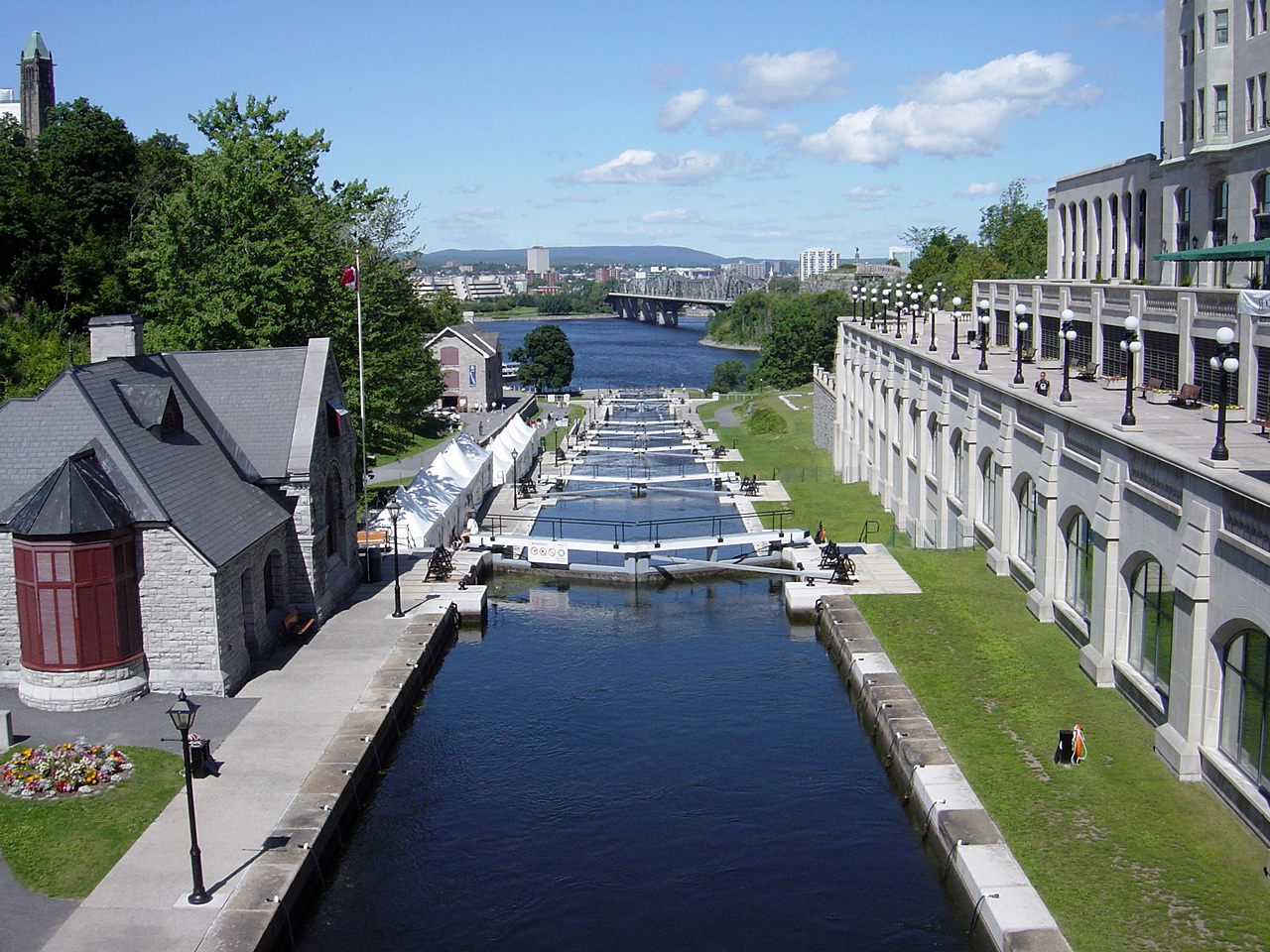
© Bobak Ha'Eri, CC BY-SA 2.5 Resized from original. (This derivative is under the same CC BY-SA license.)
World Heritage Research
Discover scientific research and academic studies that deepen our understanding of Rideau Canal from its history and significance to its conservation, management, and contemporary challenges.
-
A diatom-based assessment of multiple stressors over the past ∼220 years on shallow Cranberry Lake in the Rideau Canal (Ontario, Canada)
A significant shift in diatom communities around 1980 marks the most pronounced ecological change in Cranberry Lake's history, linked to accelerated warming and prolonged ice-free periods. This study reconstructs the lake's environmental history using a sediment core, revealing transitions from marshland to lake formation (ca. 1800 CE) and subsequent ecosystem alterations due to canal construction (ca. 1830 CE). Diatom shifts since 2012, coinciding with nuisance algal blooms, suggest warming-driven limnological changes, despite stable nutrient levels. The research combines diatom analysis with historical records and modern monitoring data to uncover the impacts of multiple stressors—flooding, settlement, invasive species, and climate change—on this UNESCO-listed system.
Gallinger, M., Rühland, K. M., Graves, E. L., Paterson, A. M., & Smol, J. P. (2026). A diatom-based assessment of multiple stressors over the past ∼220 years on shallow Cranberry Lake in the Rideau Canal (Ontario, Canada). Botany, 104, 1–14. https://doi.org/10.1139/cjb-2025-0102
View Publication Record | Read Publication -
Characterization of Boat Wakes in a Multi-Use Recreational Waterway
Wakesurf boats generate significantly higher maximum wave heights (Hmax) compared to other recreational boat types, with their median Hmax doubling that of others. Runabouts and cruisers contribute half of the total wake energy density in the Rideau Canal Waterway. The study also reveals that boating activity is substantially underestimated by lockage records alone, being seven times greater than indicated. This research introduces a typology of recreational boats to characterize their wake impacts, providing critical data for predictive models of shoreline and habitat effects. It underscores the need for targeted management strategies, particularly for wakesurfing in narrow channels where wave attenuation is limited.
Robinson, S. A. (2026). Characterization of Boat Wakes in a Multi-Use Recreational Waterway [figshare]. https://doi.org/10.6084/M9.FIGSHARE.32579610
View Publication Record | Read Publication -
Sensor Integration to Create a Digital Twin Framework of a Snowblower Robot
A modular sensor-integrated digital twin framework has been developed to monitor and assess the performance of an autonomous snowblower robot operating under harsh winter conditions on the Rideau Canal Skateway. The system captures real-time measurements of the robot's electrical and mechanical behavior using rotational speed encoders, voltage sensors, current sensors, and reflective infrared sensors, synchronized with motor controller telemetry. Signal filtering enhances data accuracy, providing a validated, time-synchronized record for future digital-twin simulation, predictive maintenance, and virtual testing in winter conditions.
Ghandali, S. Sensor Integration to Create a Digital Twin Framework of a Snowblower Robot. https://doi.org/10.22215/etd/2026-17209
View Publication Record | Read Publication -
An Open-Source Pipeline for Runtime-Optimized Heritage Photogrammetry in Game Engines
A groundbreaking open-source pipeline, Mesh2Tile, significantly advances the processing of photogrammetric meshes for interactive 3D visualization in game engines. It achieves up to a 62% reduction in file size for larger models while maintaining performance comparable to commercial solutions like Cesium Ion, enabling real-time streaming at 120 FPS in Unreal Engine 5. Unlike existing tools, Mesh2Tile employs adaptive octree tiling based on triangle density and per-tile texture baking, eliminating redundancy and offering precise control over level-of-detail (LOD) generation. Validated through a case study of the Bytown Museum Commissariat Buildingthis pipeline addresses cost barriers and data sovereignty concerns, empowering institutions to manage sensitive heritage data efficiently while ensuring high-performance visualization.
Merchant, A., Weigert, A., Dennis, C., & Fai, S. (2026). An Open-Source Pipeline for Runtime-Optimized Heritage Photogrammetry in Game Engines. The International Archives of the Photogrammetry, Remote Sensing and Spatial Information Sciences, XLIX-B2-2026, 485–492. https://doi.org/10.5194/isprs-archives-xlix-b2-2026-485-2026
View Publication Record | Read Publication -
Leisure as Catalyst for Well-Being and Sense of Belonging Among Iranian Immigrant Women Aged 30–55 in Ottawa, Canada
Leisure activities, including group walks along the Rideau Canal, Classical Persian dance workshops, and visits to the National Gallery of Canada, significantly contributed to the well-being and sense of belonging among Iranian immigrant women aged 30–55 in Ottawa. These activities provided emotional relief, opportunities for social connection, and a comfortable setting due to shared language and migration experiences. While participants rated the activities positively for enjoyment, accessibility, and social contact, sustained participation was influenced by factors such as time pressure, caregiving demands, weather, transportation, cost, and access to clear information. The study highlights the importance of leisure in promoting well-being beyond formal health and settlement services.
Hadidi, M., O’Connor, E., Abu-Zahra, N., Ambrosio, L., & Regan Wills, E. (2026). Leisure as Catalyst for Well-Being and Sense of Belonging Among Iranian Immigrant Women Aged 30–55 in Ottawa, Canada. International Journal of Environmental Research and Public Health, 23(8), 999. https://doi.org/10.3390/ijerph23080999
View Publication Record | Read Publication -
Border Heritage Cultures and the Continuing Politics of Legacy
Borders shape distinct heritage cultures that persist despite geopolitical contestations, as demonstrated by the Rideau Canal and other global sites. The study defines border heritage cultures—where borders and heritage intersect—and illustrates their endurance through case studies, including the Basque region (Spain/France) and Karelia (Russia/Finland). It highlights how these cultures create a sense of belonging amid political tensions, challenging traditional heritage narratives. The research synthesizes geopolitical dynamics in border heritage theorization, offering new insights into how borders matter in cultural preservation.
Konrad, V. (2026). Border Heritage Cultures and the Continuing Politics of Legacy. Border Heritage, 298–318. https://doi.org/10.4324/9781003621836-9
View Publication Record | Read Publication -
Cladocera responses to ~200-year history of environmental stressors on Rideau Canal (Ontario, Canada) lakes
Recent climate warming has significantly altered cladoceran assemblages in Rideau Canal lakes, Ontario, with increased dominance of Bosmina spp. and declines in littoral taxa, despite relatively stable changes during the canal's 200-year history. This study reconstructs past ~200 years of cladoceran dynamics using sediment cores to assess responses to environmental stressors such as climate change, zebra mussel invasions, and cyanobacterial blooms. Unlike diatom assemblages, which showed major shifts, cladoceran turnover was consistently lower but reflected recent limnological changes, including reduced total phosphorus concentrations and altered food resources. The findings highlight the sensitivity of this key intermediate trophic level to contemporary environmental pressures.
Graves, E. L., Balasubramaniam, K., Rühland, K. M., Paterson, A. M., & Smol, J. P. (2026). Cladocera responses to ~200-year history of environmental stressors on Rideau Canal (Ontario, Canada) lakes. Journal of Limnology, 85. https://doi.org/10.4081/jlimnol.2026.2258
View Publication Record | Read Publication