
World Heritage Identification Number: 1007
World Heritage since: 2004
Category: Natural Heritage
WHE Type: Protected Areas & National Parks
Transboundary Heritage: No
Endangered Heritage: No
Country: 🇿🇦 South Africa
Continent: Africa
UNESCO World Region: Africa
Map
Cape Floral Region Protected Areas: A Global Biodiversity Hotspot
The Cape Floral Region Protected Areas (CFRPA) is a remarkable testament to the richness and diversity of life on Earth. Inscribed on the World Heritage List in 2004, this South African site is recognized as one of the world's richest centers of terrestrial biodiversity. Spanning across various protected areas including national parks, nature reserves, wilderness areas, state forests, and mountain catchment areas, the CFRPA encompasses a vast expanse of unique ecosystems that harbor a wealth of endemic species.
More to come…UNESCO Description of the World Heritage Site
Inscribed on the World Heritage List in 2004, the property is located at the south-western extremity of South Africa. It is one of the world’s great centres of terrestrial biodiversity. The extended property includes national parks, nature reserves, wilderness areas, State forests and mountain catchment areas. These elements add a significant number of endemic species associated with the Fynbos vegetation, a fine-leaved sclerophyllic shrubland adapted to both a Mediterranean climate and periodic fires, which is unique to the Cape Floral Region.
UNESCO Justification of the World Heritage Site
Criterion (ix): The property is considered of Outstanding Universal Value for representing ongoing ecological and biological processes associated with the evolution of the unique Fynbos biome. These processes are represented generally within the Cape Floral Region and captured in the component areas that make up the 13 protected area clusters. Of particular scientific interest are the adaptations of the plants to fire and other natural disturbances; seed dispersal by ants and termites; the very high level of plant pollination by insects, mainly beetles and flies, birds and mammals; and high levels of adaptive radiation and speciation. The pollination biology and nutrient cycling are other distinctive ecological processes found in the site. The Cape Floral Region forms a centre of active speciation where interesting patterns of endemism and adaptive radiation are found in the flora.
Criterion (x): The Cape Floral Region is one of the richest areas for plants when compared to any similar sized area in the world. It represents less than 0.5% of the area of Africa but is home to nearly 20% of the continent’s flora. The outstanding diversity, density and endemism of the flora are among the highest worldwide. Some 69% of the estimated 9,000 plant species in the region are endemic, with 1,736 plant species identified as threatened and with 3,087 species of conservation concern. The Cape Floral Region has been identified as one of the world’s 35 biodiversity hotspots.
Encyclopedia Record: Cape Floristic Region
The Cape Floral Region is a floristic region located near the southern tip of South Africa. It is the only floristic region of the Cape Floristic Kingdom, and includes only one floristic province, known as the Cape Floristic Province.Additional Site Details
Area: 1,094,742 hectares
Number of Components: 1
(x) — Contains most important habitats for biodiversity
Coordinates: -34.3558051153 , 18.4750321846
IUCN World Heritage Outlook
The 2025 Conservation Outlook on Cape Floral Region Protected Areas reports the following assessment:
Source: International Union for Conservation of Nature (IUCN) · View assessment
Image
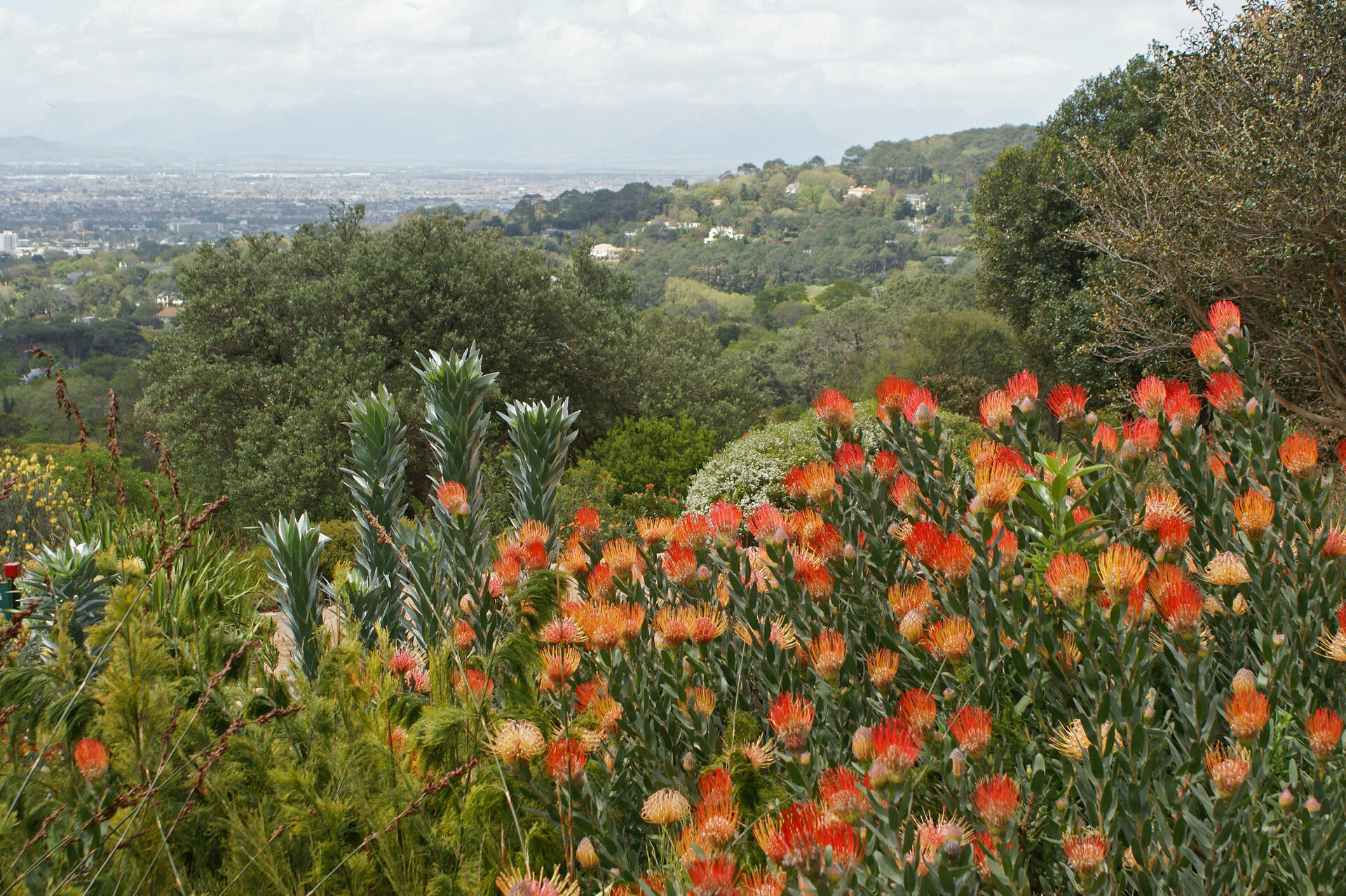
© Rialfver at nl.wikipedia, CC BY-SA 3.0 Resized from original. (This derivative is under the same CC BY-SA license.)
World Heritage Research
Discover scientific research and academic studies that deepen our understanding of Cape Floral Region Protected Areas from its history and significance to its conservation, management, and contemporary challenges.
-
The faunistic diversity of spiders (Arachnida: Araneae) of the South African Cape Floristic Kingdom
A comprehensive survey of spider diversity in the Cape Floral Region Protected Areas, part of South Africa's Cape Floristic Kingdom (CFK), reveals 960 species across 62 families, representing 42.4% of South Africa's known spider fauna. The study, based on data from the South African National Survey of Arachnida (SANSA) up to 2023, identifies 269 endemic species (28%) and highlights conservation concerns for 49 species (5.1%). While most species (71%) are widely distributed with no known threats, significant data gaps remain, particularly among the 229 Data Deficient species. The Salticidae family dominates with 128 species, including 30 endemics, followed by Gnaphosidae, Thomisidae, and Lycosidae. This research underscores the CFK's rich but understudied arachnid biodiversity, emphasizing the need for further exploration to uncover and describe its hidden diversity.
Dippenaar-Schoeman, A. S., Haddad, C. R., Foord, S. H., & Lotz, L. N. (2024). The faunistic diversity of spiders (Arachnida: Araneae) of the South African Cape Floristic Kingdom. Transactions of the Royal Society of South Africa, 79(1), 1–22. https://doi.org/10.1080/0035919x.2024.2324912
View Publication Record | Read Publication -
Determination of Hydrological Niche of Restionaceae Species in Silvermine, South Africa
A groundbreaking study reveals the critical role of hydrological factors in shaping the distribution and survival of Restionaceae species within the Cape Floral Region (CFR), a globally significant biodiversity hotspot. This research, conducted at Silvermine, South Africa, demonstrates that microclimate-level hydrological variables are pivotal in determining the niche of these threatened plants, which face existential threats from urbanization, agriculture, and groundwater extraction. By generating unique hydrological datasets, the study not only models species niches with unprecedented accuracy but also provides a robust framework for assessing conservation strategies and predicting long-term impacts of climate change on plant diversity. This work builds upon the CFR's established role as a test case for biodiversity modeling, offering critical insights that could reshape conservation efforts in semi-arid environments worldwide.
Guo, D., Arnolds, J. L., Midgley, G. F., Araya, Y. N., Silvertown, J., & Musil, C. F. (2021). Determination of Hydrological Niche of Restionaceae Species in Silvermine, South Africa. Current Advances in Geography, Environment and Earth Science Vol. 1, 1–12. https://doi.org/10.9734/bpi/cagees/v1/4247f
View Publication Record | Read Publication -
Biomes are nobody’s kingdom: on environmental and historical plant geography
This study argues that biomes and floral kingdoms serve distinct, non-overlapping roles in global plant geography. While floral kingdoms (phytochoria) reflect evolutionary history and are defined by endemic taxa, biomes are primarily shaped by environmental factors like climate and soil, with no significant evolutionary component. The research contrasts these concepts, emphasizing that biomes should not be defined by lineage presence or evolution. It highlights the Cape Floral Kingdom's expansion to include diverse biomes, challenging the notion of contiguous floral kingdoms. The study also notes mismatches between biodiversity priorities (phytochoria) and ecosystem service values (biomes), advocating for separate mapping approaches in conservation efforts.
Procheş, Ş. (2020). Biomes are nobody’s kingdom: on environmental and historical plant geography. New Phytologist, 228(5), 1460–1462. Portico. https://doi.org/10.1111/nph.16300
View Publication Record | Read Publication -
Disentangling native and alien plant diversity in coastal sand dune ecosystems worldwide
A global analysis of coastal sand dune ecosystems reveals distinct patterns and drivers for native and alien plant diversity. Native species richness increases along the sea-to-inland gradient, particularly in the Cape and Paleotropical floristic kingdoms, while alien species richness remains relatively consistent across regions but is strongly influenced by anthropogenic factors such as gross domestic product (GDP). The study, which analyzed 14,841 vegetation plots worldwide using generalized linear models (GLMs) and mixed models (GLMMs), found weak support for the invasion paradox, suggesting that spatial scale plays a minor role in native-alien richness patterns. These findings highlight the need to consider native and alien species separately when studying biodiversity, offering insights for targeted conservation and management strategies.
Tordoni, E., Bacaro, G., Weigelt, P., Cameletti, M., Janssen, J. A. M., Acosta, A. T. R., Bagella, S., Filigheddu, R., Bergmeier, E., Buckley, H. L., Ciccarelli, D., Forey, E., Hennekens, S. M., Lubke, R. A., Mahdavi, P., Peet, R. K., Peinado, M., Sciandrello, S., & Kreft, H. (2020). Disentangling native and alien plant diversity in coastal sand dune ecosystems worldwide. Journal of Vegetation Science, 32(1). Portico. https://doi.org/10.1111/jvs.12961
View Publication Record | Read Publication -
Underestimated regional species diversity in the Cape Floristic Region revealed by phylogenetic analysis of the Erica abietina/E. viscaria clade (Ericaceae)
Phylogenetic analysis of the Erica abietina/E. viscaria clade (Ericaceae) reveals that the seven currently recognized subspecies of E. abietina represent at least three distinct, endemic lineages with non-overlapping distributions in the Cape Floristic Region (CFR). This challenges current taxonomic classifications and underscores the underestimated regional species diversity within this globally significant floral kingdom. The study, using nuclear ribosomal and plastid DNA sequences, resurrects the name E. grandiflora for two subspecies and introduces a new species, E. situshiemalis, further highlighting the complex endemism of Cape Erica. These findings add to the known endemic species in Table Mountain National Park.
Pirie, M. D., Oliver, E. G. H., Gehrke, B., Heringer, L., Mugrabi de Kuppler, A., Le Maitre, N. C., & Bellstedt, D. U. (2017). Underestimated regional species diversity in the Cape Floristic Region revealed by phylogenetic analysis of the Erica abietina/E. viscaria clade (Ericaceae). Botanical Journal of the Linnean Society, 184(2), 185–203. https://doi.org/10.1093/botlinnean/box021
View Publication Record | Read Publication -
Vegetation responses to season of fire in an aseasonal, fire-prone fynbos shrubland
In the aseasonal, fire-prone fynbos shrubland of South Africa's Cape Floral Region, fire season does not significantly impact proteoid recruitment, unlike in Mediterranean-climate shrublands. The study found that factors such as species type, pre-fire parent density, and post-fire vegetation age were more influential than fire timing or rainfall. While germination occurred primarily during cooler months, summer plantings took longer, indicating limited drought-avoiding dormancy. This flexibility in proteoid recruitment suggests that fire management can be adapted without seasonal restrictions, unlike in winter-rainfall shrublands.
Kraaij, T., Cowling, R. M., van Wilgen, B. W., Rikhotso, D. R., & Difford, M. (2017). Vegetation responses to season of fire in an aseasonal, fire-prone fynbos shrubland. PeerJ, 5, e3591. Portico. https://doi.org/10.7717/peerj.3591
View Publication Record | Read Publication -
Accelerating Computer-Based Recognition of Fynbos Leaves Using a Graphics Processing Unit
A significant advancement in plant species identification for the Cape Floristic Kingdom (CFK) has been achieved through GPU-accelerated technology. The Fynbos Leaf Optical Recognition Application (FLORA) now offers faster processing speeds without compromising accuracy, with the GPU-accelerated version saving up to 51.85 milliseconds on average for high-resolution images. This development addresses the challenges faced by volunteers and casual workers in managing this biodiverse region, which is threatened by wildfires and invasive species. The study compared three versions of FLORA—MATLAB prototype, C++ non-accelerated, and C++ GPU-accelerated—and demonstrated a notable speed-up of 8.7 times for the C++ version over the MATLAB prototype. This innovation paves the way for more efficient large-scale plant identification tasks, such as rebuilding feature descriptors in leaf databases.
Winberg, S. L., Ramone, M., & Naidoo, K. (2017). Accelerating Computer-Based Recognition of Fynbos Leaves Using a Graphics Processing Unit. South African Computer Journal, 29(3). https://doi.org/10.18489/sacj.v29i3.432
View Publication Record | Read Publication
