World Heritage Identification Number: 496
World Heritage since: 1988
Category: Cultural Heritage
WHE Type: Religious Sites & Sacred Architecture
Transboundary Heritage: No
Endangered Heritage: No
Country: 🇬🇧 United Kingdom of Great Britain and Northern Ireland
Continent: Europe
UNESCO World Region: Europe and North America
Map
The Historic Ensemble of Canterbury Cathedral, St Augustine's Abbey, and St Martin's Church
The Historic Ensemble of Canterbury Cathedral, St Augustine's Abbey, and St Martin's Church, located in the city of Canterbury, Kent, England, is a significant cultural and religious site of immense historical importance. Inscribed as a UNESCO World Heritage Site in 1988, this remarkable ensemble reflects the long history of Christianity in England, beginning with the arrival of St Augustine in Canterbury in 597.
UNESCO's recognition reflects more than the age of these buildings. The three sites together preserve an extraordinary record of how Christianity took root in England and shaped its history, culture, and architecture. From the early mission of St Augustine to the medieval power of Canterbury Cathedral and the city's importance as a centre of pilgrimage, the ensemble represents a continuous Christian tradition spanning more than a thousand years.
Canterbury Cathedral, formally known as the Cathedral and Metropolitical Church of Christ, Canterbury, is the seat of the Archbishop of Canterbury, the senior bishop of the Church of England and a leading figure in the worldwide Anglican Communion. Although the Christian community at Canterbury dates back to the 6th century, the present cathedral was largely built and developed from the 11th century onward. It showcases a remarkable combination of Romanesque and Gothic architecture, including Early English and Perpendicular Gothic features.
Among its most notable features are the crypt, the Quire, and the magnificent Bell Harry Tower. Inside the cathedral, this rich heritage is vividly preserved through its world-renowned collection of medieval stained glass. Spanning more than 1,200 square metres, the cathedral's stained glass includes remarkable 12th- and 13th-century panels, including the famous Miracle Windows depicting stories of miracles attributed to Thomas Becket. These extraordinary windows continue to cast coloured light across the ancient stone, offering a vivid connection with the medieval pilgrims who once came to Canterbury.
St Augustine's Abbey, founded around 598 following St Augustine's arrival in Kent, played an important role in the Christianisation of the Anglo-Saxon kingdoms. Augustine became the first Archbishop of Canterbury, while the abbey developed into an important monastery and burial place for the early archbishops of Canterbury and the kings of Kent. Although largely in ruins today, the remains of the abbey provide an important reminder of Augustine's missionary work and the development of Christianity and monasticism in England.
St Martin's Church completes the trio of sites within the UNESCO ensemble. Widely regarded as the oldest church in England, it has been used continuously as a place of Christian worship since at least the 6th century. The church incorporates surviving Roman fabric and has been altered and extended over the centuries. Its early origins make it an exceptional link between Roman Britain and the Christianisation of the Anglo-Saxon kingdoms.
The ensemble is also associated with one of the most famous events in English history: the murder of Archbishop Thomas Becket in Canterbury Cathedral in 1170. Becket, who was Archbishop of Canterbury at the time, was killed by four knights who believed that they were acting on the wishes of King Henry II. Becket was initially buried in the cathedral's eastern crypt, and in 1220 his remains were moved to a magnificent shrine in Trinity Chapel. The shrine was destroyed in 1538 during the Reformation under Henry VIII, and the fate of Becket's remains remains uncertain. Today, the site of his martyrdom and the location of his former shrine continue to attract visitors and pilgrims.
Together, Canterbury Cathedral, St Augustine's Abbey, and St Martin's Church form a remarkable ensemble that illustrates more than a thousand years of Christian history in England. Their shared history, religious significance, and architectural heritage provide a unique insight into the development of Christianity, pilgrimage, monastic life, and English architecture. For anyone interested in English history, Christianity, medieval heritage, or historic architecture, Canterbury remains a truly remarkable destination.
UNESCO Description of the World Heritage Site
Canterbury, in Kent, has been the seat of the spiritual head of the Church of England for nearly five centuries. Canterbury's other important monuments are the modest Church of St Martin, the oldest church in England; the ruins of the Abbey of St Augustine, a reminder of the saint's evangelizing role in the Heptarchy from 597; and Christ Church Cathedral, a breathtaking mixture of Romanesque and Perpendicular Gothic, where Archbishop Thomas Becket was murdered in 1170.
UNESCO Justification of the World Heritage Site
Criterion (i): Christ Church Cathedral, especially the east sections, is a unique artistic creation. The beauty of its architecture is enhanced by a set of exceptional early stained glass windows which constitute the richest collection in the United Kingdom.
Criterion (ii): The influence of the Benedictine abbey of St Augustine was decisive throughout the Middle Ages in England. The influence of this monastic centre, and its scriptorium, extended far beyond the boundaries of Kent and Northumbria.
Criterion (vi): St Martin’s Church, St Augustine’s Abbey and the Cathedral are directly and tangibly associated with the history of the introduction of Christianity to the Anglo-Saxon kingdoms.
Encyclopedia Record: Canterbury Cathedral
Canterbury Cathedral is the cathedral of the archbishop of Canterbury, the spiritual leader of the Church of England and symbolic leader of the worldwide Anglican Communion. Located in Canterbury, Kent, it is on the site of one of the oldest Christian structures in England and forms part of a World Heritage Site. Its formal title is the Cathedral and Metropolitical Church of Christ, Canterbury.Additional Site Details
Area: 18.17 hectares
Number of Components: 3
(ii) — Significant interchange of human values
(vi) — Directly associated with events or living traditions
Coordinates: 51.28 , 1.083333333
Image
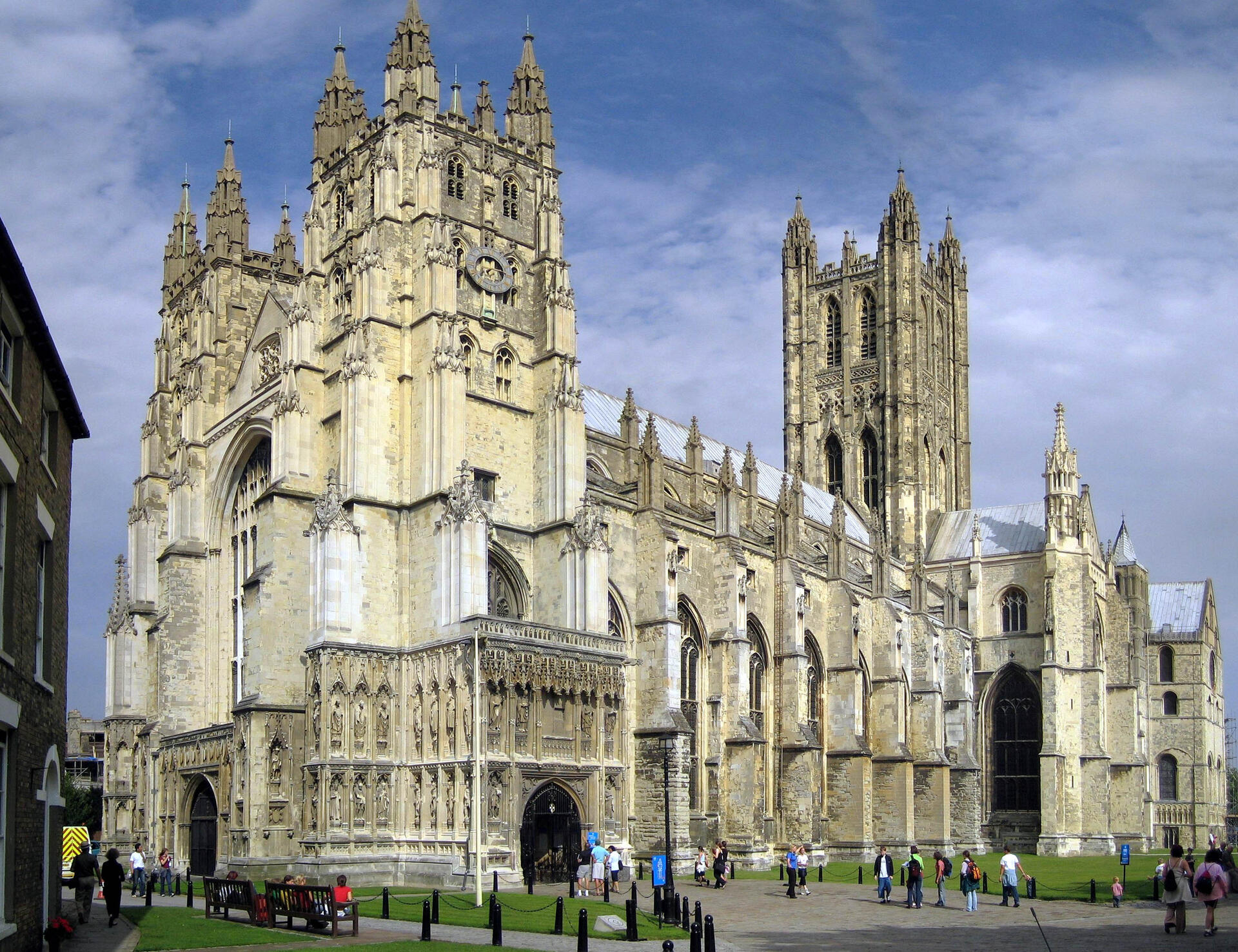
© Hans Musil, CC BY-SA 4.0 Resized from original. (This derivative is under the same CC BY-SA license.)
World Heritage Research
Discover scientific research and academic studies that deepen our understanding of Canterbury Cathedral, St Augustine's Abbey, and St Martin's Church from its history and significance to its conservation, management, and contemporary challenges.
-
The east Redemption Window in Canterbury Cathedral: a pastoral reflection
A pastoral reflection on the medieval stained-glass east window of Canterbury Cathedral reveals its profound symbolism, offering insights into its religious and historical significance. The study examines the intricate details of the window, particularly focusing on the Redemption Window, to uncover its deeper meanings and cultural impact. Through a combination of art historical analysis and theological interpretation, the research highlights how this iconic feature of Canterbury Cathedral serves as both an artistic masterpiece and a spiritual beacon. This approach provides a fresh perspective on the intersection of faith, symbolism, and medieval craftsmanship.
Spence, A. (2025). The east Redemption Window in Canterbury Cathedral: a pastoral reflection. Theology, 128(2), 117–121. https://doi.org/10.1177/0040571x251322333
View Publication Record | Read Publication -
Anglo-Norman Studies XLVII
Anglo-Norman Studies XLVII offers a comprehensive exploration of the Anglo-Norman period, revealing its intellectual and political dynamism through diverse scholarly analyses. The volume highlights key insights into the production and significance of charters, diplomatic practices, and the roles of influential figures such as Peter the Deacon, Bishop Odo of Bayeux, and Eudo Dapifer. It also examines the portrayal of historical figures in Old Norse sagas and the evolution of institutions like St John's Abbey in Colchester. By integrating literary, historical, and archaeological perspectives, this collection provides a nuanced understanding of Anglo-Norman culture, governance, and religious practices during a pivotal era.
Allen, R., Armstrong, D., Burton, J., Goeres, E., Golding, B., Jamieson, C. A., Karn, N., King, V., Langlands, A., Loud, G. A., Roach, L., & Hagger, M. (Eds.). (2025). Anglo-Norman Studies XLVII. https://doi.org/10.1515/9781805438410
View Publication Record | Read Publication -
Canterbury Cathedral: The Liturgy of the Cathedral and its Music, c. 1075–1642
Canterbury Cathedral, founded by Lanfranc in 1070 and consecrated by 1077, served as the central spiritual hub for a Benedictine monastic community. For nearly 470 years before Lanfranc, the cathedral's primary purpose was liturgical observance, a continuous cycle of worship, prayer, contemplation, and penance aimed at intercession for humanity and spiritual reward. This practice persisted for another 900 years post-Lanfranc, underscoring its enduring significance in medieval Christian ritual. The study examines the liturgy's role not merely as an act of devotion but as a means to benefit society and secure salvation, reflecting the deep theological and social dimensions of monastic life during this period.
Bowers, R. (2024). Canterbury Cathedral: The Liturgy of the Cathedral and its Music, c. 1075–1642. English Church Polyphony, IV–408. https://doi.org/10.4324/9781003556244-6
View Publication Record | Read Publication -
The Choirs of Glasgow and Canterbury Cathedrals
A comparative analysis of the choirs in Glasgow Cathedral and Canterbury Cathedral reveals distinct architectural approaches to spatial design, highlighting the inventive use of differentiated spatial units. The study focuses on the lower choir of Glasgow Cathedral, contrasting it with the well-documented choir of Canterbury Cathedral. This comparison elucidates the architects' abilities in spatial articulation and inventiveness, offering insights into their design philosophies.
Druffner, F. (2024). The Choirs of Glasgow and Canterbury Cathedrals. Medieval Art and Architecture in the Diocese of Glasgow, 50–54. https://doi.org/10.4324/9781003580171-7
View Publication Record | Read Publication -
Liturgical Calendars, Saints and Services in Medieval England
A previously unknown psalter owned by Bishop Ralph Baldock (c. 1300) and the continued reading of Old English homilies at Canterbury Cathedral in the 1180s were uncovered, alongside new insights into liturgical practices involving key medieval figures like Thomas Becket and St. Hugh of Lincoln. The study also reveals why psalters are often paired with calendars and solves a hagiographical puzzle surrounding saints venerated on January 19th. Combining four unpublished papers with an introductory overview, the research employs historiographical and bibliographical analysis to reconstruct medieval liturgical traditions, including 'Sarum' services in late parish churches and the devotional practice of St Gregory’s Trental.
Pfaff, R. W. (2024). Liturgical Calendars, Saints and Services in Medieval England. https://doi.org/10.4324/9781003555636
View Publication Record | Read Publication -
Medieval Manuscripts in Post-Medieval England
A comprehensive examination of medieval manuscripts in post-medieval England reveals the diverse and interconnected networks of collectors, libraries, and institutions that preserved these cultural artifacts. The study highlights significant figures such as Robert Green of Welby, Thomas Dackomb, John Twyne of Canterbury, and the Carye brothers, who played pivotal roles in collecting and preserving monastic manuscripts during a transformative period. It also sheds light on notable collections like those of Sir Walter Cope and Henry Savile, providing insights into their origins and significance. The research reconstructs fragmented manuscripts, including one from St Augustine's Abbey, Canterbury, offering a rare glimpse into the intellectual and cultural landscape of medieval England. By analyzing booklists, sammelbands, and library stamps, the study contributes to our understanding of manuscript circulation and preservation in the transition from the medieval to the post-medieval era.
Watson, A. G. (2023). Medieval Manuscripts in Post-Medieval England (, Ed.). Routledge. https://doi.org/10.4324/9781003418610
View Publication Record | Read Publication -
The Architectural History of Canterbury Cathedral
A groundbreaking analysis of Canterbury Cathedral's architectural evolution reveals new insights into its Norman and Perpendicular phases, challenging established narratives. The study introduces provocative theories about William of Sens' original Gothic choir designs and Trinity Chapel, alongside a reattribution and redating of the cathedral's pulpitum—a first-time exploration of these periods. By integrating archaeological evidence with restoration data, the research maps the contributions of individual master masons, uncovering details no longer visible today. This comprehensive study not only enriches our understanding of Canterbury Cathedral but also sets a new standard for architectural historiography in British heritage.
Woodman, F. (2023). The Architectural History of Canterbury Cathedral. https://doi.org/10.4324/9781003354932
View Publication Record | Read Publication