World Heritage Identification Number: 1084
World Heritage since: 2003
Category: Cultural Heritage
WHE Type: Agriculture Landscapes, Parks & Gardens
Transboundary Heritage: No
Endangered Heritage: No
Country: 🇬🇧 United Kingdom of Great Britain and Northern Ireland
Continent: Europe
UNESCO World Region: Europe and North America
Map
Royal Botanic Gardens, Kew: A Global Treasure Trove of Plant Diversity
The Royal Botanic Gardens, Kew, located in southwest London, United Kingdom, stand as a testament to humanity’s enduring fascination with the natural world. Inscribed as a UNESCO World Heritage Site in 2003, Kew is recognised for its exceptional historic landscape, its influence on garden design, and its outstanding contributions to botanical science. The Gardens encompass a remarkable collection of living plants, preserved specimens, botanical illustrations, books, and archives that document centuries of exploration, research, and discovery.
The origins of Kew can be traced to the 18th century, when Princess Augusta established an exotic garden at Kew in 1759. Over time, this royal garden developed into one of the world’s most important botanical institutions. Today, the Royal Botanic Gardens, Kew manages a living collection containing more than 27,000 taxa, representing a vast diversity of plant life from around the world. These collections include both common and rare species, many of which are important for research, conservation, and understanding the changing state of global biodiversity.
One of Kew’s greatest scientific resources is its Herbarium, one of the largest botanical collections in the world, containing more than 8 million preserved plant and fungal specimens. These specimens provide essential reference material for scientists studying plant classification, evolution, ecology, and conservation. By documenting plant diversity over centuries, the Herbarium serves as an invaluable record of the world’s flora and supports research aimed at protecting threatened plant species.
Beyond its preserved collections, Kew also boasts one of the world’s most important botanical libraries and archives, containing more than 750,000 items, including rare books, manuscripts, and historical publications. Its extensive collection of botanical artwork, including illustrations, paintings, and related materials, reflects the close relationship between science and art in the study of plants. Together, these resources provide unique insights into the history of botany, horticulture, exploration, and plant conservation.
The Royal Botanic Gardens, Kew has played a leading role in botanical research for more than two centuries. Its scientists conduct research in areas including plant taxonomy, genetics, ecology, and conservation biology, contributing to global efforts to understand and protect plant diversity. Kew is also home to the Millennium Seed Bank, one of the world’s largest wild plant seed conservation programs, which works to preserve seeds from threatened plant species and safeguard biodiversity for future generations.
Kew’s influence extends beyond its scientific work. Throughout its history, the Gardens have contributed to the study and cultivation of economically important plants, including crops and species that shaped global agriculture and trade. Through international partnerships and scientific collaboration, Kew continues to support plant conservation and sustainable use of botanical resources around the world.
The Gardens are also renowned for their architectural and horticultural landmarks. Visitors can explore the iconic Palm House, a masterpiece of Victorian glasshouse design; the Great Pagoda, an 18th-century architectural landmark; and the Temperate House, the largest Victorian glasshouse in the world. These attractions, together with Kew’s landscapes, lakes, and diverse plant collections, make it one of the United Kingdom’s most celebrated cultural and natural destinations.
Kew also shares important historical and scientific connections with botanical institutions around the world, including the Singapore Botanic Gardens, which was itself inscribed as a separate UNESCO World Heritage Site in 2015. Through the exchange of plant knowledge, specimens, and research expertise, these institutions represent the continuing global importance of botanical gardens in understanding and protecting the natural world.
Today, the Royal Botanic Gardens, Kew welcomes millions of visitors each year while continuing its role as a global center for botanical research and conservation. Its recognition as a UNESCO World Heritage Site reflects not only the beauty of its historic landscapes but also its enduring contribution to scientific discovery, education, and the preservation of the planet’s botanical heritage.
UNESCO Description of the World Heritage Site
This historic landscape garden features elements that illustrate significant periods of the art of gardens from the 18th to the 20th centuries. The gardens house botanic collections (conserved plants, living plants and documents) that have been considerably enriched through the centuries. Since their creation in 1759, the gardens have made a significant and uninterrupted contribution to the study of plant diversity and economic botany.
UNESCO Justification of the World Heritage Site
Criterion (ii): Since the 18th century, the Botanic Gardens of Kew have been closely associated with scientific and economic exchanges established throughout the world in the field of botany, and this is reflected in the richness of its collections. The landscape and architectural features of the Gardens reflect considerable artistic influences both with regard to the European continent and to more distant regions;
Criterion (iii): Kew Gardens have largely contributed to advances in many scientific disciplines, particularly botany and ecology;
Criterion (iv): The landscape gardens and the edifices created by celebrated artists such as Charles Bridgeman, William Kent, Lancelot 'Capability' Brown and William Chambers reflect the beginning of movements which were to have international influence;
Encyclopedia Record: Kew Gardens
Kew Gardens is a botanic garden in southwest London that houses the "largest and most diverse botanical and mycological collections in the world". Founded in 1759, from the exotic garden at Kew Park, its living collections include some of the 27,000 taxa curated by Royal Botanic Gardens, Kew, while the herbarium, one of the largest in the world, has over 8.5 million preserved plant and fungal specimens. The library contains more than 750,000 volumes, and the illustrations collection contains more than 175,000 prints and drawings of plants. It is one of London's top tourist attractions and is a World Heritage Site.Additional Site Details
Area: 132 hectares
Number of Components: 1
(iii) — Unique or exceptional testimony to a cultural tradition
(iv) — Outstanding example of a type of building or landscape
Coordinates: 51.48194444 , -0.2940277778
Image
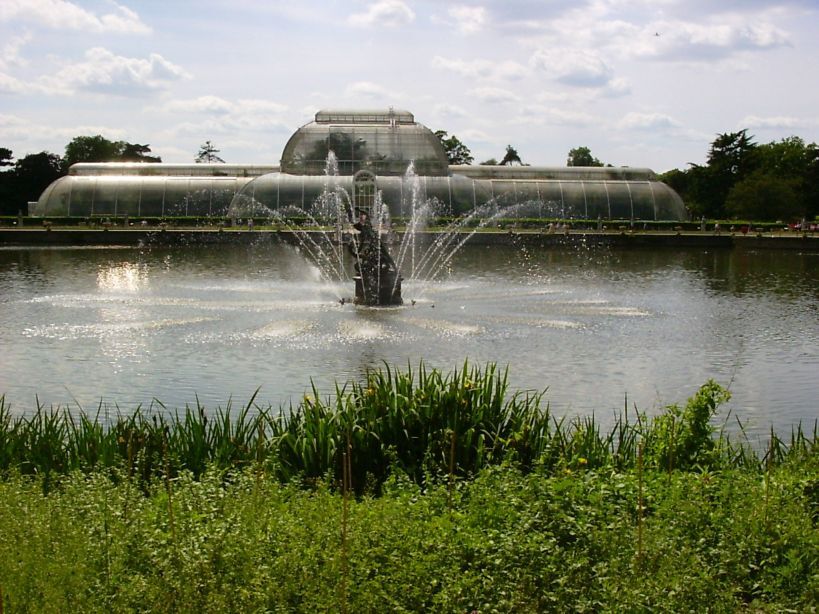
© Paul Hermans at Dutch Wikipedia, CC BY-SA 3.0 Resized from original. (This derivative is under the same CC BY-SA license.)
World Heritage Research
Discover scientific research and academic studies that deepen our understanding of Royal Botanic Gardens, Kew from its history and significance to its conservation, management, and contemporary challenges.
-
The Relationships between the Indian Botanic Garden, Howrah and the Royal Botanic Gardens, Kew in Economic Botany
A two-century collaboration between the Indian Botanic Garden, Howrah, and the Royal Botanic Gardens, Kew has significantly advanced the study and distribution of economically valuable plants. Despite differing original purposes, both institutions played pivotal roles in introducing and propagating exotic species, particularly those with economic importance. This research highlights their interconnected efforts in plant introductions, emphasizing their enduring impact on global economic botany. The study employs historical analysis to trace these relationships, providing insights into how institutional collaboration has shaped botanical science.
Hastings, R. B. (2024). The Relationships between the Indian Botanic Garden, Howrah and the Royal Botanic Gardens, Kew in Economic Botany. Nelumbo, 1–12. https://doi.org/10.20324/nelumbo/v28/1986/74666
View Publication Record | Read Publication -
The type material in the David W. Mitchell myxomycete collection at the Royal Botanic Garden, Kew
A comprehensive analysis of the David W. Mitchell myxomycete collection at Kew reveals 58 critical type specimens, including holotypes, isotypes, paratypes, and other key materials. These represent 11 taxa authored or co-authored by Mitchell and 42 taxa from colleague exchanges, preserving essential nomenclature for myxomycete taxonomy. The study catalogs these specimens with detailed images, labels, origin data, and conservation status, while also compiling a list of Mitchell's nomenclatural proposals and publications. This work provides a foundational resource for myxomycete research, ensuring the integrity and accessibility of type material for future studies.
LADO, C., & WRIGLEY DE BASANTA, D. (2024). The type material in the David W. Mitchell myxomycete collection at the Royal Botanic Garden, Kew. Phytotaxa, 649(2), 135–158. https://doi.org/10.11646/phytotaxa.649.2.1
View Publication Record | Read Publication -
“A Great Responsibility”: Biodiversity Crisis in the Royal Botanic Gardens, Kew
By the late 1980s, the Royal Botanic Gardens, Kew, had shifted its focus to biodiversity, becoming a global leader in conservation advocacy. This study traces how biodiversity emerged as a central concept within Kew's research, governance, and public outreach, highlighting its integration into institutional strategy. The research employs qualitative methods to analyze existing studies on environmental concepts, examining how Kew communicated the biodiversity crisis through one of the world's most influential botanic gardens. The findings underscore the significance of institutions like Kew in shaping environmental narratives and driving conservation efforts during a pivotal period.
Akerman, I. (2024). “A Great Responsibility”: Biodiversity Crisis in the Royal Botanic Gardens, Kew. Environmental History, 29(3), 447–473. https://doi.org/10.1086/730559
View Publication Record | Read Publication -
Virginia Woolf and Vanessa Bell at Kew Gardens
A study reveals the significant collaboration between Virginia Woolf and her sister, artist Vanessa Bell, in creating two versions of Woolf's hand-printed booklet, Kew Gardens. Published in 1919 and 1927 by the Hogarth Press, these editions feature Bell’s woodcuts that respond to Woolf’s blend of modernism and nostalgia, set within the Royal Botanic Gardens at Kew. The text and images reflect Roger Fry’s theories on modernist form, emphasizing illustrations as independent creative works rather than literal reflections of the text. This research highlights the interplay between literature and visual art in capturing the essence of a UNESCO-listed site through innovative artistic techniques.
Smith, E. L. (2023). Virginia Woolf and Vanessa Bell at Kew Gardens. Women and the Collaborative Art of Gardens, 145–170. https://doi.org/10.4324/9781003381549-8
View Publication Record | Read Publication -
The colonial roots of botany – legacies of empire in the botanic gardens of Oxford and Kew
While botanic gardens such as Oxford and Kew have long been linked to colonial expansion, their public communication of this history remains superficial despite growing awareness among scientists about the need to acknowledge Indigenous peoples and places. This study reveals that colonial-era scientific practices persist in plant nomenclature even as institutions grapple with ethical reckoning. Through ethnographic fieldwork conducted in 2022–2023, researchers analyzed signage and guided tours to demonstrate how colonial legacies are only lightly addressed for visitors, despite internal efforts. The findings highlight a disconnect between institutional recognition of these issues and their public representation.
Nielsen, V. (2023). The colonial roots of botany – legacies of empire in the botanic gardens of Oxford and Kew. Museum Management and Curatorship, 38(6), 696–712. https://doi.org/10.1080/09647775.2023.2269222
View Publication Record | Read Publication -
Fortuitous Alignment: The Royal Botanic Gardens, Kew and the Sustainable Development Goals
Botanic gardens, including the Royal Botanic Gardens, Kew (Kew), are increasingly pivotal in addressing biodiversity loss and human well-being, particularly in urban areas. This study demonstrates that Kew's strategic alignment with the Sustainable Development Goals (SDGs) through policy engagement, education, outreach, and scientific research significantly enhances its impact on global sustainability efforts. By translating SDG targets into actionable projects, Kew effectively contributes to high-level objectives, showcasing how a single organization can make meaningful progress toward these goals both locally and internationally.
Cowell, C. R., Bullough, L.-A., Dhanda, S., Harrison Neves, V., Ikin, E., Moore, J., Purdon, R., Williams, C., Willison, J., & Willoughby, S. J. (2022). Fortuitous Alignment: The Royal Botanic Gardens, Kew and the Sustainable Development Goals. Sustainability, 14(4), 2366. https://doi.org/10.3390/su14042366
View Publication Record | Read Publication -
Kew Gardens
A vivid literary depiction of the Royal Botanic Gardens, Kew, captures the intricate beauty and diversity of its flora. The passage describes a hundred stalks rising from an oval flower-bed, each unfurling into heart-shaped or tongue-shaped leaves adorned with red, blue, or yellow petals marked by spots of color. This detailed observation highlights the botanical richness and aesthetic appeal of Kew Gardens, offering a poetic yet scientifically grounded representation of its plant life. The work employs descriptive language to convey the visual complexity and variability of the garden's vegetation, providing both an artistic and ecological perspective.
Woolf, V. (2022). Kew Gardens. Kew Gardens and Other Short Fiction. https://doi.org/10.1093/owc/9780198838135.003.0002
View Publication Record | Read Publication