World Heritage Identification Number: 425
World Heritage since: 1987
Category: Cultural Heritage
WHE Type: Buildings & Architectural Ensembles
Transboundary Heritage: No
Endangered Heritage: No
Country: 🇬🇧 United Kingdom of Great Britain and Northern Ireland
Continent: Europe
UNESCO World Region: Europe and North America
Map
Blenheim Palace: England’s Baroque Country House of Outstanding Universal Value
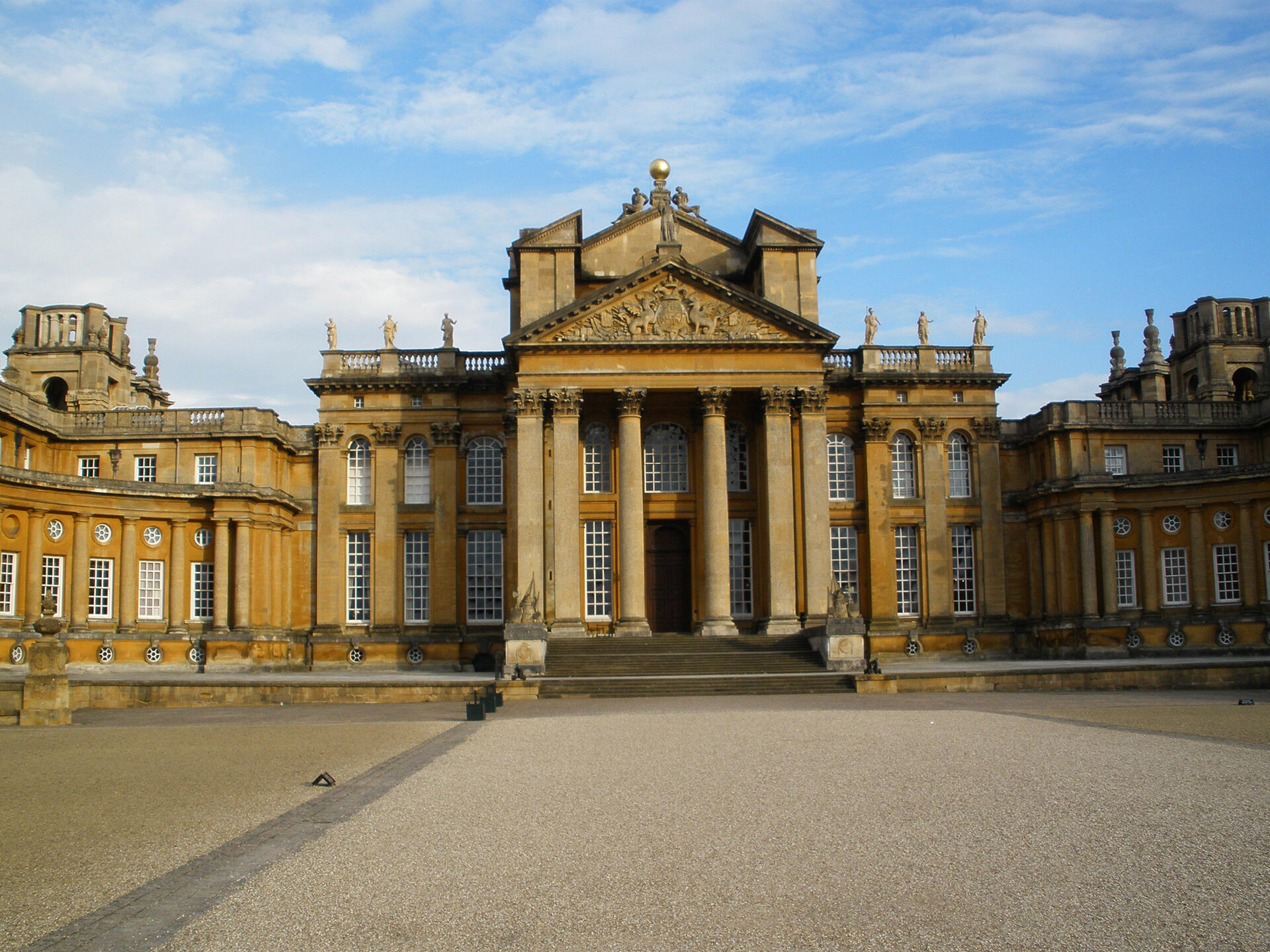
Blenheim Palace, located in Woodstock, Oxfordshire, England, stands as a testament to the grandeur of eighteenth-century architecture and the spirit of national pride. Inscribed as a UNESCO World Heritage Site in 1987, this monumental country house serves as the seat of the Dukes of Marlborough and offers a remarkable blend of history, art, and landscape design that continues to captivate visitors from around the world.
The origins of Blenheim Palace can be traced back to 1704, when John Churchill, the first Duke of Marlborough, led Allied forces to a decisive victory over French and Bavarian armies at the Battle of Blenheim during the War of the Spanish Succession. As a token of gratitude and recognition for this significant military achievement, Queen Anne and Parliament granted Churchill the royal manor of Woodstock and funds for the construction of a grand residence. The palace was built between 1705 and 1722 under the direction of the architects Sir John Vanbrugh and Nicholas Hawksmoor.
Notably, Blenheim Palace holds the unique distinction of being the only non-royal, non-episcopal country house in England to bear the title of "Palace." However, its construction was marred by intense political and personal strife. A bitter dispute arose between the first Duchess of Marlborough, Sarah Churchill, and the architect Sir John Vanbrugh over mounting costs and design extravagances, culminating in Vanbrugh being banned from the site before his monumental masterpiece was fully completed.
The design of Blenheim Palace is widely regarded as one of the finest examples of English Baroque architecture. Combining monumental scale with dramatic ornamentation, the palace reflects both the power and prestige of its patron and the ambitions of early eighteenth-century Britain. Its exterior features grand colonnades, elaborate stone carvings, imposing facades, and richly decorated entrances, all contributing to its commanding presence.
Inside, the palace boasts opulent interiors adorned with exquisite artwork, tapestries, and historic furnishings. Notable rooms include the Long Library, which houses an extensive collection of books and portraits, and the Great Hall, crowned by Sir James Thornhill’s magnificent ceiling fresco celebrating the military triumphs of the Duke of Marlborough. Throughout the palace, numerous portraits and decorative works chronicle the history and achievements of the Marlborough family.
Surrounding the palace is a picturesque landscaped park covering approximately 2,000 acres (810 hectares), much of which was redesigned in the eighteenth century by the celebrated landscape architect Lancelot “Capability” Brown. Brown transformed the grounds into a carefully composed natural landscape featuring lakes, woodlands, sweeping lawns, and gently rolling hills, creating a harmonious relationship between architecture and nature. Today, the park remains a popular destination for visitors seeking both historical insight and scenic beauty.
Blenheim Palace has also played an important role in British history beyond its association with the Dukes of Marlborough. Sir Winston Churchill, former Prime Minister of the United Kingdom and a direct descendant of the first Duke of Marlborough, was born at the palace in 1874. Over the centuries, Blenheim Palace has hosted royal visits, political gatherings, and numerous cultural events, reinforcing its status as one of Britain’s most significant historic estates.
Overall, Blenheim Palace stands as a symbol of British history, architectural achievement, and national identity. Its magnificent Baroque design, richly decorated interiors, and expansive landscaped park make it one of the most remarkable country houses in Europe. Whether admired for its historical associations, artistic treasures, or peaceful parkland, Blenheim Palace offers visitors an enduring and memorable connection to Britain’s cultural heritage.
UNESCO Description of the World Heritage Site
Blenheim Palace, near Oxford, stands in a romantic park created by the famous landscape gardener 'Capability' Brown. It was presented by the English nation to John Churchill, first Duke of Marlborough, in recognition of his victory in 1704 over French and Bavarian troops. Built between 1705 and 1722 and characterized by an eclectic style and a return to national roots, it is a perfect example of an 18th-century princely dwelling.
UNESCO Justification of the World Heritage Site
Criterion (ii): By their refusal of the French models of classicism, the Palace and Park illustrate the beginnings of the English Romantic movement, which was characterised by the eclecticism of its inspiration, its return to national sources and its love of nature. The influence of Blenheim on the architecture and organisation of space in the 18th and 19th centuries was greatly felt both in England and abroad.
Criterion (iv): Built by the nation to honour one of its heroes, Blenheim is, above all, the home of an English aristocrat, the 1st Duke of Marlborough, who was also Prince of the Germanic Holy Roman Empire, as we are reminded in the decoration of the Great Drawing Room the Saloon by Louis Laguerre (1719-20). Like the World Heritage properties Residence of Würzburg and the Castles of Augustusburg and Falkenlust in Brühl, Blenheim is typical of 18th century European princely residences.
Encyclopedia Record: Blenheim Palace
Blenheim Palace is a country house in Woodstock, Oxfordshire, England. It is the seat of the Dukes of Marlborough. Originally called Blenheim Castle, it has been known as Blenheim Palace since the 19th century. One of England's largest houses, it was built between 1705 and 1722, and designated a UNESCO World Heritage Site in 1987.Additional Site Details
Area: Not available
Number of Components: 1
(iv) — Outstanding example of a type of building or landscape
Coordinates: 51.84194444 , -1.361388889
World Heritage Research
Discover scientific research and academic studies that deepen our understanding of Blenheim Palace from its history and significance to its conservation, management, and contemporary challenges.
-
Investigating Failure Mechanisms in Historical and Modern Wrought Irons During Tensile Testing with Acoustic Emission Monitoring and Imaging
Historical wrought irons exhibit distinct failure mechanisms compared to modern counterparts, primarily driven by microstructural defects such as transverse slags and voids. A study analyzing 14th-, 18th-, and 20th-century irons through tensile testing, acoustic emission (AE) monitoring, digital image correlation, scanning electron microscopy, and micro-CT revealed three key failure modes: plastic deformation (35–87 kHz), debonding (125–156 kHz), and fracture (197–298 kHz). Modern irons displayed ductile failures with post-yield plasticity, while historical specimens showed defect-driven failures marked by localized strain concentrations. These findings highlight how micro-mechanical processes influence macro-scale mechanical properties, offering insights into the durability of heritage materials like those used in Blenheim Palace.
Akcicek, K., Zuo, J., Viles, H., & Acikgoz, S. (2026). Investigating Failure Mechanisms in Historical and Modern Wrought Irons During Tensile Testing with Acoustic Emission Monitoring and Imaging. International Journal of Architectural Heritage, 1–21. https://doi.org/10.1080/15583058.2026.2670321
View Publication Record | Read Publication -
Resilient Pasts for Sustainable Futures: The Role of Building Conservation in Creating a Sustainable Built Environment
Historic buildings, including UNESCO World Heritage Sites like Blenheim Palace, offer valuable insights into sustainable and resilient construction practices that can endure for centuries. A study highlights the critical role of building conservation in adapting to climate change, which is no longer a distant threat but an immediate challenge. Flooding, the UK's primary hazard, poses significant risks, with recent extreme weather events demonstrating the need for buildings to withstand unprecedented conditions. The research analyzed two historic estates—Blenheim Palace and a group of churches—to assess their vulnerabilities to local and regional climate change hazards. It emphasized the importance of planned maintenance and conservation philosophy in managing sustainable change and enhancing resilience. The findings underscore that understanding climate-related risks is essential for effective asset management and future maintenance planning, providing actionable strategies for preserving our built heritage.
Slade, M., Johnson, S., O’Dowd, M., & Moncaster, A. (2026). Resilient Pasts for Sustainable Futures: The Role of Building Conservation in Creating a Sustainable Built Environment. IOP Conference Series: Earth and Environmental Science, 1615(1), 12063. https://doi.org/10.1088/1755-1315/1615/1/012063
View Publication Record | Read Publication -
The REFRESH Project: historical water management at Blenheim Palace
Historical water management at Blenheim Palace reveals a dynamic interplay between engineering, landscape design, and environmental adaptation over 300 years. Preliminary findings from the REFRESH project suggest that traditional hydraulic systems, shaped by climatic conditions such as aridity, drought, and floods, offer valuable insights for contemporary conservation and sustainability strategies. The study combines extensive archival research with oral histories to reconstruct past water management practices, demonstrating their potential to inform future climate adaptation solutions while aligning with conservation principles.
Wilhelm, K., Désarnaud, J., Khan, N., & Viles, H. (2025). The REFRESH Project: historical water management at Blenheim Palace. In Oxford Water Day conference. University of Oxford. https://doi.org/10.5287/ORA-ZRYQGWJBA
View Publication Record | Read Publication -
History and modernity: multimodality and interactivity of museums' communication (based on coronation 2023 exhibitions at british museums)
A groundbreaking study reveals how British museums leveraged multimodal and interactive strategies during the 2023 King Charles III and Queen Camilla coronation exhibitions, fundamentally reshaping visitor engagement with cultural heritage. The research demonstrates that integrating visual, textual, audio, sensory, and digital elements transforms museums into dynamic communicative spaces, fostering active participation over passive consumption. Through a multimodal discourse analysis of five key exhibitions—including Blenheim Palace's 'Royal Connections: Crowns and Coronets'—the study highlights how these strategies enhance educational enrichment, accessibility, and inclusivity, particularly in the digital era. Findings suggest that participatory museum models, supported by digital tools and social media, are democratizing cultural heritage experiences, offering valuable insights for museology and evolving museum practices.
Biliuk, Y. (2024). History and modernity: multimodality and interactivity of museums’ communication (based on coronation 2023 exhibitions at british museums). Current Issues of Ukrainian Linguistics: Theory and Practice, (49), 201–218. https://doi.org/10.17721/apultp.2024.49.201-218
View Publication Record | Read Publication -
The EPC and the Future of the European Order
A landmark summit at Blenheim Palace, the birthplace of Winston Churchill, marked a pivotal moment for European unity and solidarity. On 18 July 2024, British Prime Minister Keir Starmer convened 46 European leaders for the fourth gathering of the European Political Community (EPC), reaffirming their unwavering commitment to Ukraine amid geopolitical challenges. The event underscored the EPC's role in shaping a resilient and cohesive European order, reflecting a strategic response to contemporary security dynamics. This high-profile diplomatic engagement at a historic site symbolized both continuity with Churchillian leadership and innovation in European governance.
Giuashvili, T. (2024). The EPC and the Future of the European Order. GEOpolitics, 1(9). https://doi.org/10.62343/geopolitics.2024.9.7
View Publication Record | Read Publication -
Geotechnical test pits for a proposed new lift at Blenheim Palace, Woodstock, Oxfordshire: an archaeological watching brief
Archaeological monitoring of four geotechnical test pits at Blenheim Palace, Woodstock, Oxfordshire, revealed no significant archaeological finds or deposits. The study, conducted as part of a proposed new lift installation, employed an archaeological watching brief to ensure compliance with heritage preservation standards. This approach involved close observation and documentation of the excavation process to identify any potential historical or cultural material. Despite the absence of notable discoveries, the research underscores the importance of such monitoring in safeguarding UNESCO World Heritage Sites during development projects.
Carvalho, C. (2024). Geotechnical test pits for a proposed new lift at Blenheim Palace, Woodstock, Oxfordshire: an archaeological watching brief. Archaeology Data Service. https://doi.org/10.5284/1139084
View Publication Record | Read Publication -
The Fleshiness of Bronze
A comparative analysis of bronze replicas versus marble prototypes reveals that material differences do not diminish the artistic quality or fidelity of reproductions. The study highlights how Pietro Cipriani's 18th-century bronze copies of famous Roman marbles, commissioned for Shirburn Castle, were deemed 'the most exact that ever were made' despite significant deviations from their originals. These replicas omitted structural supports and featured modified compositions, yet their smooth finishes and reflective properties accentuated the subjects' forms with remarkable precision. The research contrasts Cipriani's work with earlier bronze copies by Massimiliano Soldani Benzi for Blenheim Palace, illustrating how artistic reinterpretation can enhance rather than detract from the mimesis of ancient prototypes.
Kinney, H. W. (2023). The Fleshiness of Bronze. The Matter of Mimesis, 218–244. https://doi.org/10.1163/9789004515413_013
View Publication Record | Read Publication