World Heritage Identification Number: 428
World Heritage since: 1987
Category: Cultural Heritage
WHE Type: Historic Cities & Urban Areas
Transboundary Heritage: No
Endangered Heritage: No
Country: 🇬🇧 United Kingdom of Great Britain and Northern Ireland
Continent: Europe
UNESCO World Region: Europe and North America
Map
City of Bath: A Blend of Ancient and Modern Architecture
The City of Bath, located in the county of Somerset, England, and the county's largest city, is a unique urban center that showcases a remarkable fusion of ancient and and later architectural styles. This city, renowned for its Roman-built baths, has been named after them and holds a significant place in history.
Founded by the Romans shortly after their invasion of 43 AD, Bath was established as a thermal spa known as Aquae Sulis around 60 AD. The Romans recognized the therapeutic properties of the hot springs and constructed bathing complexes, temples, and other structures that still stand today, although most survive as excavated remains. These Roman remains, including the Roman Baths and the Temple of Sulis Minerva, form a significant part of the city's archaeological and historical heritage.
During the Middle Ages, Bath developed into an important regional center, benefiting from its strategic location and its growing role in the wool and cloth trade. While much of the medieval city has been altered or rebuilt, elements of this period survive, most prominently Bath Abbey, whose origins date to the medieval era. Beyond the Abbey, fragments of the medieval city walls, elements of the historic street layout, and archaeological remains beneath later buildings provide further evidence of the city’s development during this time.
The 18th century marked another turning point in Bath’s history. Throughout the Georgian era, the city was transformed into a fashionable spa resort, attracting aristocracy and visitors from across Britain. During this period, neoclassical and Palladian-inspired architecture came to define the city’s appearance. Iconic landmarks such as the Royal Crescent, the Circus, and the Assembly Rooms were designed by architects John Wood the Elder and his son John Wood the Younger, establishing Bath’s reputation as one of the most elegant planned cities in Europe.
Bath’s rich cultural history extends beyond its architecture. The novelist Jane Austen lived in the city between 1801 and 1806, and Bath features prominently in two of her novels, Northanger Abbey and Persuasion. The Jane Austen Centre provides exhibitions and interpretation dedicated to her life, works, and connections to the city, even though it is not located in a house where she lived.
In the modern era, Bath continues to thrive as a cultural hub. It hosts a wide range of festivals and events, including The Bath Festival, which incorporates both music and literature, as well as the popular Bath Christmas Market. The city's vibrant arts scene, coupled with its historical charm, attracts visitors from around the world.
In 1987, the City of Bath was inscribed as a UNESCO World Heritage Site, in recognition of its Roman remains, historic spa culture, and outstanding Georgian architecture. In 2021, Bath also became part of the transnational World Heritage Site known as "The Great Spa Towns of Europe,” further highlighting its international historical significance. This second designation, a rare distinction for a single city, further emphasizes Bath's unique position in history and its enduring appeal.
Overall, the City of Bath stands as a testament to the interplay between history and evolution. Its Roman roots, medieval expansion, Georgian transformation, and contemporary vitality create a captivating tapestry that invites exploration and appreciation. Whether one delves into the remnants of the Roman Baths or marvels at the elegance of the Royal Crescent, the City of Bath offers a journey through time that few cities can match.
UNESCO Description of the World Heritage Site
Founded by the Romans as a thermal spa, Bath became an important centre of the wool industry in the Middle Ages. In the 18th century, under George III, it developed into an elegant town with neoclassical Palladian buildings, which blend harmoniously with the Roman baths.
UNESCO Justification of the World Heritage Site
Criterion (i): Bath’s grandiose Neo-classical Palladian crescents, terraces and squares spread out over the surrounding hills and set in its green valley, are a demonstration par excellence of the integration of architecture, urban design and landscape setting, and the deliberate creation of a beautiful city. Not only are individual buildings such as the Assembly Rooms and Pump Room of great distinction, they are part of the larger overall city landscape that evolved over a century in a harmonious and logical way, drawing together public and private buildings and spaces in a way that reflects the precepts of Palladio tempered with picturesque aestheticism. Bath’s quality of architecture and urban design, its visual homogeneity and its beauty is largely testament to the skill and creativity of the architects and visionaries of the 18th and 19th centuries who applied and developed Palladianism in response to the specific opportunities offered by the spa town and its physical environment and natural resources (in particular the hot springs and the local Bath Oolitic limestone). Three men – architect John Wood Senior, entrepreneur and quarry owner Ralph Allen and celebrated social shaper and Master of Ceremonies Richard “Beau” Nash – together provided the impetus to start this social, economic and physical rebirth, resulting in a city that played host to the social, political and cultural leaders of the day. That the architects who followed were working over the course of a century, with no master plan or single patron, did not prevent them from contriving to relate each individual development to those around it and to the wider landscape, creating a city that is harmonious and logical, in concord with its natural environment and extremely beautiful.
Criterion (ii): Bath exemplifies the 18th century move away from the inward-looking uniform street layouts of Renaissance cities that dominated through the 15th–17th centuries, towards the idea of planting buildings and cities in the landscape to achieve picturesque views and forms, which could be seen echoed around Europe particularly in the 19th century. This unifying of nature and city, seen throughout Bath, is perhaps best demonstrated in the Royal Crescent (John Wood Younger) and Lansdown Crescent (John Palmer). Bath’s urban and landscape spaces are created by the buildings that enclose them, providing a series of interlinked spaces that flow organically, and that visually (and at times physically) draw in the green surrounding countryside to create a distinctive garden city feel, looking forward to the principles of garden cities developed by the 19th century town planners.
Criterion (iv): Bath reflects two great eras in human history: Roman and Georgian. The Roman Baths and temple complex, together with the remains of the city of Aquae Sulis that grew up around them, make a significant contribution to the understanding and appreciation of Roman social and religious society. The 18th century re-development is a unique combination of outstanding urban architecture, spatial arrangement and social history. Bath exemplifies the main themes of the 18th century neoclassical city; the monumentalisation of ordinary houses, the integration of landscape and town, and the creation and interlinking of urban spaces, designed and developed as a response to the growing popularity of Bath as a society and spa destination and to provide an appropriate picturesque setting and facilities for the cure takers and social visitors. Although Bath gained greatest importance in Roman and Georgian times, the city nevertheless reflects continuous development over two millennia with the spectacular medieval Abbey Church sat beside the Roman temple and baths, in the heart of the 18th century and modern day city.
Encyclopedia Record: Bath, Somerset
Bath is a city in Somerset, England, known for and named after its Roman-built baths. At the 2021 census, the population was 94,092. Bath is in the valley of the River Avon, 97 miles (156 km) west of London and 11 miles (18 km) southeast of Bristol. The city became a UNESCO World Heritage Site in 1987, and was later added to the transnational World Heritage Site known as the "Great Spa Towns of Europe" in 2021. Bath is also the largest city and settlement in Somerset.Additional Site Details
Area: 2,900 hectares
Number of Components: 1
(ii) — Significant interchange of human values
(iv) — Outstanding example of a type of building or landscape
Coordinates: 51.3813055556 , -2.3590555556
Image
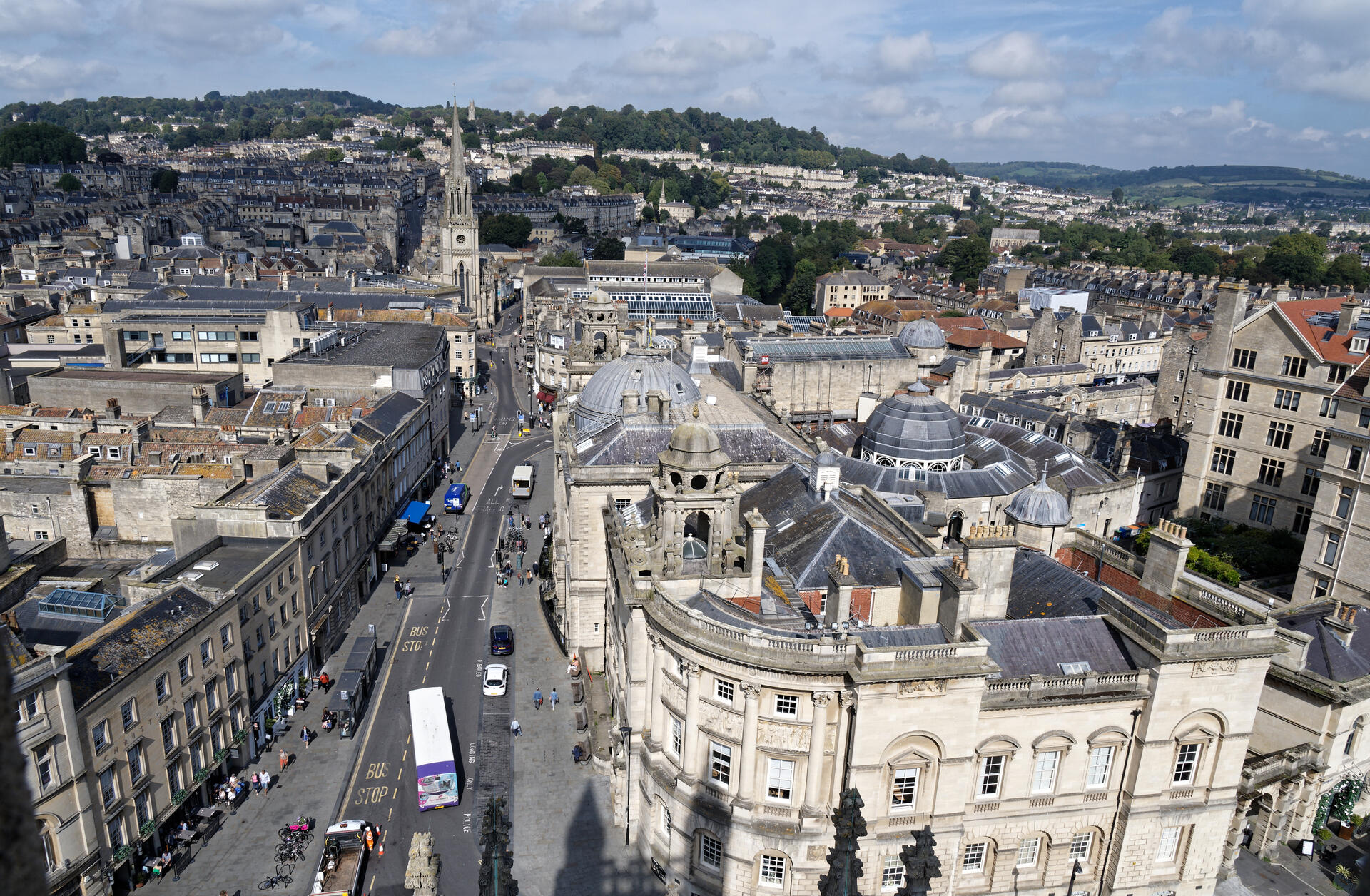
© Raboe001, CC BY-SA 3.0 Resized from original. (This derivative is under the same CC BY-SA license.)
World Heritage Research
Discover scientific research and academic studies that deepen our understanding of City of Bath from its history and significance to its conservation, management, and contemporary challenges.
-
Reconstructing the peak flow of historical flood events using a hydraulic model: The city of Bath, United Kingdom
Including historical flood data can significantly increase estimates of extreme flood risk. A 1D hydraulic model of the River Avon in Bath, UK, revealed that incorporating pre-1960 flood events raised the 1-in-100-year design flood estimate by up to 30%. The study reconstructed peak flows for 16 historical events using archival cross-sections, technical drawings, and epigraphic marks, then calibrated the model against two known floods (1947 and 1960). By extending the annual maximum flow series back to 1866, researchers demonstrated how long-term flood frequency analysis can improve modern risk assessments. This approach highlights the importance of historical records in refining flood defense planning.
Stamataki, I., & Kjeldsen, T. R. (2021). Reconstructing the peak flow of historical flood events using a hydraulic model: The city of Bath, United Kingdom. Journal of Flood Risk Management, 14(3). Portico. https://doi.org/10.1111/jfr3.12719
View Publication Record | Read Publication -
Reconstructing a hydraulic model for historic flood levels in the city of Bath, United Kingdom
A hydraulic model reconstructing historic flood levels in Bath, UK, demonstrates that documentary evidence of past floods can significantly reduce uncertainty in contemporary flood risk assessments. The study, focusing on the River Avon, leveraged a rich record of 19th-century to present-day flood marks, maps, photographs, and newspaper articles to numerically reconstruct the 1960 flood event—a catalyst for Bath's current flood protection scheme. By comparing this model with a simple Manning equation approach, researchers found that hydraulic modeling offers more accurate estimates of design flood flows, thereby improving future risk predictions. Sensitivity analyses further assessed uncertainties in water levels during extreme events, highlighting the potential of historical data to enhance flood defense strategies.
Stamataki, I., & Kjeldsen, T. (2020). Reconstructing a hydraulic model for historic flood levels in the city of Bath, United Kingdom. https://doi.org/10.5194/egusphere-egu2020-3751
View Publication Record | Read Publication