World Heritage Identification Number: 1070
World Heritage since: 2003
Category: Cultural Heritage
WHE Type: Buildings & Architectural Ensembles
Transboundary Heritage: No
Endangered Heritage: No
Country: 🇷🇺 Russian Federation
Continent: Europe
UNESCO World Region: Europe and North America
Map
The Fortified City of Derbent: A Historical Gem Along the Caspian Sea
The Citadel, Ancient City, and Fortress Buildings of Derbent, located in the Republic of Dagestan, Russia, stand as a testament to the region's rich history and strategic significance. Inscribed as a UNESCO World Heritage Site in 2003, this ancient city offers a unique blend of architectural wonders and historical insights into the Sasanian Persian Empire's defensive network.
More to come…UNESCO Description of the World Heritage Site
The Citadel, Ancient City and Fortress Buildings of Derbent were part of the northern lines of the Sasanian Persian Empire, which extended east and west of the Caspian Sea. The fortification was built in stone. It consisted of two parallel walls that formed a barrier from the seashore up to the mountain. The town of Derbent was built between these two walls, and has retained part of its medieval fabric. The site continued to be of great strategic importance until the 19th century.
UNESCO Justification of the World Heritage Site
Criterion (iii): The site of the ancient city of Derbent has been crucial for the control of the north-south passage on the west side of the Caspian Sea since the 1st millennium BCE. The defence structures that were built by the Sasanians in the 5th century CE were in continuous use by the succeeding Persian, Arabic, Mongol, and Timurid governments for some fifteen centuries.
Criterion (iv): The ancient city of Derbent and its defence structures are the most significant section of the strategic defence systems designed and built in the Sasanian Empire along their northern limes, and maintained during the successive governments until the Russian occupation in the 19th century.
Encyclopedia Record: Derbent
Derbent, also historically known as Darband, or Derbend, is the southernmost city in Russia. It is situated along the southeastern coast of the Republic of Dagestan, occupying the narrow gateway between the Caspian Sea and the Caucasus Mountains, and connecting the Eurasian Steppe to the north and the Iranian Plateau to the south. Derbent covers an area of 69.63 square kilometres (26.88 mi2) with a population of roughly 120,000 residents.Additional Site Details
Area: 37.658 hectares
Number of Components: 1
(iv) — Outstanding example of a type of building or landscape
Coordinates: 42.0558333333 , 48.2827777778
Image
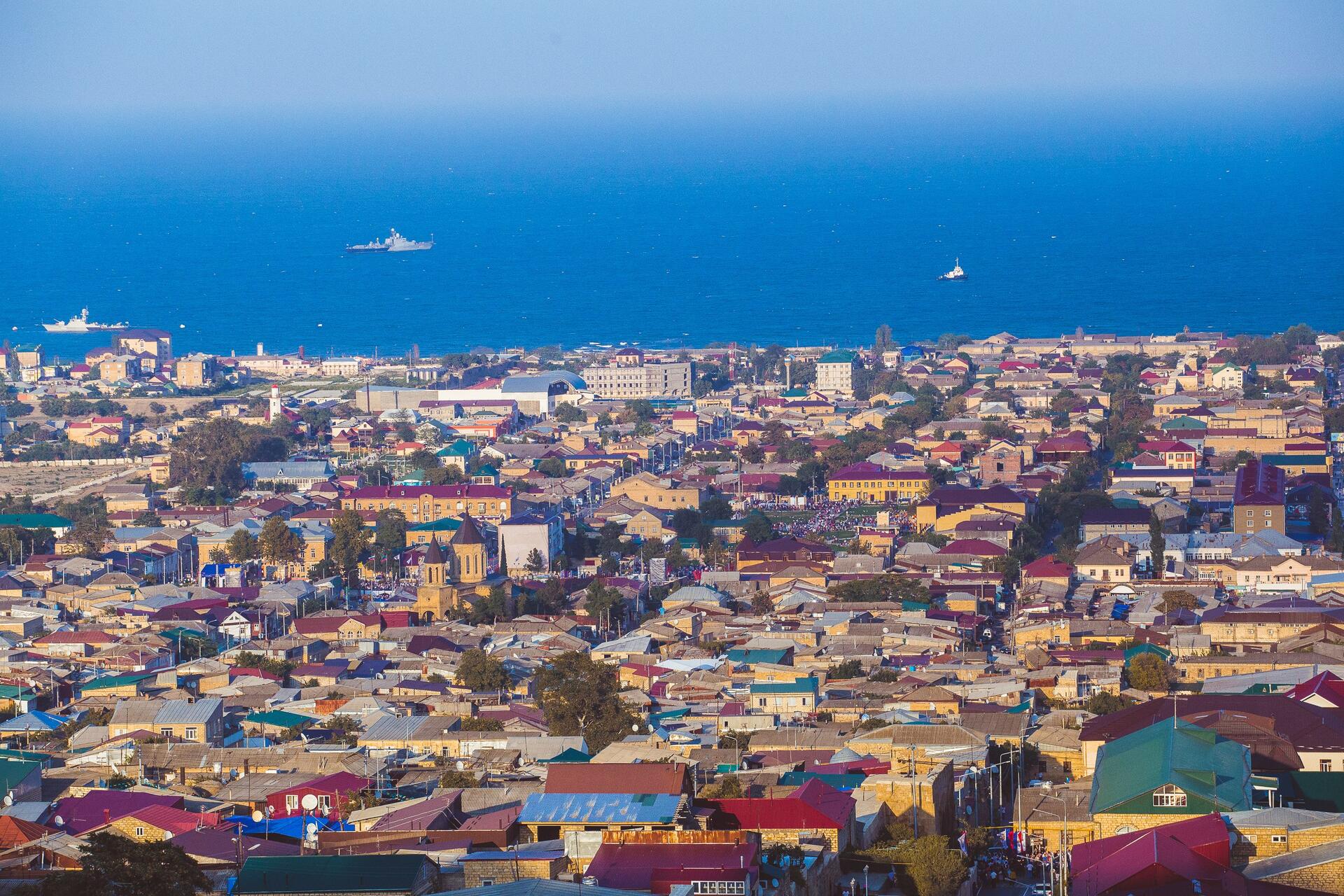
© Аль-Гимравий, CC BY-SA 3.0 Resized from original. (This derivative is under the same CC BY-SA license.)
World Heritage Research
Discover scientific research and academic studies that deepen our understanding of Citadel, Ancient City and Fortress Buildings of Derbent from its history and significance to its conservation, management, and contemporary challenges.
-
The role of the Russian state in the formation and development of international trade with the countries of the Muslim East along the medieval North-South transit corridor
Research reveals that the Russian state played a pivotal role in establishing and controlling international trade along the medieval North-South transit corridor, particularly through the Volga-Caspian route. This control was solidified after the collapse of the Golden Horde (1502) and the conquest of the Kazan and Astrakhan khanates by Ivan the Terrible, enabling Moscow to dominate this critical trade artery. The study highlights how Astrakhan, founded in 1558, became a major trading hub attracting merchants from Persia, Shamakhi, Bukhara, Khiva, and other Eastern cities, generating substantial revenue for the Russian treasury. The research, based on Arabic, English, Russian, and local sources alongside archaeological data, employs historicism, objectivity, and an interdisciplinary approach to analyze trade routes, economic centers, and goods such as furs from the 'Russian North,' which were highly valued in Eastern markets.
Kudryavtsev, A. A. (2026). The role of the Russian state in the formation and development of international trade with the countries of the Muslim East along the medieval North-South transit corridor. Гуманитарные И Юридические Исследования, 13(2), 253–260. https://doi.org/10.37493/2409-1030.2026.2.9
View Publication Record | Read Publication -
Materials on the Genealogy of the Hereditary Muslim Nobility of Derbent
A previously unknown 18th-century Arabic manuscript, 'The List of Seyids of the City of Derbent,' reveals the structure and privileges of the hereditary Muslim nobility in Derbent during the late Khanate era. This rare document, alongside Russian archival records and other historical sources, demonstrates that the Descendants of the Prophet Muhammad (Seyids) in Derbent maintained distinct social status and economic benefits—such as revenue from ancient waqf endowments—under Dagestani Shi’ite khans. Unlike Kazikumukh sharifs, these Seyids faced attempts by outsiders to claim membership, a phenomenon resisted by local communities with the backing of khanate authority. The study provides new insights into the genealogy and social dynamics of this noble lineage during a pivotal period in Caucasian history.
Aytberov, T. M. (2025). MATERIALS ON THE GENEALOGY OF THE HEREDETARY MUSLIM NOBILITY OF DERBENT. History, Archeology and Ethnography of the Caucasus, 21(1), 21–37. https://doi.org/10.32653/ch21121-37
View Publication Record | Read Publication -
Water facilities in the architectural and socio-cultural space of the city (on the example of medieval Derbent)
Medieval Derbent, the southernmost and most ancient city of Russia, showcases how water facilities played a pivotal role in shaping its architectural and socio-cultural landscape. A comprehensive analysis reveals that these structures, integral to urban planning, were designed with cohesive materials and styles that created a unified environment. The study highlights surviving water bodies as key elements in the city's development, offering insights into their historical significance and functional integration within Derbent's socio-cultural fabric.
Kyurebekova, M. (2024). Water facilities in the architectural and socio-cultural space of the city (on the example of medieval Derbent). Smart Composite in Construction, 5(2), 76–87. https://doi.org/10.52957/2782-1919-2024-5-2-76-87
View Publication Record | Read Publication -
Derbent’s underwater cultural heritage as a tourist resource
Underwater archaeological research near Derbent, Russia's southernmost city, has uncovered significant historical artifacts and ancient fortification remains on the Caspian Sea floor. These findings hold potential as a unique tourist resource, particularly for recreational diving and underwater museology. The study employed geographical mapping techniques to analyze the submerged structures and divers' discoveries, assessing their viability for tourism development. It also advocates for stronger integration of Dagestan's historical and geographical sciences to deepen historical reconstructions. A proposed underwater park project aims to further leverage this cultural heritage, offering a glimpse into Russia's lesser-known maritime history.
Eldarov, E. M., & Fazlullin, S. M. (2024). Derbent’s underwater cultural heritage as a tourist resource. Smart Tourism, 5(2), 2801. https://doi.org/10.54517/st.v5i2.2801
View Publication Record | Read Publication -
Derbent in the history of Zoroastrianism in the Caucasus
Derbent emerged as a pivotal multi-ethnic city and fortress in the 6th century AD, playing a crucial role in the geopolitical struggles between Rome and Sasanian Iran. This study reveals that Derbent's rulers, who controlled the strategic Derbent Passage, significantly influenced the region's religious and political landscape. While the local population was predominantly Christian, aligned with Byzantine influences, Persian nobility, garrison, and administration adhered to Zoroastrianism. The research, based on interdisciplinary methods and analysis of ancient texts, epigraphy, and archaeological data from Derbent (1970–1995), highlights how anti-Iranian uprisings in the Caucasus were closely tied to Derbent's political orientation, demonstrating its central role in the spread and resistance against Zoroastrianism.
Kudryavtsev, A. А. (2023). Derbent in the history of Zoroastrianism in the Caucasus. Гуманитарные И Юридические Исследования, 10(2), 237–243. https://doi.org/10.37493/2409-1030.2023.2.7
View Publication Record | Read Publication -
Excavation of Derbent Settlement in 2019
Excavations at the Derbent settlement in 2019 uncovered a complex of 11 rooms and medieval Muslim burials, providing new insights into the site's historical topography, architecture, and chronology. The findings date the inhabited structures to the 5th century AD, with evidence suggesting their abandonment during significant military-political events such as the anti-Sasanian revolt (450-451 AD) or the Iran-Savir war (503-508 AD). Chronological indicators like bronze belt buckles and fibulae, along with Sasanian pottery, support this dating. The excavation sheds light on the settlement's role as a crucial administrative, military, and religious center in East Caucasus, known historically as Chor/Chol.
Gadjiev, M. S., Budaychiev, A. L., Abdulaev, A. M., & Abiev, A. K. (2022). EXCAVATION OF DERBENT SETTLEMENT IN 2019. History, Archeology and Ethnography of the Caucasus, 18(2), 519–542. https://doi.org/10.32653/ch182519-542
View Publication Record | Read Publication -
Ancient Derbent in the History of the Early Christian World
Derbent's citadel, a 5th–7th century fortress, is revealed as not only a military stronghold but also the Caucasus' largest economic and religious center during Sasanian rule (439–484 AD). Archaeological excavations uncovered a cruciform Christian temple within the citadel, later repurposed as a reservoir, dating to the 5th century. This discovery was confirmed in 2020 using georadar, laser scanning, and photogrammetry, solidifying Derbent's significance in early Christian history. The study highlights its role in anti-Iranian uprisings, where Caucasian rulers allied with nomads against Sasanian persecution of Christianity.
Kudryavtsev, A. (2022). Ancient Derbent in the History of the Early Christian World. Vestnik of Saint Petersburg University. History, 67(3), 910–929. https://doi.org/10.21638/spbu02.2022.314
View Publication Record | Read Publication