World Heritage Identification Number: 1549
World Heritage since: 2019
Category: Cultural Heritage
WHE Type: Buildings & Architectural Ensembles
Transboundary Heritage: No
Endangered Heritage: No
Country: 🇦🇿 Azerbaijan
Continent: Asia
UNESCO World Region: Europe and North America
Map
The Historic Centre of Sheki with the Khan’s Palace: A Blend of Cultures and Architecture
The Historic Centre of Sheki with the Khan’s Palace, inscribed as a UNESCO World Heritage Site in 2019, offers a unique blend of cultures and architectural styles that have been shaped by the city's strategic location and historical events. Situated at the foot of the Greater Caucasus Mountains and divided by the Gurjana River, Sheki presents a captivating urban landscape that reflects the influences of various civilizations.
More to come…UNESCO Description of the World Heritage Site
The historic city of Sheki is located at the foot of the Greater Caucasus Mountains and divided in two by the Gurjana River. While the older northern part is built on the mountain, its southern part extends into the river valley. Its historic centre, rebuilt after the destruction of an earlier town by mudflows in the 18th century, is characterized by a traditional architectural ensemble of houses with high gabled roofs. Located along important historic trade routes, the city's architecture is influenced by Safavid, Qadjar and Russian building traditions. The Khan Palace, in the northeast of the city, and a number of merchant houses reflect the wealth generated by silkworm breeding and the trade in silk cocoons from the late 18th to the 19th centuries.UNESCO Justification of the World Heritage Site
Criterion (ii): As the major cultural and commercial centre in the region, the Historic Centre of Sheki exhibits an important interchange of multiple cultural influences, which have their origin in its history over two millennia, but developed particularly under the Safavid, Ottoman and Qajar influences, and the later impact of Russian rule. Sheki in turn influenced a wider territory of Caucasus and beyond. The current urban form, which dates back to the new construction after the flood of 1772, continued earlier building traditions responding to the local climatic conditions, and the requirements of the traditional economy and crafts activitiesIn particular construction elements and details of Sheki’s domestic architecture, such as balconies, doors, arches, and fences, reflect oriental characteristics that later evolved under Russian influence. Sheki is also an exceptional testimony to the feudal system of the Caucasian khanates, which developed from 1743 to 1819, as expressed in the architecture of the Khan’s palaces, the interiors of wealthy merchant houses, and the fortifications.
Criterion (v): Completely realized according to ancient rules, the Historic Centre of Sheki represents an extraordinary example of a planned productive ‘garden city’, as exemplified in its hydraulic water system for driving mills and irrigation, productive structures related to sericulture, and the peculiar organization of the houses aligned with their cultivated fields, all set within a forested landscape setting.
Encyclopedia Record: Three Saints Church (Shaki)
Nukha Three Saints Church, Nukha Holy Church or Round Temple is a former Russian Orthodox church building located in Shaki, Azerbaijan near Khan's Palace, named after the Cappadocian Fathers.Additional Site Details
Area: 120.5 hectares
Number of Components: 1
(v) — Outstanding example of traditional human settlement
Coordinates: 41.2033333333 , 47.1875
Image
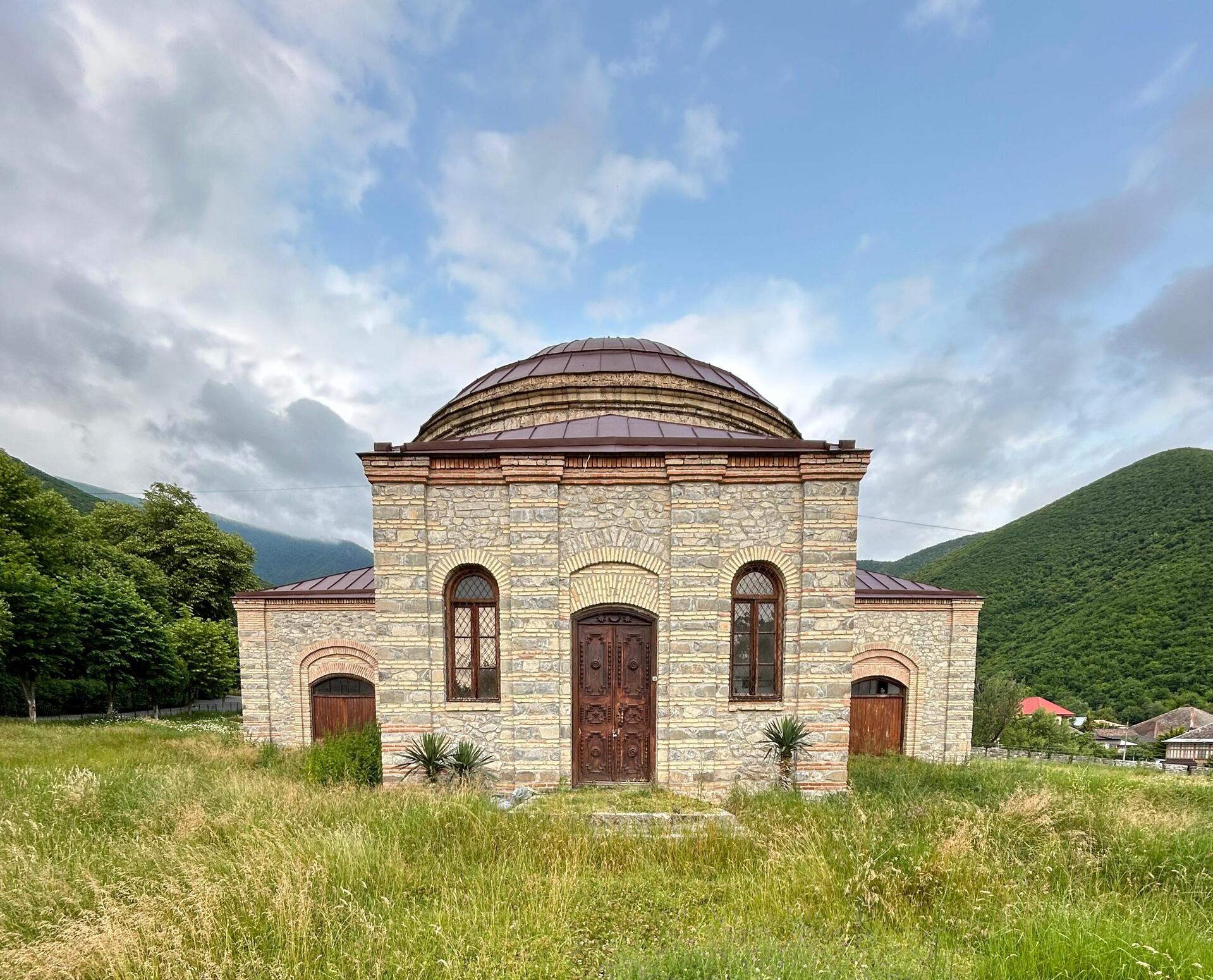
© Rəcəb Yaxşı, CC BY-SA 4.0 Resized from original. (This derivative is under the same CC BY-SA license.)