World Heritage Identification Number: 717
World Heritage since: 1995
Category: Cultural Heritage
WHE Type: Historic Cities & Urban Areas
Transboundary Heritage: No
Endangered Heritage: No
Country: 🇮🇹 Italy
Continent: Europe
UNESCO World Region: Europe and North America
Map
The Historic Centre of Siena: A Medieval Masterpiece in Tuscany
The Historic Centre of Siena, located in the heart of Tuscany, Italy, stands as a testament to the enduring legacy of medieval urban planning. Inscribed as a UNESCO World Heritage Site in 1995, Siena represents the culmination of over two centuries of architectural and artistic development, from the 12th to the 15th century.
More to come…UNESCO Description of the World Heritage Site
Siena is the embodiment of a medieval city. Its inhabitants pursued their rivalry with Florence right into the area of urban planning. Throughout the centuries, they preserved their city's Gothic appearance, acquired between the 12th and 15th centuries. During this period the work of Duccio, the Lorenzetti brothers and Simone Martini was to influence the course of Italian and, more broadly, European art. The whole city of Siena, built around the Piazza del Campo, was devised as a work of art that blends into the surrounding landscape.
UNESCO Justification of the World Heritage Site
Criterion (i): Through its urban and architectural characteristics, the historic centre of Siena is a testimony to human creativity and expresses human artistic and aesthetic capacity in material form.
Criterion (ii): The strong, personal example of artistic civilization, its architecture, painting, sculpture and town planning in particular had a very strong cultural influence not merely on the whole territory of the Republic of Siena but also in Italy and Europe, especially between the 13th and 17th centuries.
Criterion (iv): The structure of the town and its evolution, uninterrupted over the centuries, along with a unity of design that has been preserved, has made Siena one of the most precious examples of the medieval and Renaissance Italian town.
Encyclopedia Record: Siena
Siena is a city in the region of Tuscany in central Italy, and the capital of the province of Siena. With a population of 53,180, it is the 12th-largest city in the region.Additional Site Details
Area: 170 hectares
Number of Components: 1
(ii) — Significant interchange of human values
(iv) — Outstanding example of a type of building or landscape
Coordinates: 43.31861111 , 11.33166667
Image
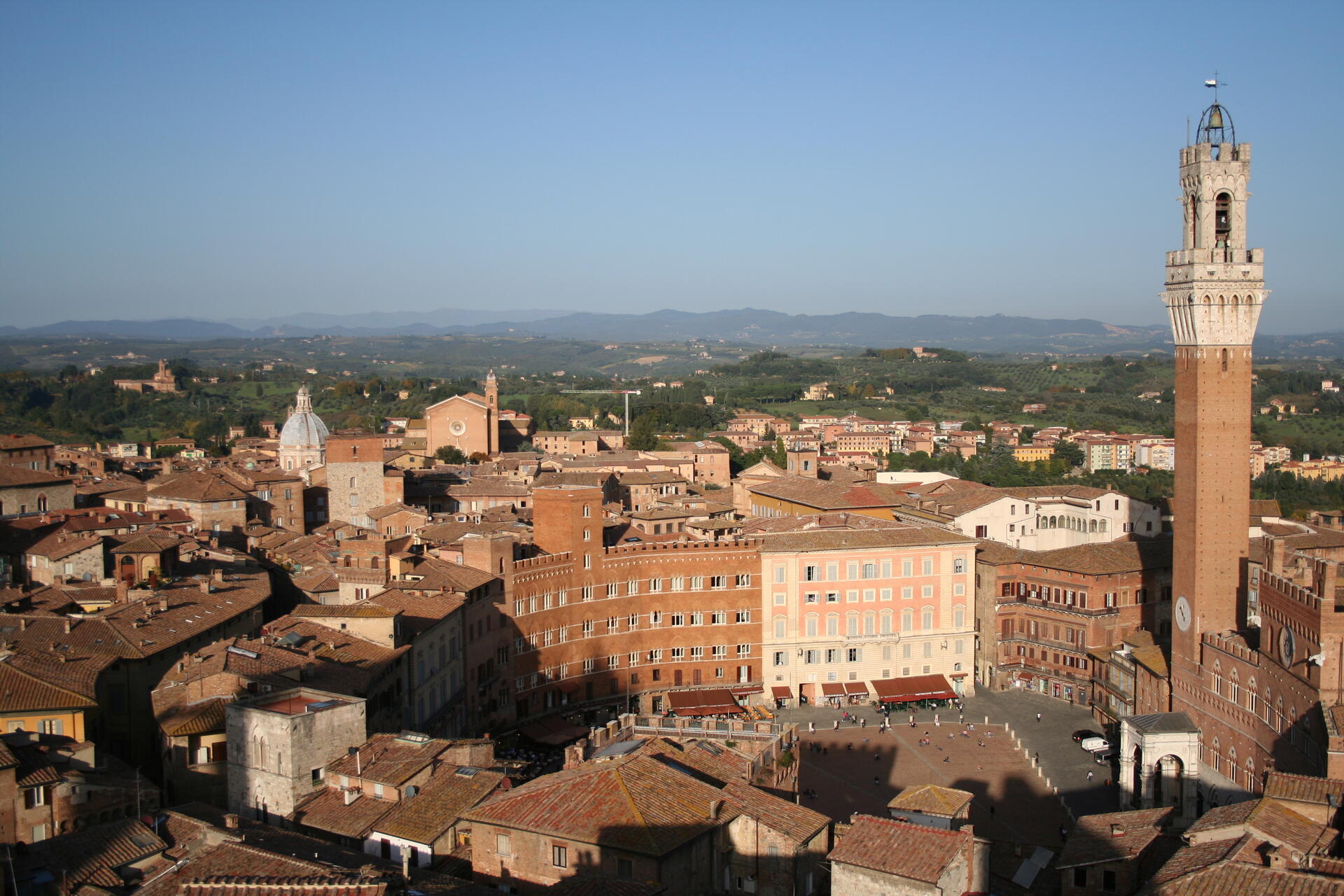
© Massimo Catarinella, CC BY-SA 3.0 Resized from original. (This derivative is under the same CC BY-SA license.)
World Heritage Research
Discover scientific research and academic studies that deepen our understanding of Historic Centre of Siena from its history and significance to its conservation, management, and contemporary challenges.
-
Multi-Modal/Multi-Resolution 3D Data Acquisition and Processing for a New Understanding of the Historical City of Siena (Italy)
Ground Penetrating Radar (GPR) and laser scanning surveys reveal hidden structures beneath Siena's historic center, offering unprecedented insights into the city's ancient fabric. The SOS project integrates full-coverage GPR data with 3D laser scans of significant structures like the cathedral, processing point clouds to eliminate noise and transform them into meshes for semantic enrichment. This multi-modal approach enables the creation of a 3D Archaeological WEBGIS, enhancing archaeological data visualization and conservation efforts. The study demonstrates how advanced geospatial technologies can uncover buried anomalies, providing a foundation for improved urban preservation strategies.
Pansini, R., Guzel, S., Morelli, G., Barsuglia, F., Penno, G., Catanzariti, G., Merico, A., Carpentiero, M. G., Camporeale, S., & Campana, S. (2024). MULTI-MODAL/MULTI-RESOLUTION 3D DATA ACQUISITION AND PROCESSING FOR A NEW UNDERSTANDING OF THE HISTORICAL CITY OF SIENA (ITALY). The International Archives of the Photogrammetry, Remote Sensing and Spatial Information Sciences, XLVIII-2/W4-2024, 341–347. https://doi.org/10.5194/isprs-archives-xlviii-2-w4-2024-341-2024
View Publication Record | Read Publication -
Group dynamics in the contrada communities of Siena, Italy
Research reveals that the contrada communities of Siena, Italy, exhibit complex group dynamics shaped by historical alliances and rivalries. A survey of 508 members found strong familial and social ties underpinning membership, while behavioral data from a ritual event (185 person-hours) showed how inter-group relationships influence individual and collective actions. These findings highlight the enduring impact of symbolic divisions on urban social interactions, offering insights into contemporary group dynamics within a UNESCO World Heritage Site.
Kenny, A. R., & Fortunato, L. (2021). Group dynamics in the contrada communities of Siena, Italy. https://doi.org/10.31235/osf.io/hxyvc
View Publication Record | Read Publication -
Territorial collective identities and the internet. Processes of individuation of Siena’s neighbourhoods
This study reveals how Siena's historic neighbourhoods, known as contrade, leverage the internet to preserve and project their collective identities against global audiences. By integrating philosophical anthropologist Hemuth Plessner’s concept of identity as an 'imagined unity' with geographer Anssi Paasi’s theories on borders and boundaries, the research demonstrates that institutionalizing social and spatial boundaries is crucial for maintaining territorial collective identities amid technological and societal changes. The analysis, based on ethnographic and digital data from Siena's historic centre and its iconic Palio festival, highlights the contrade's strategic use of online platforms to assert control over their narratives while engaging with broader global contexts.
Boos, T. (2020). Territorial collective identities and the internet. Processes of individuation of Siena’s neighbourhoods. Geografiska Annaler: Series B, Human Geography, 102(4), 305–327. https://doi.org/10.1080/04353684.2020.1775490
View Publication Record | Read Publication -
Collaboration and Correction: Re-examining the Writings of Lucy Olcott Perkins, ‘a lady resident in Siena’
Lucy Olcott Perkins' contributions to the study of Sienese art, particularly during her residence in Siena and collaboration with William Heywood, highlight the significance of networked research and collaborative partnerships in early 20th-century scholarship. Her work, marked by directness and simplicity, brought lesser-known artworks to scholarly attention while also reflecting the privileges and limitations faced by women in academic collaborations during this period. This study re-examines her writing career across two phases—one characterized by rigorous collaboration with access to historic sites, and another marked by isolation following her marriage breakdown. By analyzing her evolving approaches and circumstances, it sheds light on the dynamics of husband-wife collaborations and their impact on women's roles in art history during this era.
Tedbury, I. (2019). Collaboration and Correction: Re-examining the Writings of Lucy Olcott Perkins, ‘a lady resident in Siena’. 19: Interdisciplinary Studies in the Long Nineteenth Century, 2019(28). https://doi.org/10.16995/ntn.838
View Publication Record | Read Publication -
Urban sustainability: Co2 uptake by green areas in the historic centre of Siena
Green areas in Siena's historic center contribute significantly to CO2 absorption, with an efficiency of 1.95 t CO2 per hectare annually—a remarkable figure for a densely populated urban area. This study quantifies the carbon uptake capacity (330.50 t CO2 yr⁻¹) of vegetation types such as trees, olive groves, vineyards, and grasslands, highlighting their role in regulating planetary energy balance. By analyzing 71.54 ha of green spaces within the 169.64-ha historic center, researchers demonstrate that strategic urban planning and maintenance of green areas are critical for sustainable city development. The findings underscore the ecological value of preserving natural heritage even in highly urbanized settings.
Marchi, M., Niccolucci, V., Pulselli, R. M., & Marchettini, N. (2018). Urban sustainability: Co2 uptake by green areas in the historic centre of Siena. International Journal of Design & Nature and Ecodynamics, 12(4), 407–417. https://doi.org/10.2495/dne-v12-n4-407-417
View Publication Record | Read Publication -
Architecture of a hydroelectrically powered wireless sensor node for underground environmental monitoring
A novel hydroelectrically powered wireless sensor node enables autonomous, real-time monitoring of underground environmental conditions without external power sources. The system harnesses energy from flowing water using a watermill principle, making it ideal for deployment in historic underground aqueducts like Siena's 'Bottini.' This innovation minimizes maintenance and supports the preservation of ancient sites by providing continuous data on environmental parameters. Tested at 'Fontebranda,' one of the largest fountains in the network, the node integrates power generation, data acquisition, and wireless transmission, demonstrating its feasibility for long-term, independent operation.
Mecocci, A., Peruzzi, G., Pozzebon, A., & Vaccarella, P. (2017). Architecture of a hydroelectrically powered wireless sensor node for underground environmental monitoring. IET Wireless Sensor Systems, 7(5), 123–129. Portico. https://doi.org/10.1049/iet-wss.2016.0103
View Publication Record | Read Publication -
Medieval Towns, Traffic and Urban Planning Half a Century since the First Pedestrian Zone in Siena, Italy
A groundbreaking urban planning solution implemented in Siena, Italy, in 1965 demonstrated the feasibility and benefits of pedestrian zones in historic medieval towns. This initiative, the first of its kind, successfully addressed traffic congestion without resorting to the construction of urban motorways or the demolition of ancient buildings, which would have irreparably damaged several historic centres. The approach set a precedent for other towns, preventing further urban decay and preserving the architectural integrity of medieval townscapes. The study highlights the long-term impact of proactive traffic management in safeguarding cultural heritage.
Stefano Maggi. (2016). Medieval Towns, Traffic and Urban Planning Half a Century since the First Pedestrian Zone in Siena, Italy. Journal of Traffic and Transportation Engineering, 4(2). https://doi.org/10.17265/2328-2142/2016.02.006
View Publication Record | Read Publication