World Heritage Identification Number: 1026
World Heritage since: 2004
Category: Cultural Heritage
WHE Type: Cultural Landscapes
Transboundary Heritage: No
Endangered Heritage: No
Country: 🇮🇹 Italy
Continent: Europe
UNESCO World Region: Europe and North America
Map
A Cultural Landscape: The Val d'Orcia of Tuscany, Italy
The Val d'Orcia, located in the heart of Tuscany, Italy, is a testament to the harmonious blend of natural beauty, human ingenuity, and artistic inspiration that characterizes this region. Inscribed as a UNESCO World Heritage Site in 2004, the Val d'Orcia offers a unique insight into the evolution of Renaissance agricultural landscapes and their enduring influence on art, culture, and tourism.
More to come…UNESCO Description of the World Heritage Site
The landscape of Val d’Orcia is part of the agricultural hinterland of Siena, redrawn and developed when it was integrated in the territory of the city-state in the 14th and 15th centuries to reflect an idealized model of good governance and to create an aesthetically pleasing picture. The landscape’s distinctive aesthetics, flat chalk plains out of which rise almost conical hills with fortified settlements on top, inspired many artists. Their images have come to exemplify the beauty of well-managed Renaissance agricultural landscapes. The inscription covers: an agrarian and pastoral landscape reflecting innovative land-management systems; towns and villages; farmhouses; and the Roman Via Francigena and its associated abbeys, inns, shrines, bridges, etc.
UNESCO Justification of the World Heritage Site
Criterion (iv): The Val d’Orcia is an exceptional reflection of the way the landscape was re-written in Renaissance times to reflect the ideals of good governance and to create an aesthetically pleasing picture.
Criterion (vi): The landscape of the Val d’Orcia was celebrated by painters from the Sienese School, which flourished during the Renaissance. Images of the Val d’Orcia, and particularly depictions of landscapes where people are depicted as living in harmony with nature, have come to be seen as icons of the Renaissance and have profoundly influenced the development of landscape thinking.
Encyclopedia Record: Val d'Orcia
The Val d'Orcia or Valdorcia is a region of Tuscany, central Italy, which extends from the hills south of Siena to Monte Amiata. Its gentle, cultivated hills are occasionally broken by gullies and by towns and villages such as Pienza, Radicofani and Montalcino. Its landscape has been depicted in works of art from Renaissance painting to modern photography.Additional Site Details
Area: 61,187.96 hectares
Number of Components: 1
(vi) — Directly associated with events or living traditions
Coordinates: 43.06666667 , 11.55
Image
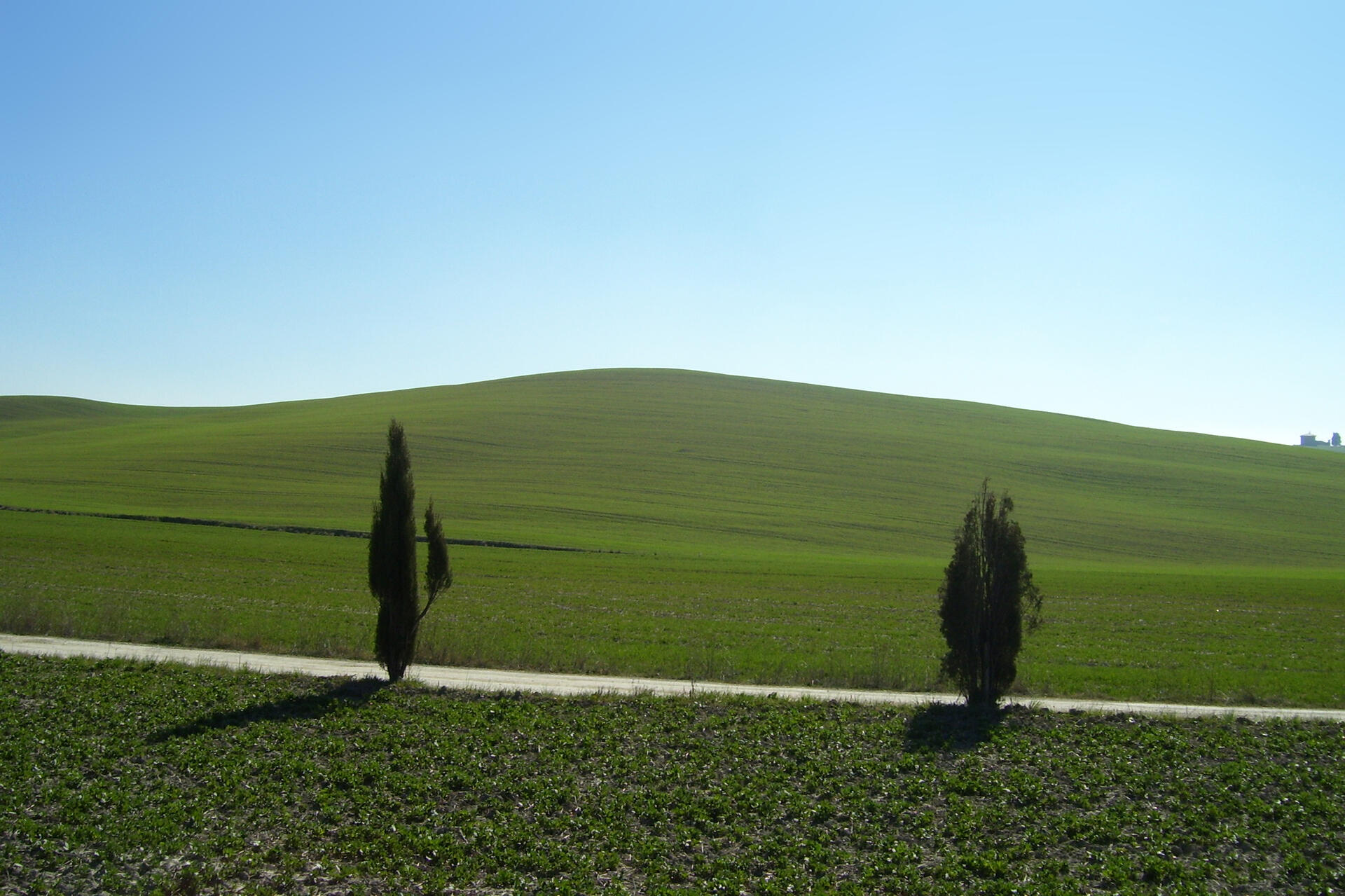
© Stefanoacetelli, CC BY-SA 3.0 Resized from original. (This derivative is under the same CC BY-SA license.)
World Heritage Research
Discover scientific research and academic studies that deepen our understanding of Val d'Orcia from its history and significance to its conservation, management, and contemporary challenges.
-
From badland to bushland? Analysis of geomorphic process dynamics and vegetation development in a sub-humid calanchi area based on high-resolution UAS data (2014–2024)
A decade-long study of the Val d'Orcia badlands reveals a transition toward landscape stabilization, driven by intrinsic geomorphic dynamics rather than climatic shifts. High-resolution UAS data (2014–2024) showed a 50% reduction in water erosion despite stable erosion rates, indicating a shift from high-frequency to high-magnitude, event-driven processes. The research also documented an unprecedented subsurface deformation process—gravitational bulging—caused by water infiltration and clay swelling. Vegetation establishment in depositional areas further contributed to stabilization, suggesting the system operates near a geomorphic threshold under normal precipitation conditions.
Stark, M., Sannino, A., Trappe, M., Rom, J., Forster, J., Kahlenberg, G., Haas, F., & Vergari, F. (2026). From badland to bushland? Analysis of geomorphic process dynamics and vegetation development in a sub-humid calanchi area based on high-resolution UAS data (2014–2024). Catena, 272, 110360. https://doi.org/10.1016/j.catena.2026.110360
View Publication Record | Read Publication -
Large dams and small reservoirs: co-modeling water storage strategies in a Mediterranean catchment under a changing climate
Future water storage in Mediterranean reservoirs is projected to decline by up to 21% due to climate change, with small agricultural reservoirs (SmARs) being more vulnerable than large dams. This decline results from reduced precipitation and increased evaporation, alongside decreased seepage losses that reduce aquifer recharge. The study, conducted within the Val d'Orcia Rural Living Lab using a co-modeling approach, simulates various water storage strategies under current and projected future climates, considering five climate models. While large dams face significant evaporation losses, SmARs are more threatened by reduced inflows. The research emphasizes the need for comprehensive, participatory analysis to inform best watershed management practices, highlighting that local actor involvement is crucial for successful adaptation.
Villani, L., Castelli, G., Forzini, E., Piemontese, L., Lucca, E., Bouizrou, I., Lompi, M., Bertoli, G., Giuliano, A., Chiarelli, D. D., Theodotou Schneider, X., Pacetti, T., Caporali, E., & Bresci, E. (2025). Large dams and small reservoirs: co-modeling water storage strategies in a Mediterranean catchment under a changing climate. Frontiers in Water, 7. https://doi.org/10.3389/frwa.2025.1673203
View Publication Record | Read Publication -
The Extra-urban Cultural District: An Emerging Local Production System: Three Italian Case Studies
Research identifies three key levers—cultural heritage, natural amenities, and local governance—that drive the success of extra-urban cultural districts (E-UCDs). Unlike urban clusters, E-UCDs thrive by leveraging rural landscapes and traditions, offering a model for sustainable development. The study analyzes three Italian case studies: Cinque Terre, Val d'Orcia, and Ravello, combining theoretical frameworks with empirical data to demonstrate how these levers interact in practice. Findings highlight the potential of E-UCDs as tools for rural revitalization, bridging cultural valorization with economic growth.
Lorenzini, E. (2011). The Extra-urban Cultural District: An Emerging Local Production System: Three Italian Case Studies. European Planning Studies, 19(8), 1441–1457. https://doi.org/10.1080/09654313.2011.586179
View Publication Record | Read Publication