
World Heritage Identification Number: 769
World Heritage since: 2003
Category: Natural Heritage
WHE Type: Natural Landscapes & Geographic Features
Transboundary Heritage: Yes
Endangered Heritage: No
Country: Mongolia, Russian Federation
Continent: Asia, Europe
UNESCO World Region: Asia and the Pacific,Europe and North America
Map
Uvs Nuur Basin: A Biodiverse Oasis in Central Asia
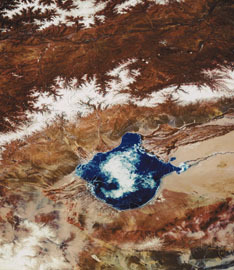
The Uvs Nuur Basin, inscribed as a UNESCO World Heritage Site in 2003, is a vast, biologically diverse region spanning over 1,068,853 hectares. This expansive basin, straddling the borders of Mongolia and Tuva, a republic within the Russian Federation, is a unique microcosm of the Central Asian landscape. Named after the Uvs Nuur Lake, a significant body of water within the basin, this region holds immense ecological, cultural, and historical value.
More to come…UNESCO Description of the World Heritage Site
The Uvs Nuur Basin (1,068,853 ha), is the northernmost of the enclosed basins of Central Asia. It takes its name from Uvs Nuur Lake, a large, shallow and very saline lake, important for migrating birds, waterfowl and seabirds. The site is made up of twelve protected areas representing the major biomes of eastern Eurasia. The steppe ecosystem supports a rich diversity of birds and the desert is home to a number of rare gerbil, jerboas and the marbled polecat. The mountains are an important refuge for the globally endangered snow leopard, mountain sheep (argali) and the Asiatic ibex.
UNESCO Justification of the World Heritage Site
Criterion (ix): The remote and enclosed salt lake system of Uvs Nuur with its high degree of naturalness is of international scientific importance due to its large-scale undisturbed climatic, hydrological and ecological processes and phenomena. Because of the relatively stable past and contemporary pastoral use of the grasslands and the absence of conversion or major human impacts over thousands of years, it constitutes a unique field site for a great variety of subjects, including research into the ongoing development of Uvs Nuur and other smaller lakes within the basin, and the still intact processes of long term lake salinisation and eutrophication. In addition to important past and current research efforts on both sides of the border and in recognition of its unique geophysical and biological characteristics, the Uvs Nuur Basin has also been selected as a field site for the International Geosphere-Biosphere Programme (IGPB), a global effort to monitor and understand global change.
Criterion (x): The serial property conserves the most valuable areas representing the much larger Uvs Nuur Basin, across an enormous range of ecosystems and habitats, including along a major altitudinal gradient. The diversity represents the major biomes of Central Asia with a corresponding floral and faunal diversity. There are important areas of different forest types and highly specialized vegetation in high altitudes, tundra systems and dry land ecosystems, including species and communities adapted to saline conditions. The more than 550 higher plants include relict species and a number of plants endemic to Mongolia and the Tuva Republic, with five species endemic to the lake basin. The various ecosystems support a rich faunal diversity, such as the argali sheep, Siberian ibex, Pallas's cat and the elusive and globally endangered snow leopard. The numerous rodents are of major ecological importance and include two vulnerable jerboa species and gerbil. The many ecological niches are occupied by an impressive density of breeding raptors. The property is also of major importance for waterfowl, as well as a stepping stone in the bird migration between Siberia and wintering ranges in China and South Asia.
Encyclopedia Record: Uvs Lake Basin
Uvs Lake Basin is an endorheic basin located on the territorial border of Mongolia and Tuva, a republic of the Russian Federation. The basin is part of the Central Asian Internal Drainage Basin and is named after Uvs Lake, a large saline lake situated in the western part of its drainage basin, and is one of the last remnants of the mammoth steppes. Uvs Lake is a shallow lake with an area of 3,350 km2 (1,290 sq mi). Its entire basin, which includes several smaller lakes, is 70,000 km2 (27,000 sq mi).Additional Site Details
Area: 898,063.5 hectares
Number of Components: 12
(x) — Contains most important habitats for biodiversity
Coordinates: 50.275 , 92.71972222
IUCN World Heritage Outlook
The 2025 Conservation Outlook on Uvs Nuur Basin reports the following assessment:
Source: International Union for Conservation of Nature (IUCN) · View assessment
Image
Unknown, Public domain
World Heritage Research
Discover scientific research and academic studies that deepen our understanding of Uvs Nuur Basin from its history and significance to its conservation, management, and contemporary challenges.
-
Taxonomic turmoil around the genus Anoplistes Audinet-Serville, 1833 (Coleoptera: Cerambycidae) in the Uvs Nuur Basin: a new species, a new synonym, and a species reinstatement
A groundbreaking taxonomic reassessment of the beetle genus Anoplistes in Mongolia's Uvs Nuur Basin reveals three key discoveries: the reinstatement of Anoplistes minutus as a distinct species, the synonymization of Anoplistes tuvensis, and the description of a previously overlooked species, Anoplistes pseudotuvensis. Using high-resolution scanning electron microscopy, researchers distinguished these taxa based on morphological differences, ecological preferences, and host plant associations. This work resolves long-standing taxonomic confusion in the genus, providing a foundation for future integrative studies combining morphology, ecology, and molecular data.
KARPIŃSKI, L. (2026). Taxonomic turmoil around the genus Anoplistes Audinet-Serville, 1833 (Coleoptera: Cerambycidae) in the Uvs Nuur Basin: a new species, a new synonym, and a species reinstatement. Zootaxa, 5759(1), 64–74. https://doi.org/10.11646/zootaxa.5759.1.4
View Publication Record | Read Publication -
New Data on Molluscan Fauna of the Ubsunur Hollow Reserve (the Republic of Tyva, Russia)
A significant discovery of the bivalve species Odhneripisidium stewarti (Preston, 1909) within the Ubsunur Hollow Reserve, a UNESCO World Heritage Site in the Republic of Tuva, Russia, marks its first recorded presence in both Russia and Mongolia. This finding expands the known molluscan fauna of the region, contributing valuable data to biodiversity studies. The research likely involved field surveys and taxonomic analysis, though specific methods are not detailed in the abstract.
Sharyi-ool, M.О. (2023). NEW DATA ON MOLLUSCAN FAUNA OF THE UBSUNUR HOLLOW RESERVE (THE REPUBLIC OF TYVA, RUSSIA). Vladimir Ya. Levanidov’s Biennial Memorial Meetings, 10, 280–283. https://doi.org/10.25221/levanidov.10.24
View Publication Record | Read Publication -
The Properties of Agriculture-Related Objects in Arid Regions in Northwest Mongolia and the Tyva Border Areas
Research in the Uvs Nuur Basin, Northwest Mongolia, reveals evidence of a previously unrecognized ancient agricultural civilization thriving in arid regions. Contrary to prior assumptions, the study identifies extensive irrigation systems, settlement traces, and distinct agricultural landscapes, suggesting significant anthropogenic impact on the environment. Using satellite imagery analysis, landscape observations, archaeological, geological, and historical methods, along with paleogeographic assessments, the research highlights wheat caryopses in peat soils, indicating past agricultural activity. The findings underscore the need for further investigation into the region's ancient history and environmental transformation, particularly regarding deforestation, overgrazing, and landscape desertification.
Prudnikova, T. N. (2022). The Properties of Agriculture-Related Objects in Arid Regions in Northwest Mongolia and the Tyva Border Areas. Arid Ecosystems, 12(4), 462–472. https://doi.org/10.1134/s2079096122040175
View Publication Record | Read Publication -
Soil conditions and vegetation cover of the «Oruku-Shynaa» cluster of the «Ubsunurskaya Hollow» reserve (southern part of the Republic of Tyva)
A study of the Oruku-Shynaa cluster within the Ubsunur Hollow Biosphere Reserve reveals significant insights into soil dynamics and vegetation cover, crucial for its potential UNESCO World Heritage Site status. The research highlights complex soil interactions, including neutral meadow-peaty soils with high humus content (9.24%) and strongly alkaline solonchak soils with negligible humus (0.42%). Saline soils exhibit high magnesium levels (up to 29 mmol/100 g), while nitrogen is abundant in meadow-peat-humus soils (1.10%), though phosphorus remains scarce across all soil types. The cluster's vegetation cover, a mix of glycophytic, halophytic, and woody shrub communities, reflects arid Central Asian floodplain-channel dynamics. Long-term environmental monitoring under protected conditions shows signs of waterlogging, peat accumulation, increased dead plant mass, and active soil salinization. These findings underscore the cluster's ecological significance and the need for sustained conservation efforts.
Kurbatskaya, S. S., Samdan, A. M., & Oorzhak, C. O.-o. (2022). Soil conditions and vegetation cover of the «Oruku-Shynaa» cluster of the «Ubsunurskaya Hollow» reserve (southern part of the Republic of Tyva). Samara Journal of Science, 11(4), 57–63. https://doi.org/10.55355/snv2022114108
View Publication Record | Read Publication -
The link between climate change and biodiversity of lacustrine inhabitants and terrestrial plant communities of the Uvs Nuur Basin (Mongolia) during the last three millennia
A three-millennia reconstruction of biodiversity and climate in the Uvs Nuur Basin (Mongolia) reveals that the region's plant, chironomid, and Cladocera communities responded strongly to shifts in precipitation and temperature. The study found that the most humid period occurred between 1400–1800 CE during the Little Ice Age, with higher biodiversity, while the Medieval Warm Period (650–1350 CE) was marked by aridity and lower diversity. Unlike other taxa, diatoms showed no direct correlation with climate factors. The research also found that dung fungi in lake sediments did not align with historical human presence or climate changes, suggesting their potential use in assessing herbivore density. This work highlights the vulnerability of high-biodiversity regions to climate change and provides a baseline for understanding long-term ecological dynamics.
Rudaya, N., Nazarova, L., Frolova, L., Palagushkina, O., Soenov, V., Cao, X., Syrykh, L., Grekov, I., Otgonbayar, D., & Bayarkhuu, B. (2021). The link between climate change and biodiversity of lacustrine inhabitants and terrestrial plant communities of the Uvs Nuur Basin (Mongolia) during the last three millennia. The Holocene, 31(9), 1443–1458. https://doi.org/10.1177/09596836211019093
View Publication Record | Read Publication -
Gobi Altai, Khangai and Khentii Mountains mapped by a mixed-method cartographic approach for comparative geophysical analysis
A novel mixed-method cartographic approach reveals strong correlations between gravity anomalies, topography, geological units, and geomorphological landforms across Mongolia's Gobi Altai, Khangai, and Khentii Mountains. The study identified distinct gravity anomaly patterns: the highest values (<80 mGal) correspond to the Altai and Khangai Mountain ranges, while negative values (<-80 mGal) dominate the Uvs Nuur and Khyargas Nuur basins. NE- to NNE-oriented faulting and rift basins were clearly visible in geophysical grids and geological maps. The methodology integrated high-resolution datasets (GEBCO, gravity raster, USGS geological data, SRTM-90 DEM) with tools like GMT, R programming ('raster' and 'tmap' libraries), and QGIS to produce nine new maps. This approach advances cartographic methods for regional geological studies in Mongolia.
Lemenkova, P. (2021). Gobi Altai, Khangai and Khentii Mountains mapped by a mixed-method cartographic approach for comparative geophysical analysis. Mongolian Geoscientist, 26(52), 62–79. https://doi.org/10.5564/mgs.v26i52.1512
View Publication Record | Read Publication -
The vegetation cover of the «Aryskannyg» cluster of the «Ubsunurskaya Kotlovina» Reserve (Ubsunur hollow) (the southern slopes of the East Tannu-Ola Mountain Range, Republic of Tyva)
A complex vegetation cover, shaped by mountain relief and sharply continental climate, characterizes the Aryskannyg cluster within the Ubsunurskaya Kotlovina Reserve. The study reveals a diverse range of plant communities, from dry-steppe to mountain-tundra, influenced by slope exposure and terrain height. Key findings include the identification of unique steppe coenoses such as resurrection (Selaginella sanguinolenta) and eastern feather grass (Stipa orientalis), alongside high-altitude forest-steppes dominated by larch and Daurian rhododendron. The research employed ecological profiling, phytocoenotic mapping, and large-scale vegetation surveys to elucidate these patterns. This diversity underscores the region's ecological significance, shaped by latitudinal and local abiotic factors.
Samdan, A. M. (2021). The vegetation cover of the «Aryskannyg» cluster of the «Ubsunurskaya Kotlovina» Reserve (Ubsunur hollow) (the southern slopes of the East Tannu-Ola Mountain Range, Republic of Tyva). Samara Journal of Science, 10(2), 78–85. https://doi.org/10.17816/snv2021102111
View Publication Record | Read Publication