World Heritage Identification Number: 1081
World Heritage since: 2004
Category: Cultural Heritage
WHE Type: Cultural Landscapes
Transboundary Heritage: No
Endangered Heritage: No
Country: 🇲🇳 Mongolia
Continent: Asia
UNESCO World Region: Asia and the Pacific
Map
Exploring the Orkhon Valley Cultural Landscape: A Journey Through Time and Space
The Orkhon Valley Cultural Landscape, situated in Central Mongolia, offers a unique blend of natural beauty and historical significance that makes it a must-visit destination for travelers seeking an immersive cultural experience. This expansive region, covering approximately 121,967 hectares, has been recognized by UNESCO as a World Heritage Site since 2004, owing to its rich archaeological remains dating back to the 6th century.
More to come…UNESCO Description of the World Heritage Site
The 121,967-ha Orkhon Valley Cultural Landscape encompasses an extensive area of pastureland on both banks of the Orkhon River and includes numerous archaeological remains dating back to the 6th century. The site also includes Kharkhorum, the 13th- and 14th-century capital of Chingis (Genghis) Khan’s vast Empire. Collectively the remains in the site reflect the symbiotic links between nomadic, pastoral societies and their administrative and religious centres, and the importance of the Orkhon valley in the history of central Asia. The grassland is still grazed by Mongolian nomadic pastoralists.
UNESCO Justification of the World Heritage Site
Criterion (ii): The Orkhon Valley clearly demonstrates how a strong and persistent nomadic culture, led to the development of extensive trade networks and the creation of large administrative, commercial, military and religious centers. The empires that these urban centers supported undoubtedly influenced societies across Asia and into Europe and in turn absorbed influence from both east and west in a true interchange of human values.
Criterion (iii): Underpinning all the development within the Orkhon valley for the past two millennia has been a strong culture of nomadic pastoralism. This culture is still a revered and indeed central part of Mongolian society and is highly respected as a ‘noble’ way to live in harmony with the landscape.
Criterion (iv): The Orkhon Valley is an outstanding example of a valley that illustrates several significant stages in human history. First and foremost it was the centre of the Mongolian Empire; secondly it reflects a particular Mongolian variation of Turkish power; thirdly, the Erdene Zuu monastery and the Tuvkhun hermitage monastery were the setting for the development of a Mongolian form of Buddhism; and fourthly, Khar Balgas, reflects the Uighur urban culture in the capital of the Uighur Empire.
Encyclopedia Record: Orkhon Valley
The Orkhon Valley Cultural Landscape sprawls along the banks of the Orkhon River in Central Mongolia, some 320 km west from the capital Ulaanbaatar. It was inscribed by UNESCO in the World Heritage List as representing the development of nomadic pastoral traditions spanning more than two millennia.Additional Site Details
Area: 121,967 hectares
Number of Components: 1
(iii) — Unique or exceptional testimony to a cultural tradition
(iv) — Outstanding example of a type of building or landscape
Coordinates: 47.479214 , 102.678482
Image
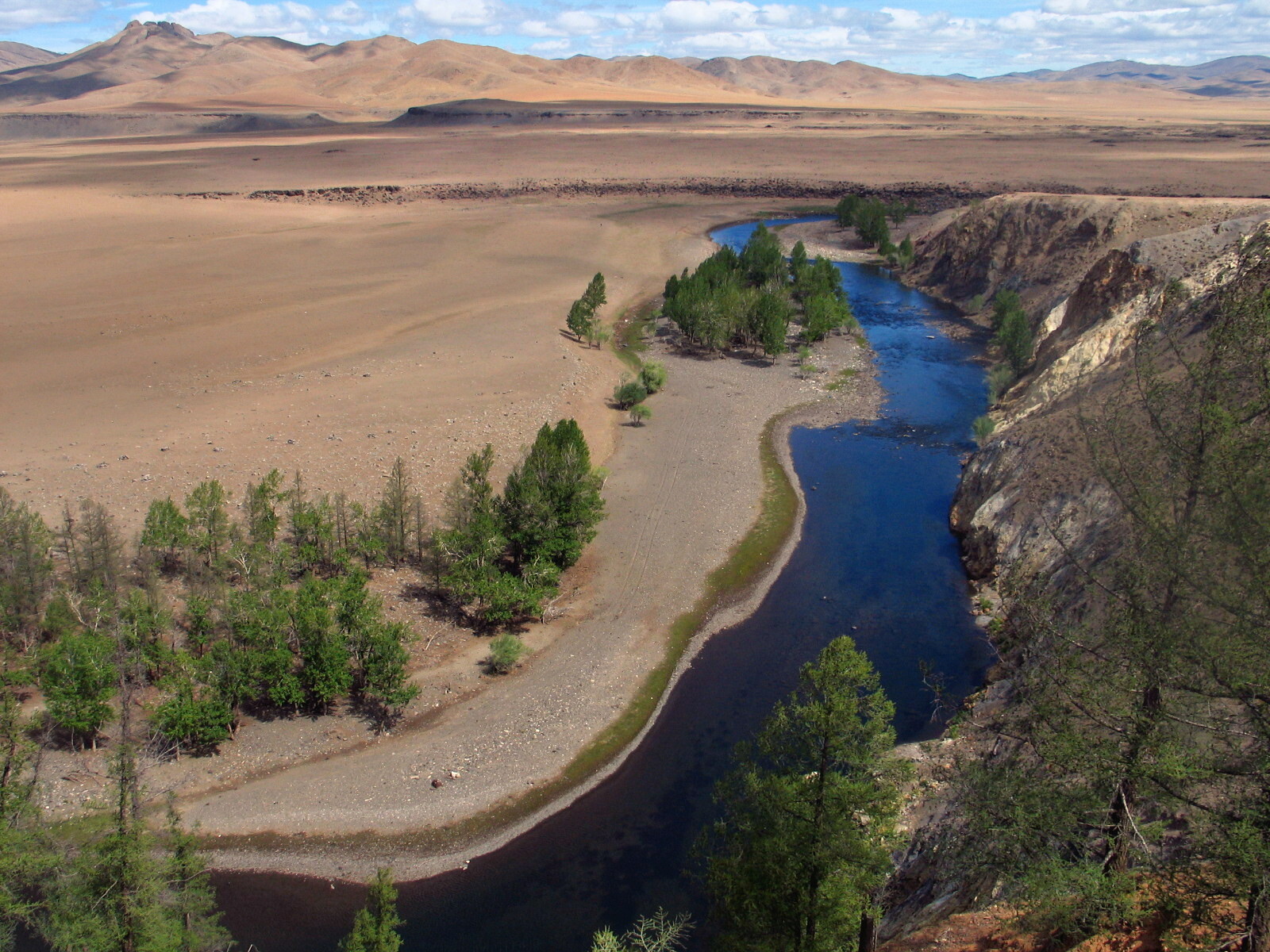
© He-ba-mue, CC BY-SA 2.5 Resized from original. (This derivative is under the same CC BY-SA license.)
World Heritage Research
Discover scientific research and academic studies that deepen our understanding of Orkhon Valley Cultural Landscape from its history and significance to its conservation, management, and contemporary challenges.
-
Buddhist monuments in the Orkhon-Tuul region
Archaeological and historical evidence reveals the Orkhon-Tuul region as a pivotal center of cultural, economic, and religious exchange from the 8th to 17th centuries, where successive ethnic groups—Uyghurs, Khidans, and Mongols—interacted, shaping Mongolia's cultural landscape. The study highlights the evolution of Buddhism in the region, transitioning from a minor influence during the Uyghur Kaganate to dominance by the 17th century, alongside the development of urbanization and legal systems. Fortification structures, administrative complexes, and religious sites—such as Ordubalyk (Khar Balgas), Khar Bukhyn Balgas, and Chin Tolgoi—demonstrate the layered impact of these groups on the landscape. By integrating written sources with archaeological findings, the research deepens understanding of ethno-confessional dynamics in central Mongolia.
Ignatova, M. M., & Kitinov, B. U. (2025). Buddhist monuments in the Orkhon-Tuul region. RUDN Journal of World History, 17(4), 551–565. https://doi.org/10.22363/2312-8127-2025-17-4-551-565
View Publication Record | Read Publication -
Late Pleistocene Paleoenvironments and Episodic Human Occupations in the Orkhon Valley of Central Mongolia
A new study of the Orkhon Valley, a UNESCO World Heritage Site in central Mongolia, reveals that human occupation during the Late Pleistocene was closely tied to shifting paleoenvironmental conditions. Research at Moiltyn-am and other Paleolithic sites indicates that a relatively humid climate prevailed during Marine Isotope Stage 3 (MIS-3), followed by aridification and sediment redeposition. Faunal analysis suggests that humans primarily hunted Bos sp. and equids, with Caprinae becoming more significant in the Early Upper Paleolithic. The study uses rare earth elements, Strontium isotopes, and faunal assemblages to reconstruct past climates and human adaptations, providing insights into the complex interactions between early human societies and their environments.
Khatsenovich, A. M., Vishnevskaya, I. A., Bazargur, D., Volvakh, A. O., Klementiev, A. M., Ge, J., Zhilich, S. V., Marchenko, D. V., Okuneva, T. G., Kogai, S. A., Gunchinsuren, B., Rybin, E. P., Olsen, J. W., & Derevianko, A. P. (2021). Late Pleistocene Paleoenvironments and Episodic Human Occupations in the Orkhon Valley of Central Mongolia. Archaeology, Ethnology & Anthropology of Eurasia, 49(2), 3–22. https://doi.org/10.17746/1563-0110.2021.49.2.003-022
View Publication Record | Read Publication -
Environmental protection and Tourism
Sustainable tourism development in Mongolia's Orkhon Valley National Park (OVNP) presents both opportunities and challenges for balancing local livelihoods, nomadic culture preservation, and environmental protection. The study highlights that OVNP, a key destination for its natural beauty, biodiversity, and historical heritage, requires strategic approaches to mitigate the impacts of growing tourism while supporting traditional lifestyles. Research focuses on integrating conservation efforts with tourism planning to safeguard watersheds, rare species, and cultural sites. The approach involves analyzing the park's ecological and socio-cultural significance, assessing current tourism trends, and proposing sustainable management strategies. This work underscores the need for policies that harmonize economic benefits with environmental stewardship in protected areas.
Tugjamba, N., & Gantumur, A. (2020). Environmental protection and Tourism. Destination Management and Marketing, 910–926. https://doi.org/10.4018/978-1-7998-2469-5.ch050
View Publication Record | Read Publication -
Luminescence Dating of an Ancient Walled Settlement in Orkhon Valley, Mongolia
A new chronology for an ancient walled settlement in the Orkhon Valley, Mongolia, suggests construction around 785±80 AD, challenging earlier archaeological estimates of 906–1125 AD. Researchers used optically stimulated luminescence (OSL) dating on quartz samples, applying the post-IR OSL method to small aliquots as proxies for single-grain measurements. Statistical analysis revealed a dose distribution with a central age model (CAM) De of 5.14±0.10 Gy and over dispersion of 47.5%, while the minimum age model (MAM) De was 3.7±0.6 Gy. The fast quartz post-IR OSL component, free from suspected partial bleaching, supported the earlier construction date. However, the MAM age aligns with independent evidence for reconstruction or reuse of the settlement around 1090±80 AD. This study demonstrates the potential of luminescence dating for young samples in cultural landscapes and refines our understanding of the Orkhon Valley's historical timeline.
S, T., S, S., L, M., & J, B. (2018). LUMINESCENCE DATING OF AN ANCIENT WALLED SETTLEMENT IN ORKHON VALLEY, MONGOLIA. Proceedings of the Mongolian Academy of Sciences, 4–14. https://doi.org/10.5564/pmas.v57i4.918
View Publication Record | Read Publication