World Heritage Identification Number: 1440
World Heritage since: 2015
Category: Cultural Heritage
WHE Type: Religious Sites & Sacred Architecture
Transboundary Heritage: No
Endangered Heritage: No
Country: 🇲🇳 Mongolia
Continent: Asia
UNESCO World Region: Asia and the Pacific
Map
The Great Burkhan Khaldun Mountain and Its Surrounding Sacred Landscape
The Great Burkhan Khaldun Mountain, located in the northeastern region of Mongolia, stands as a significant cultural and historical landmark. Inscribed as a UNESCO World Heritage Site in 2015, this sacred mountain range is deeply intertwined with the spiritual beliefs, traditions, and history of the Mongolian people.
More to come…UNESCO Description of the World Heritage Site
The site is situated in the north-east of the country in the central part of the Khentii mountain chain where the vast Central Asian steppe meets the coniferous forests of the Siberian taiga. Burkhan Khaldun is associated with the worship of sacred mountains, rivers and ovoo-s (shamanic rock cairns), in which ceremonies have been shaped by a fusion of ancient shamanic and Buddhist practices. The site is also believed to be the place of Genghis Khan’s birth and burial. It testifies to his efforts to establish mountain worship as an important part of the unification of the Mongol people.
UNESCO Justification of the World Heritage Site
Criterion (iv): Burkhan Khaldun Sacred Mountain reflects the formalisation of mountain worship by Chinggis Khan, a key factor in his success in unifying the Mongol peoples during the creation of the Mongolian Empire, an event of vital historical significance for Asian and world history.
Criterion (vi): The Burkhan Khaldun Sacred Mountain is directly and tangibly associated with The Secret History of the Mongols, an historical and literary epic recognised as of world importance in its entry in the Memory of the World Register. The Secret History records the links between the mountain and Chinggis Khan, his formal recognition of mountain worship, and the formal status of Burkhan Khaldun as one of four sacred mountains designated during his lifetime.
Encyclopedia Record: Burkhan Khaldun
The Burkhan Khaldun is one of the Khentii Mountains in the Khentii Province of northeastern Mongolia. The mountain or its locality is believed to be the birthplace of Genghis Khan as well as his tomb. It is also the birthplace of one of his most successful generals, Subutai.Additional Site Details
Area: 443,739.2 hectares
Number of Components: 1
(vi) — Directly associated with events or living traditions
Coordinates: 48.7619777778 , 109.0093277778
Image
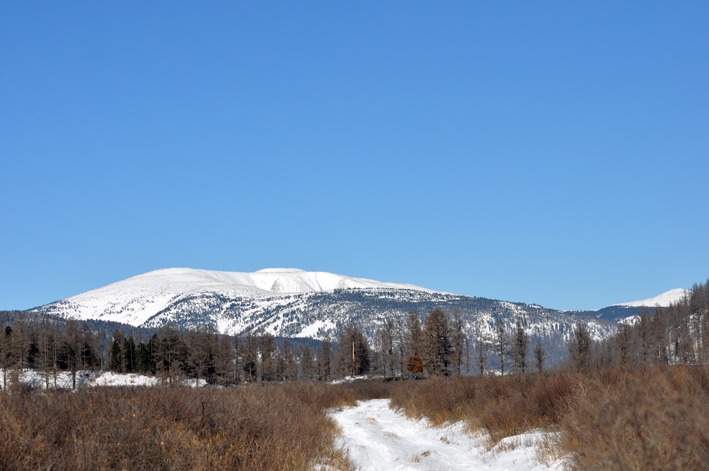
© Ganzorig Gavaa, CC BY-SA 2.0 Resized from original. (This derivative is under the same CC BY-SA license.)
World Heritage Research
Discover scientific research and academic studies that deepen our understanding of Great Burkhan Khaldun Mountain and its surrounding sacred landscape from its history and significance to its conservation, management, and contemporary challenges.
-
What the Bricks Tell Us from a Temple at Burkhan Khaldun Mountains: Chronological Insights from pIRIR Luminescence
A groundbreaking study leverages post-IR infrared luminescence (pIRIR) to date bricks from the Buddhist temple ruins at Burkhan Khaldun Mountains, Mongolia, revealing their manufacturing period between 1230±50 AD and 1280±40 AD. This aligns with the era of extensive construction in Karakorum, offering chronological insights into the region's architectural history. The research applied both coarse and polymineral fine grain techniques to feldspar, distinguishing it from previous methods. Additionally, the study compared mineralogical compositions of bricks from various temple sites, including those in Karakorum and Erdene Zuu, enhancing our understanding of historical brick production and trade.
S, S., S, T., & B, T. (2017). WHAT THE BRICKS TELL US FROM A TEMPLE AT BURKHAN KHALDUN MOUNTAINS: CHRONOLOGICAL INSIGHTS FROM pIRIR LUMINESCENCE. Proceedings of the Mongolian Academy of Sciences, 4–12. https://doi.org/10.5564/pmas.v56i4.837
View Publication Record | Read Publication