World Heritage Identification Number: 1759
World Heritage since: 2026
Category: Cultural Heritage
WHE Type: Archaeological Sites
Transboundary Heritage: No
Endangered Heritage: No
Country: 🇲🇳 Mongolia
Continent: Asia
UNESCO World Region: Asia and the Pacific
Map
The Cemetery Complexes of the Xiongnu Nobility: Insights into Ancient Nomadic Culture
The Cemetery Complexes of the Xiongnu Nobility, inscribed as a UNESCO World Heritage Site in 2026, offer a unique glimpse into the lives and culture of one of history's most enigmatic nomadic empires. Stretching across the expansive Eurasian steppe, the Xiongnu Empire thrived from the 3rd century BCE to the 2nd century CE, its influence reaching far beyond its territorial boundaries.
More to come…UNESCO Description of the World Heritage Site
This serial property comprises eight funerary complexes of the Xiongnu nobility. The Xiongnu, ancient predecessors of a confederation of Eurasian nomadic peoples, established a powerful empire between the 3rd century BCE and the 2nd century CE that eventually occupied a vast territory centred on what is now Mongolia. They interacted with the Han Chinese and controlled nodes along the main parts of the Steppe Route of the Silk Roads. Among the numerous archaeological remains found across the former expanse of the empire, their cemeteries provide important insights into Xiongnu burial culture. The main burials, notable for their substantial size and depth, are accompanied by satellite graves marked by small ring-shaped mounds, as well as sacrificial structures consisting of alignments of paired stones. A wide range of artefacts found in the tombs, including horse tack and chariots as well as weapons, tools and food for the afterlife, provides a window into the Xiongnu way of life and social structure. The tombs of the Xiongnu nobility highlight the engineering and organisational skills of this predominantly nomadic culture.Encyclopedia Record: Xiongnu
The Xiongnu were a tribal confederation of nomadic peoples who, according to ancient Chinese sources, inhabited the eastern Eurasian Steppe from the 3rd century BC to the late 1st century AD. Modu Chanyu, the supreme leader after 209 BC, founded the Xiongnu Empire.Additional Site Details
Area: 3,409 hectares
Number of Components: 8
Coordinates: 48.3270833334 , 101.914833333
Image
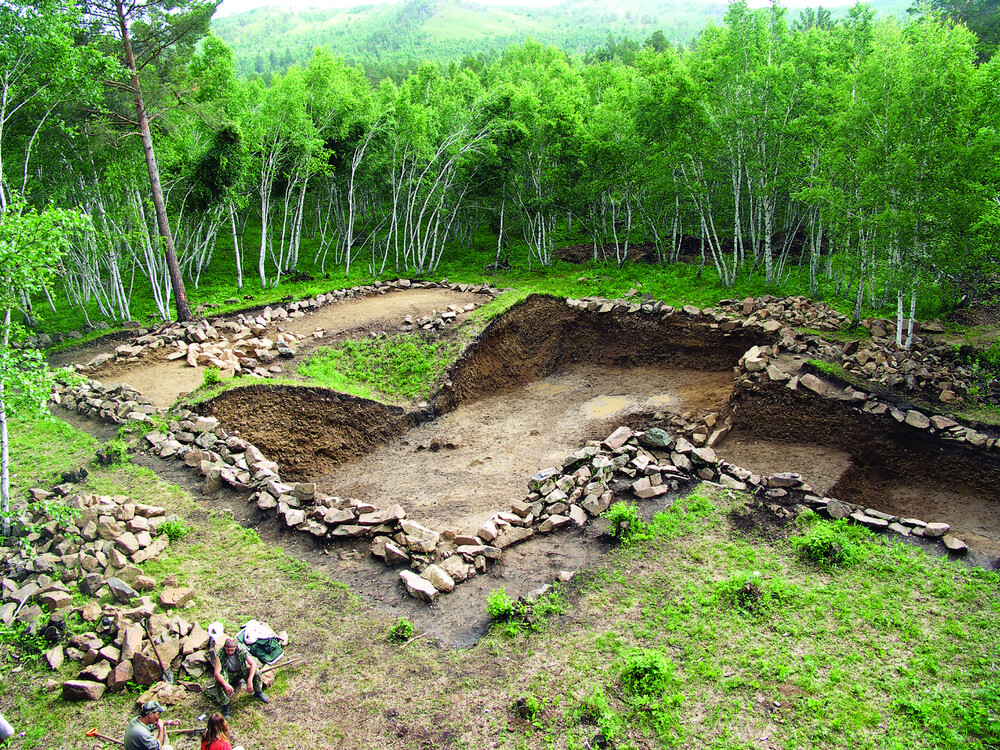
© N.Erdene-Ochir. Used with permission.