World Heritage Identification Number: 1736
World Heritage since: 2025
Category: Cultural Heritage
WHE Type: Archaeological Sites
Transboundary Heritage: No
Endangered Heritage: No
Country: 🇨🇳 China
Continent: Asia
UNESCO World Region: Asia and the Pacific
Map
Xixia Imperial Tombs: A Legacy of Multicultural Civilization Along the Silk Road
The Xixia Imperial Tombs, inscribed as a UNESCO World Heritage Site in 2025, offer a unique glimpse into the rich history and cultural diversity of the Xixia Dynasty. Situated in the foothills of the southern Helan Mountains in Ningxia, these tombs serve as the imperial cemetery of the Xixia Dynasty, founded by the Tanguts in 1038 and lasting until its destruction by Genghis Khan’s Mongol army in 1227.
More to come…UNESCO Description of the World Heritage Site
Located in the foothills of the southern Helan Mountains in Ningxia, this necropolis is the imperial cemetery of the Xixia Dynasty. It includes nine imperial mausoleums, 271 subordinate tombs, a northern architectural complex, and 32 flood control structures. Founded by the Tanguts in 1038, the Xixia Dynasty lasted until its destruction by Genghis Khan’s Mongol army in 1227. Positioned along the Silk Road, it became a multicultural civilization modelled on Chinese imperial traditions, with Buddhism at its core. The property reflects the dynasty’s religious and socio-political legacy.
UNESCO Justification of the World Heritage Site
Criterion (ii): The Xixia Imperial Tombs bear witness to cultural and religious influences from multiple sources, ranging from the traditions of the Song and Tang dynasties to the beliefs and funerary customs of the Tanguts, where adherence to Buddhism dominated and ancestral traditions persisted. These characteristics are fully reflected in the spatial organisation, design and architecture of the Xixia funerary complex.
Criterion (iii): The Xixia Imperial Tombs illustrate the spiritual and cultural originality of the Xixia Dynasty and the Tangut people. This civilisation developed for nearly 200 years in contact with the Silk Road through cultural and commercial exchange in north-west China, from the 11th to the 13th century.
Encyclopedia Record: Western Xia mausoleums
The Western Xia mausoleums occupy an area of some 50 km2 (19 sq mi) at the foot of the Helan Mountains in the Ningxia Hui Autonomous Region of northwestern China, and include nine imperial mausoleums and 250 tombs of imperial relatives and officials of China's Western Xia dynasty. This burial complex lies some 40 km (25 mi) westward from capital city of the Western Xia, the Xingqing fu or Xingqing, what is modern-day Yinchuan, capital of the Ningxia Hui Autonomous Region.Additional Site Details
Area: 3,899 hectares
Number of Components: 1
(iii) — Unique or exceptional testimony to a cultural tradition
Coordinates: 38.4158333333 , 105.9711111111
Image
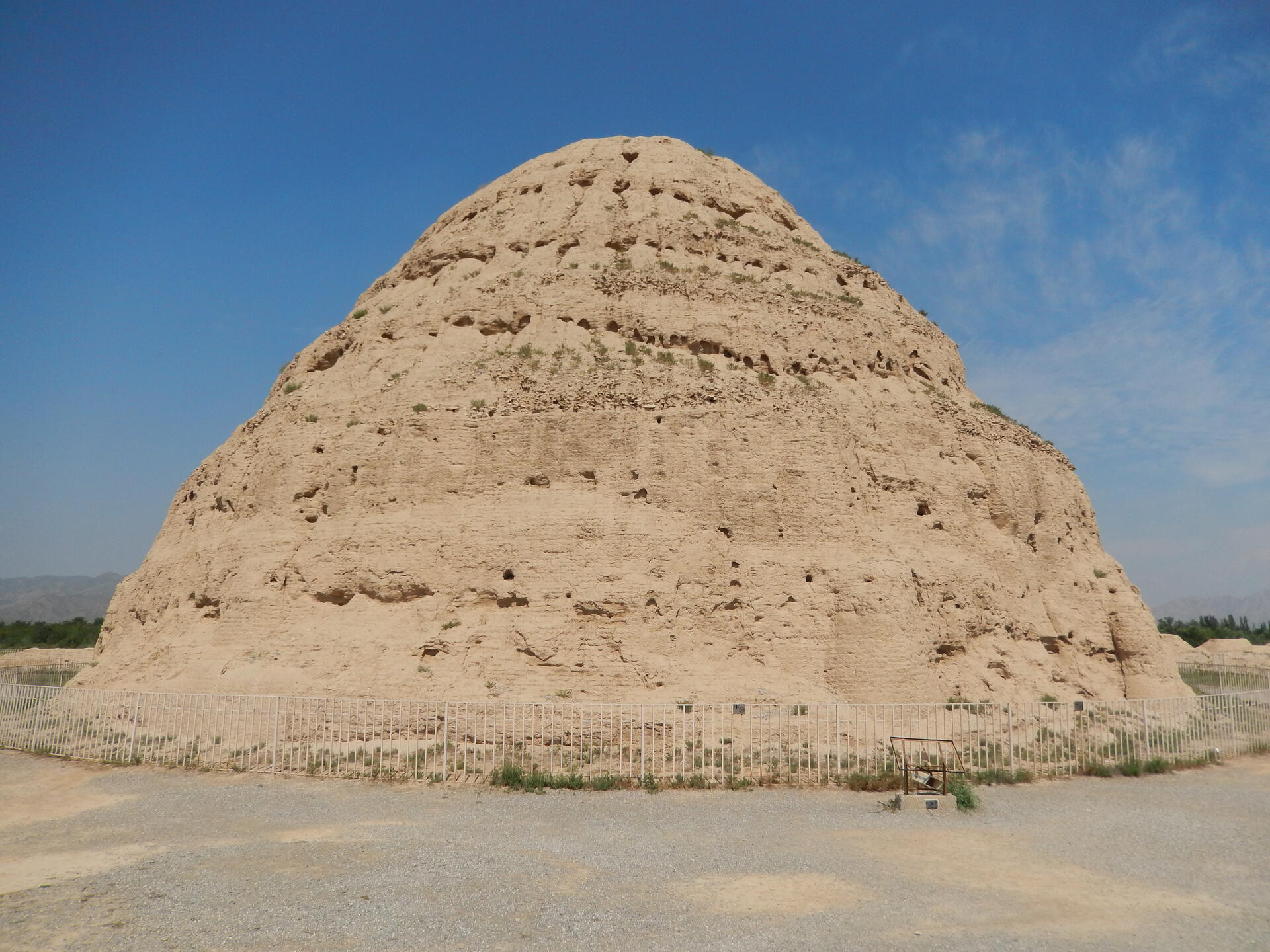
© BabelStone, CC BY-SA 3.0 Resized from original. (This derivative is under the same CC BY-SA license.)
World Heritage Research
Discover scientific research and academic studies that deepen our understanding of Xixia Imperial Tombs from its history and significance to its conservation, management, and contemporary challenges.
-
Cultural Heritage Protection and Flood Hazard Control in Arid Areas: A Case Study of Xixia Imperial Tombs in China
A critical misconception about arid regions being flood-free is challenged by new research, which reveals that climate change-driven extreme precipitation events pose significant and underestimated risks to cultural heritage sites like China's Xixia Imperial Tombs. The study demonstrates that proactive, preventive conservation—integrating engineering solutions with technology-based monitoring systems—is essential for long-term protection against compound hazards of drought, desertification, and sudden flooding. By analyzing the site’s geographical characteristics, traditional flood management structures, and contemporary practices, the research provides a transferable framework for heritage risk management in similar arid environments worldwide.
Zhang, R., & Kwon, C. (2026). Cultural Heritage Protection and Flood Hazard Control in Arid Areas: A Case Study of Xixia Imperial Tombs in China. Heritage, 9(5), 168. https://doi.org/10.3390/heritage9050168
View Publication Record | Read Publication -
Remote Sensing Archaeology of the Xixia Imperial Tombs: Analyzing Burial Landscapes and Geomantic Layouts
A suspected true location for the ninth imperial tomb (M9) of the Xixia Imperial Tombs has been identified using declassified GAMBIT imagery, significantly advancing understanding of Tangut burial practices and geomantic layouts. This discovery was achieved through an integrated remote sensing approach combining multi-resolution satellite data—including Gaofen-2 (GF-2), Landsat-8 OLI, and Google Earth—with deep learning techniques like YOLOv5 for automated feature detection. The study also applied spectral indices and image fusion to enhance archaeological feature visibility, demonstrating the effectiveness of this methodology for site preservation and analysis. By providing a replicable framework for heritage studies, the research underscores the potential of advanced remote sensing and machine learning in uncovering and safeguarding cultural landscapes.
Ji, W., Li, L., Yang, J., Hao, Y., & Luo, L. (2025). Remote Sensing Archaeology of the Xixia Imperial Tombs: Analyzing Burial Landscapes and Geomantic Layouts. Remote Sensing, 17(14), 2395. https://doi.org/10.3390/rs17142395
View Publication Record | Read Publication -
Muon Detection Technology and Its Application in the Archeology of XiXia Imperial Tombs
Muon imaging technology has been successfully applied for the first time to detect internal density anomalies within the No. 2 Mausoleum of the XiXia Imperial Tombs. This non-destructive method leverages cosmic ray muons to identify structural details crucial for preservation efforts. The study introduces optimized observation parameters and inversion techniques, including a density-length product calculation based on muon survival rates, addressing gaps in muon detection research. These advancements enhance the efficiency and accuracy of muon imaging, providing key data for archaeological analysis and conservation strategies.
Zhou, S., Yu, Z., Zeng, Z., Zhao, J., Zeng, X., An, B., & Ren, X. (2025). Muon Detection Technology and Its Application in the Archeology of XiXia Imperial Tombs. Applied Sciences, 15(16), 8941. https://doi.org/10.3390/app15168941
View Publication Record | Read Publication -
Cultural Translation Strategies of the Western Xia Tombs from the Perspective of World Heritage: From the Protection of Earthly Sites to the Construction of a Digital Cultural Tourism Ecosystem
Contemporary cultural heritage protection must pivot on technology, utilize scenes as carriers, and co-create value to establish a dynamically balanced digital cultural tourism ecosystem. This study proposes a 'cultural translation' framework for the Western Xia Mausoleum, demonstrating how three-dimensional collaboration—material heritage protection, digital technology empowerment, and cultural value reconstruction—can transform earthen sites from mere preservation to dynamic revitalization. The research confirms that such an approach holds significant global relevance for the protection and revitalization of similar cultural heritage sites, offering a replicable digital solution for their sustainable development.
Xu, T., & Sun, K. (2025). Cultural Translation Strategies of the Western Xia Tombs from the Perspective of World Heritage: From the Protection of Earthly Sites to the Construction of a Digital Cultural Tourism Ecosystem. Advances in Humanities and Modern Education Research, 3(1), 144. https://doi.org/10.70114/ahmer.2025.3.1.p144
View Publication Record | Read Publication -
Climate-adaptive prediction of wind erosion risks for earthen heritage under multi-scenario futures
A novel framework integrating centimeter-scale LiDAR modeling, high-resolution CFD simulations, and CMIP6 climate data predicts nonlinear wind erosion risks for earthen heritage sites under multiple future scenarios. Applied to the Xixia Imperial Tombs, this approach reveals that moderate climate forcing (SSP2–4.5) poses higher long-term degradation risk than extreme scenarios (SSP5–8.5), with significant interannual variability and uncertainty ranges. The study advances predictive modeling of climate-driven hazards in arid regions, offering critical insights for resilient conservation strategies under UNESCO’s climate action framework.
Wang, Q., Xiao, J., Dang, A., Xu, X., Huang, J., & Zhang, R. (2026). Climate-adaptive prediction of wind erosion risks for earthen heritage under multi-scenario futures. Climate Risk Management, 51, 100763. https://doi.org/10.1016/j.crm.2025.100763
View Publication Record | Read Publication -
Singularités architecturales du cimetière impérial des Xixia : le monument funéraire
The Xixia imperial necropolis, located against the Helan Mountains near Yinchuan, China, presents unique architectural features distinct from traditional Chinese and neighboring states' funerary practices. Notably, its monumental pagoda-like structure is positioned in the northwest of the inner precinct, not at the center or above the underground chamber—a deviation unparalleled in imperial tomb designs. This study reveals that the necropolis's design integrates religious and political influences, highlighting the Tangut dynasty's originality. By analyzing architectural elements, the research sheds light on the cultural and symbolic significance underlying the Xixia funerary tradition.
Zhang-Goldberg, D. (2012). Singularités architecturales du cimetière impérial des Xixia : le monument funéraire. Arts Asiatiques, 67(1), 47–62. https://doi.org/10.3406/arasi.2012.1773
View Publication Record | Read Publication