World Heritage Identification Number: 812
World Heritage since: 1997
Category: Cultural Heritage
WHE Type: Archaeological Sites
Transboundary Heritage: No
Endangered Heritage: No
Country: 🇨🇳 China
Continent: Asia
UNESCO World Region: Asia and the Pacific
Map
The Ancient City of Ping Yao: A Well-Preserved Example of Traditional Han Chinese Urban Planning
The Ancient City of Ping Yao, located in central Shanxi, China, stands as an exceptional testament to the evolution of architectural styles and town planning in Imperial China over five centuries. This historic city, inscribed as a UNESCO World Heritage Site in 1997, offers a unique glimpse into the rich cultural heritage of China.
More to come…UNESCO Description of the World Heritage Site
Ping Yao is an exceptionally well-preserved example of a traditional Han Chinese city, founded in the 14th century. Its urban fabric shows the evolution of architectural styles and town planning in Imperial China over five centuries. Of special interest are the imposing buildings associated with banking, for which Ping Yao was the major centre for the whole of China in the 19th and early 20th centuries.
UNESCO Justification of the World Heritage Site
Criterion (ii): The townscape of Ancient City of Ping Yao excellently reflects the evolution of architectural styles and town planning in Imperial China over five centuries with contributions from different ethnicities and other parts of China.
Criterion (iii): The Ancient City of Ping Yao was a financial center in China from the 19th century to the early 20th century. The business shops and traditional dwellings in the city are historical witnesses to the economic prosperity of the Ancient City of Ping Yao in this period.
Criterion (iv): The Ancient City of Ping Yao is an outstanding example of the Han Chinese city of the Ming and Qing Dynasties (14th-20th centuries) that has retained all its features to an exceptional degree.
Encyclopedia Record: Pingyao
Pingyao, officially Pingyao Ancient City, is a walled city in central Shanxi, China, famed for its importance in Chinese economic history and for its well-preserved Ming and Qing urban planning and architecture. It is the only walled city seat in China to survive with its Ming–Qing layout substantially complete. Administratively, it comprises the town of Gutao in Pingyao County, Jinzhong.Additional Site Details
Area: 245.62 hectares
Number of Components: 3
(iii) — Unique or exceptional testimony to a cultural tradition
(iv) — Outstanding example of a type of building or landscape
Coordinates: 37.20139 , 112.15444
Image
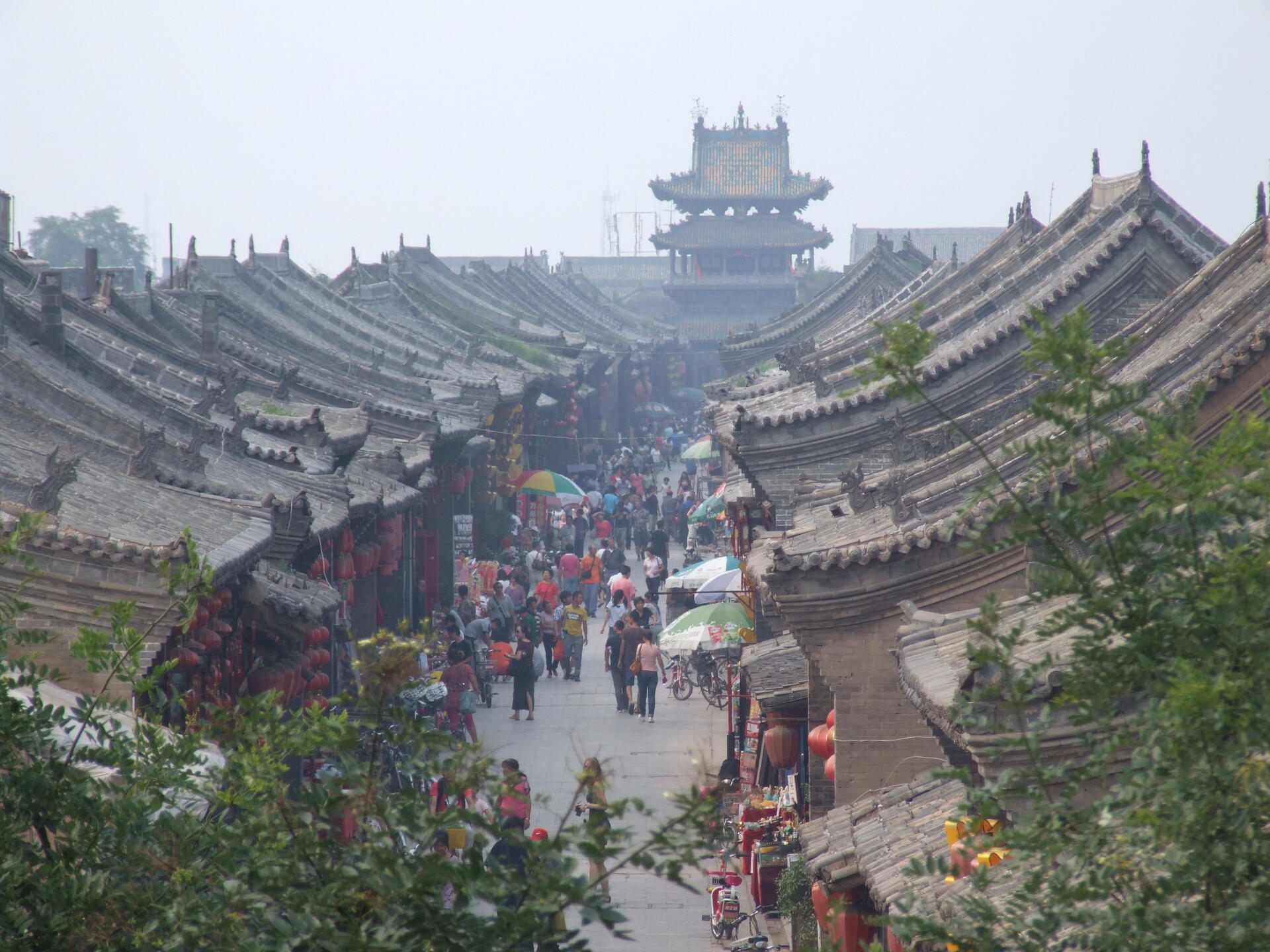
© Nicor, CC BY-SA 3.0 Resized from original. (This derivative is under the same CC BY-SA license.)
World Heritage Research
Discover scientific research and academic studies that deepen our understanding of Ancient City of Ping Yao from its history and significance to its conservation, management, and contemporary challenges.
-
Tourism and the Tourist Experience
Pingyao, once a thriving Ming and Qing-era banking center, now faces the paradox of UNESCO World Heritage Site status: while it has elevated its global fame, this recognition has also led to a 'resource curse,' where preservation efforts have prioritized physical remnants over livability. However, ongoing conservation plans since 2014 are shifting this dynamic, balancing heritage protection with resident-focused development and cultural revitalization. The study highlights how World Heritage designation can both constrain and empower urban transformation, offering opportunities for sustainable tourism while addressing the challenges of balancing preservation with modern needs.
Johnston, A. S. (2024). Tourism and the Tourist Experience. Thinking Heritage through China, 132–145. https://doi.org/10.4324/9781003457558-12
View Publication Record | Read Publication -
An Object-Oriented UAV 3D Path Planning Method Applied in Cultural Heritage Documentation
A novel object-oriented UAV path planning method significantly enhances the efficiency and accuracy of 3D reconstruction for cultural heritage documentation. By defining geometric classes on a coarse model and generating regular aerial strip units, the approach optimizes flight paths while avoiding obstacles, resulting in high-resolution images that faithfully capture textures. Applied to UNESCO World Heritage Sites like Ping Yao's Ancient City and the Yellow Crane Tower, this method outperforms conventional planning techniques, improving both flight efficiency and visual finesse of reconstruction results.
Liu, X., Ji, Z., Zhou, H., Zhang, Z., Tao, P., Xi, K., Chen, L., & Marcato Junior, J. (2022). AN OBJECT-ORIENTED UAV 3D PATH PLANNING METHOD APPLIED IN CULTURAL HERITAGE DOCUMENTATION. ISPRS Annals of the Photogrammetry, Remote Sensing and Spatial Information Sciences, V-1-2022, 33–40. https://doi.org/10.5194/isprs-annals-v-1-2022-33-2022
View Publication Record | Read Publication -
Characteristics and weathering mechanisms of the traditional Chinese blue brick from the ancient city of Ping Yao
Salt crystallization and freeze–thaw cycles are identified as the primary factors contributing to the weathering of traditional Chinese blue bricks, particularly in damp areas of the UNESCO-listed Ancient City of Ping Yao. This study analyzed brick samples from historical buildings, assessing their mineralogical and physico-mechanical properties—such as density, porosity, water absorption, and compressive strength—as well as their resistance to salt crystallization and frost. Laboratory experiments revealed that these environmental stresses degrade brick integrity through mechanisms like contour scaling, flaking, powdering, and efflorescence formation. The research proposes an anti-weathering strategy combining damp blocking, desalination, and targeted brick replacement, offering practical solutions for preserving this heritage site while addressing broader challenges in conserving traditional Chinese architecture.
Liu, J.-b., & Zhang, Z.-j. (2020). Characteristics and weathering mechanisms of the traditional Chinese blue brick from the ancient city of Ping Yao. Royal Society Open Science, 7(8), 200058. https://doi.org/10.1098/rsos.200058
View Publication Record | Read Publication