World Heritage Identification Number: 1003
World Heritage since: 2000
Category: Cultural Heritage
WHE Type: Archaeological Sites
Transboundary Heritage: No
Endangered Heritage: No
Country: 🇨🇳 China
Continent: Asia
UNESCO World Region: Asia and the Pacific
Map
Longmen Grottoes: A Testament to Chinese Buddhist Artistry
The Longmen Grottoes, situated approximately 12 kilometers south of modern-day Luoyang in Henan Province, China, stand as a remarkable testament to the artistic prowess of the Chinese during the late Northern Wei and Tang Dynasties (316-907). Inscribed as a UNESCO World Heritage Site in 2000, these grottoes and niches house the most extensive and impressive collection of Chinese art dedicated solely to the Buddhist religion.
More to come…UNESCO Description of the World Heritage Site
The grottoes and niches of Longmen contain the largest and most impressive collection of Chinese art of the late Northern Wei and Tang Dynasties (316-907). These works, entirely devoted to the Buddhist religion, represent the high point of Chinese stone carving.
UNESCO Justification of the World Heritage Site
Criterion (i) : The sculptures of the Longmen Grottoes are an outstanding manifestation of human artistic creativity.
Criterion (ii) : The Longmen Grottoes illustrate the perfection of a long-established art form which was to play a highly significant role in the cultural evolution in this region of Asia.
Criterion (iii) : The high cultural level and sophisticated society of Tang Dynasty China are encapsulated in the exceptional stone carvings of the Longmen Grottoes.
Encyclopedia Record: Longmen Grottoes
The Longmen Grottoes or Longmen Caves are some of the finest examples of Chinese Buddhist art. Housing tens of thousands of statues of Shakyamuni Buddha and his disciples, they are located 12 kilometres (7.5 mi) south of present-day Luoyang in Henan province, China. The images, many once painted, were carved as outside rock reliefs and inside artificial caves excavated from the limestone cliffs of the Xiangshan (香山) and Longmenshan, running east and west. The Yi River flows northward between them and the area used to be called Yique. The alternative name of "Dragon's Gate Grottoes" derives from the resemblance of the two hills that check the flow of the Yi River to the typical "Chinese gate towers" that once marked the entrance to Luoyang from the south. There are as many as 100,000 statues within the 2,345 caves, ranging from 1 inch (25 mm) to 57 feet (17 m) in height. The area also contains nearly 2,500 stelae and inscriptions, hence the name "Forest of Ancient Stelae", as well as over sixty Buddhist pagodas. Situated in a scenic natural environment, the caves were dug from a 1 kilometre (0.62 mi) stretch of cliff running along both banks of the river. 30% date from the Northern Wei and 60% from the Tang dynasty, caves from other periods accounting for less than 10% of the total. Starting with the Northern Wei dynasty in 493 AD, patrons and donors included emperors, Wu Zetian, members of the royal family, other rich families, generals, and religious groups.Additional Site Details
Area: 331 hectares
Number of Components: 1
(ii) — Significant interchange of human values
(iii) — Unique or exceptional testimony to a cultural tradition
Coordinates: 34.46666667 , 112.4666667
Image
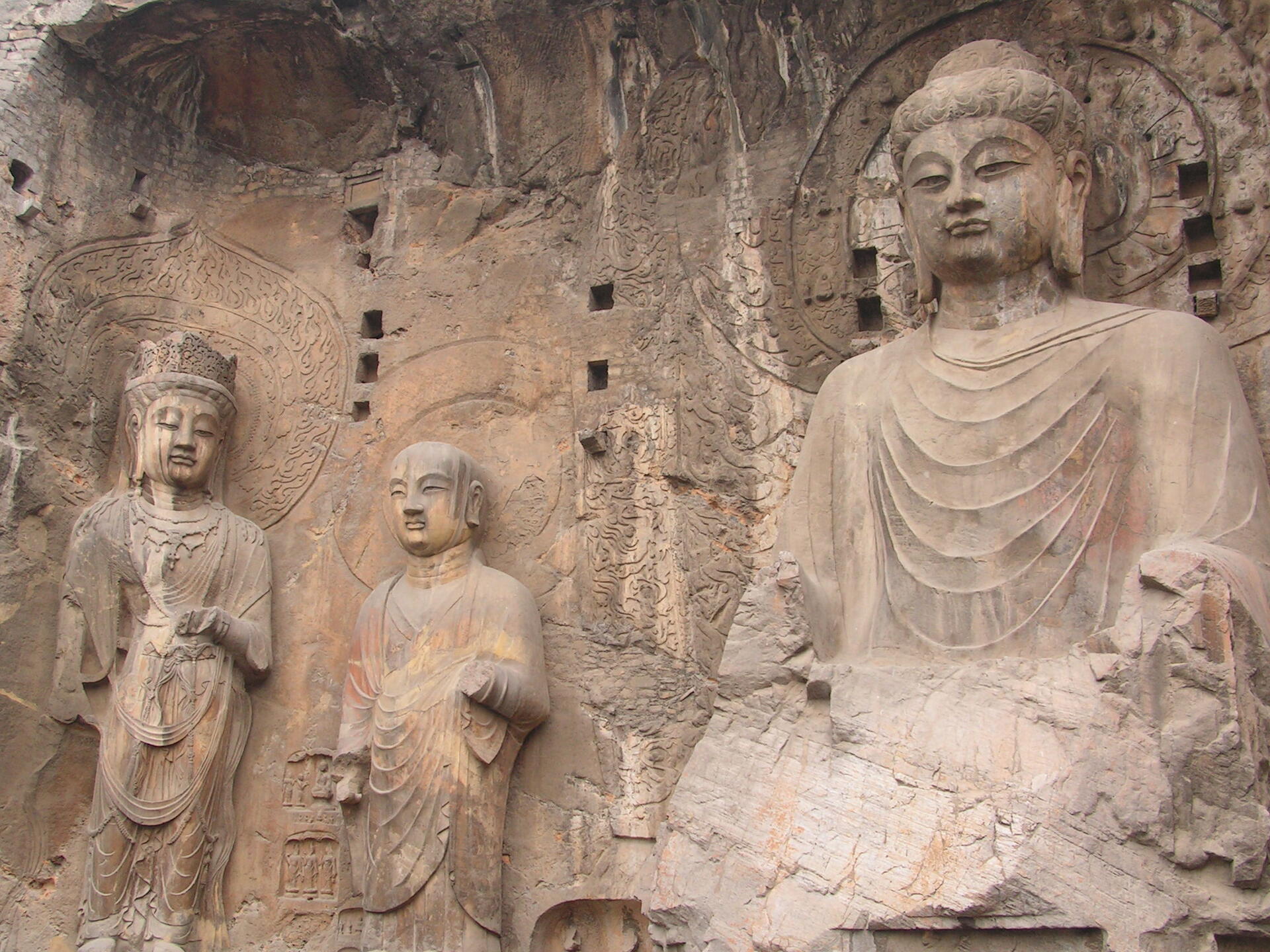
© Rialfver Original uploader was Rialfver at nl.wikipedia, CC BY-SA 3.0 Resized from original. (This derivative is under the same CC BY-SA license.)
World Heritage Research
Discover scientific research and academic studies that deepen our understanding of Longmen Grottoes from its history and significance to its conservation, management, and contemporary challenges.
-
Identification of Bacterial Communities Involved in Bioweathering Crusts on Limestone Sculptures of the Longmen Grottoes
Researchers have identified key bacterial communities contributing to bioweathering crusts on the limestone sculptures of Longmen Grottoes. The study reveals that Cyanobacteria, Acidobacteria, Chloroflexi, Actinobacteria, Firmicutes, and Planctomycetota dominate these microbial communities, with Cyanobacteria playing a significant role in crust formation. Additionally, the presence of bacterial isolates like Enterobacter sp. and Bacillus sp. suggests potential bioprotection mechanisms, while five types of biogenic organic acids indicate stone corrosion processes. Scanning electron microscopy further confirmed microbial penetration, highlighting biomechanical damage to the monuments. This study provides critical microbiological insights for heritage conservation efforts.
Ma, C., Fang, Z., Li, X., & Liu, X. (2023). Identification of Bacterial Communities Involved in Bioweathering Crusts on Limestone Sculptures of the Longmen Grottoes. Coatings, 13(9), 1506. https://doi.org/10.3390/coatings13091506
View Publication Record | Read Publication -
Posthumous Release for Lay Women in Tang China: Two Cases from the Longmen Grottoes
Cave burials at Longmen Grottoes, a renowned Tang-era Buddhist site, offered lay women a socially acceptable means to break familial ties after death. Two cases—Lady Lou and Lady Zhang—reveal distinct motivations: Lady Lou drew parallels with Indian ascetic practices without enacting compassionate offerings, while Lady Zhang was reburied by her sons in a joint tomb with her husband. Analysis of archaeological material and epigraphic evidence suggests that cave burials were not compromises but rather aligned with Buddhist teachings on posthumous release, addressing societal expectations around women's familial roles. The study highlights the persistence of family ties in the afterlife, with married women maintaining spousal and parental relations, while unmarried girls risked becoming seductive spirits due to lack of marital bonds.
Zhu, P. (2023). Posthumous Release for Lay Women in Tang China: Two Cases from the Longmen Grottoes. Religions, 14(3), 365. https://doi.org/10.3390/rel14030365
View Publication Record | Read Publication -
The Use of Digital Advancement Technology in Protecting the Longmen Grottoes Art
Digital restoration technology offers a non-invasive method to preserve and reconstruct the degraded Buddha statues of Longmen Grottoes, enabling virtual appreciation while minimizing physical damage. This approach allows for the recovery of lost historical details and cultural insights from fragmented statues, even those irrecoverable in their original form. By analyzing representative niches across different dynasties, researchers simulate missing features such as apparel, facial expressions, and body shapes using advanced digital modeling. The study demonstrates that virtual restoration not only safeguards these UNESCO-listed artifacts but also enhances global accessibility to grotto art through online platforms.
Li, X., Mohd Yusof, M. J., Hiong, S. W., & Perumal, V. (2021). The Use of Digital Advancement Technology in Protecting the Longmen Grottoes Art. Journal of Physics: Conference Series, 1875(1), 12011. https://doi.org/10.1088/1742-6596/1875/1/012011
View Publication Record | Read Publication -
Grey Incidence analyze of Environment Monitoring Data and Research on the Disease Prevention Measures of Longmen Grottoes
A grey incidence analysis of environmental monitoring data from the Longmen Grottoes reveals critical relationships between environmental factors and the deterioration processes affecting its cultural relics. The study identifies seepage water and fracture displacement as key contributors to weathering, organism growth, and other diseases threatening the site's preservation. By analyzing temperature, humidity, wind, precipitation, light intensity, soil moisture, and rock surface temperatures—both regionally and within experimental caves—the research establishes a relational order of environmental impacts on structural degradation. The findings support targeted disease prevention measures based on the formation mechanisms of these deteriorative processes.
LeiLei, Z., XueZhi, F., & Fei, C. (2018). Grey Incidence analyze of Environment Monitoring Data and Research on the Disease Prevention Measures of Longmen Grottoes. IOP Conference Series: Earth and Environmental Science, 153, 62006. https://doi.org/10.1088/1755-1315/153/6/062006
View Publication Record | Read Publication -
Geological Protection Project of the Longmen Grottoes in Luoyang
A comprehensive geological protection strategy for the Longmen Grottoes has been developed to mitigate damage from mechanical, chemical, and biological weathering. The study analyzed the current state of erosion in three key caverns—Qianxi Temple, HuangPuGong Cave, and Lu Hole—and proposed targeted solutions based on geological conditions. By categorizing deterioration mechanisms, researchers aim to preserve these ancient stone carvings, offering a model for safeguarding similar cultural relics worldwide.
Liu, Q. X., Duan, Y. H., & Deng, J. Y. (2012). Geological Protection Project of the Longmen Grottoes in Luoyang. Advanced Materials Research, 594-597, 155–160. https://doi.org/10.4028/www.scientific.net/amr.594-597.155
View Publication Record | Read Publication -
Research on the Weathering Problems of Longmen Grottoes
Longmen Grottoes is experiencing significant weathering damage, with chemical weathering emerging as the most pronounced threat due to deteriorating environmental and climatic conditions. The study categorizes weathering into physical, chemical, and biological types, analyzing their mechanisms and impacts on the grottoes. While previous research has documented these issues, this work highlights the increasing severity of chemical weathering, posing a critical challenge to the preservation of this cultural heritage. The approach involves synthesizing existing studies to elucidate damage patterns and mechanisms, providing a foundation for targeted conservation strategies.
Xu, T., & Ding, W. X. (2012). Research on the Weathering Problems of Longmen Grottoes. Advanced Materials Research, 446-449, 1537–1540. https://doi.org/10.4028/www.scientific.net/amr.446-449.1537
View Publication Record | Read Publication -
Internationalizing heritage: UNESCO and China’s Longmen Grottoes
UNESCO's World Heritage List plays a pivotal role in China's internationalization, particularly through its recognition of significant heritage sites like the Longmen Grottoes. This study reveals that the internationalization process is not merely about deregulation but involves complex interactions—collaboration, resistance, confrontation, and compromise—among states, communities, citizens, and global actors. The case of Luoyang demonstrates how tensions between universal internationalism, nationalism, and localism are managed through state-led developments. The research highlights that both globalization and internationalization can strengthen the state at multiple levels, challenging the notion of a zero-sum game in heritage preservation.
Dong Wang. (2010). Internationalizing heritage: UNESCO and China’s Longmen Grottoes. China Information, 24(2), 123–147. https://doi.org/10.1177/0920203x10369097
View Publication Record | Read Publication -
Investigation on Application of Biomimetic Technology to the Conservation of Longmen Grottoes
A biomimetic approach using calcium oxalate to protect historic stone structures, including the UNESCO World Heritage Site Longmen Grottoes, shows promising results. Laboratory experiments demonstrated that a protective film formed on marble stone effectively resists soil and acid weathering, while field trials at Longmen Grottoes validated its practical application. Characterization via XRD and SEM confirmed the material's stability and effectiveness, suggesting this method could significantly advance the conservation of vulnerable cultural heritage sites.
Liu, Q., Zhang, B. J., & Yang, G. L. (2010). Investigation on Application of Biomimetic Technology to the Conservation of Longmen Grottoes. Applied Mechanics and Materials, 26-28, 43–47. https://doi.org/10.4028/www.scientific.net/amm.26-28.43
View Publication Record | Read Publication