World Heritage Identification Number: 1318
World Heritage since: 2011
Category: Cultural Heritage
WHE Type: Buildings & Architectural Ensembles
Transboundary Heritage: No
Endangered Heritage: No
Country: 🇮🇹 Italy
Continent: Europe
UNESCO World Region: Europe and North America
Map
Longobards in Italy: Places of Power and Cultural Transformation
The Lombards, also known as the Longobards or the Langobards, played a crucial role in the transition from the Classical world to the European Middle Ages. Their culture developed through the interaction of different traditions, combining the heritage of Ancient Rome, Christian spirituality, Byzantine influence, and elements derived from the Germanic world. This cultural synthesis produced a distinctive architectural and artistic tradition and helped shape the emerging medieval world of Europe.
The seven groups of structures included in this World Heritage Site represent different aspects of Lombard power and society. They range from urban and religious complexes to fortified settlements, monasteries, churches, and pilgrimage sites. Among the most important are the Tempietto Longobardo and episcopal complex in Cividale del Friuli, the monastic complex of San Salvatore–Santa Giulia in Brescia, the fortified settlement of Castelseprio–Torba, the church of San Salvatore in Spoleto, the Tempietto del Clitunno near Campello sul Clitunno, the Church of Santa Sofia in Benevento, and the Sanctuary of San Michele in Monte Sant’Angelo. Together, they illustrate the geographical reach and cultural diversity of the Lombard kingdom.
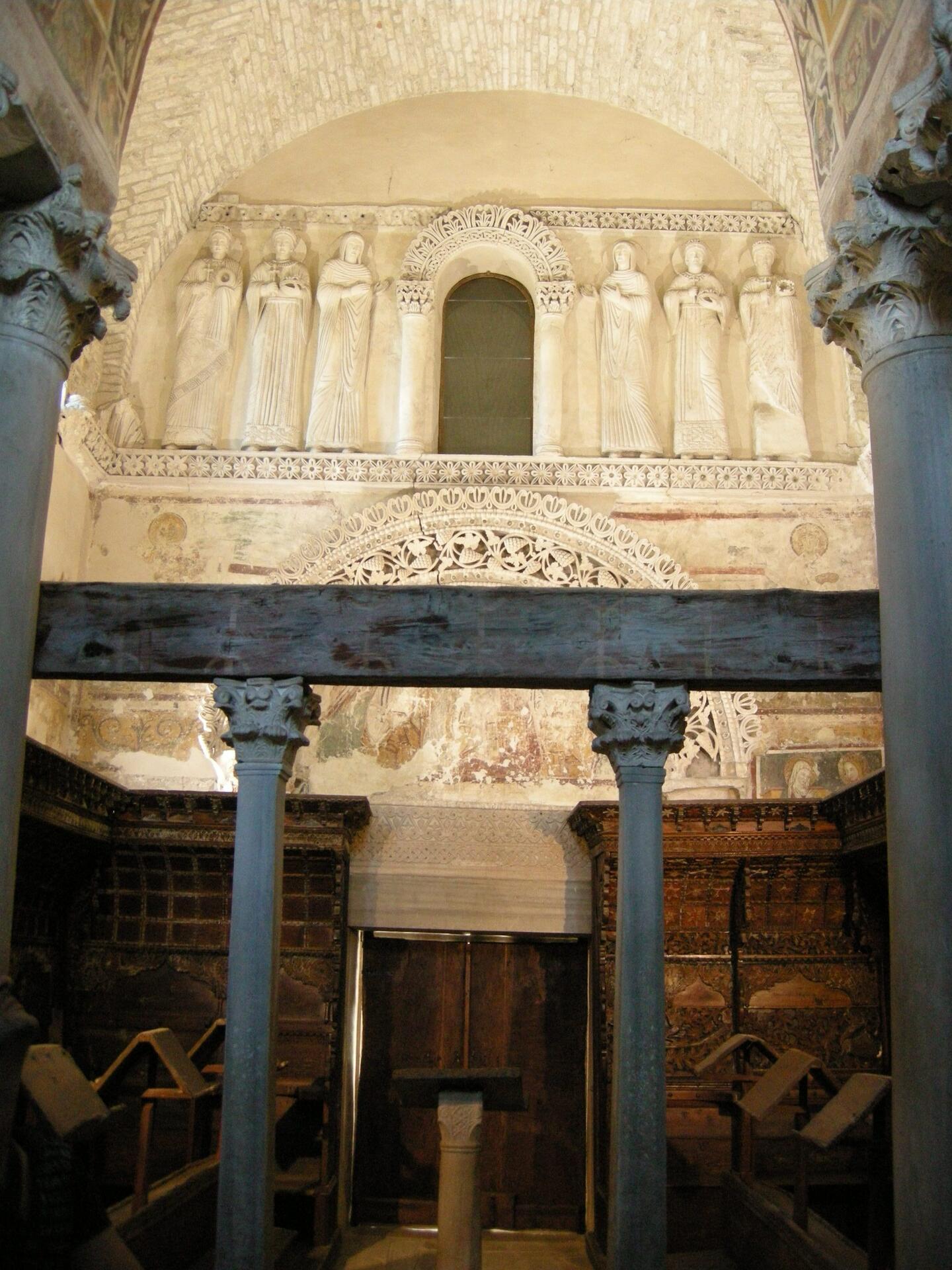
One of the most striking aspects of these monuments is their fusion of diverse architectural influences. The Tempietto Longobardo in Cividale, for example, combines a sophisticated architectural design with richly decorated stucco, frescoes, and other elements reflecting the artistic culture of the Lombard court. In Brescia, the monastery of San Salvatore–Santa Giulia incorporates Roman and Byzantine architectural elements into a monumental Lombard foundation. At Campello sul Clitunno, the Tempietto deliberately evokes the forms of a Classical Roman temple, demonstrating how ancient architectural traditions could be reinterpreted within an early medieval Christian context.
Santa Sofia in Benevento provides another remarkable example of this cultural synthesis. Built around 760 by Arechis II, duke of Benevento, the church combines an unusually complex central plan with columns reused from ancient monuments. Its name and dedication to Christ’s Divine Wisdom echo the great Hagia Sophia in Constantinople, though architecturally the church followed the model of Liutprand’s palatine church in Pavia. In this way, the monument reflects both the Lombards’ engagement with the Roman past and their connections to the wider Byzantine and Mediterranean world.
In addition to their architectural significance, these sites played an important role in the spiritual and cultural development of Medieval European Christianity. The Lombards contributed considerably to the growth of the monastic movement, while monasteries and religious foundations became important centers of cultural and intellectual life. UNESCO emphasizes the role of the Lombards in the transition from Antiquity into the emerging medieval world, particularly through their contribution to monasticism and Christian cultural development.
The religious history of the Lombards was itself part of this transformation. After their arrival in Italy, many Lombards were associated with Arian Christianity, while pagan traditions also survived among parts of the population. Over time, however, the Lombard elite increasingly adopted Catholic Christianity. Figures such as Queen Theodelinda played an important role in strengthening relations between the Lombard court and the Catholic Church. The gradual religious transformation contributed to the integration of Lombard and Roman populations and became an important element in the development of Lombard society.
The Sanctuary of San Michele at Monte Sant’Angelo illustrates another important aspect of this development. The Lombards adopted the cult of the Archangel Michael and transformed Monte Sant’Angelo into a major Lombard sanctuary and pilgrimage destination from the 7th century onward. Its position on routes leading toward the Holy Land helped establish it as an important center of pilgrimage, and the site later became one of the most significant centers of the cult of Saint Michael in the Western Christian world.
The Lombard kingdom itself lasted from 568 until 774, when Charlemagne conquered the Lombard kingdom and captured Pavia. Although Lombard political rule came to an end, Lombard institutions, elites, artistic traditions, and cultural influences continued to play a role in the history of medieval Italy. The monuments preserved in the UNESCO serial property therefore represent more than isolated examples of early medieval architecture: together, they document a period in which Roman, Christian, Byzantine, and Germanic traditions were being transformed into new forms of medieval European culture.
Altogether, the Longobards in Italy: Places of Power (568–774 A.D.) offers a fascinating glimpse into one of the formative periods of European history. The seven sites demonstrate the Lombards’ ability to absorb and reinterpret diverse cultural traditions while developing their own forms of architecture, art, religion, and political expression. They also highlight the Lombards’ important contribution to the development of Medieval European Christianity, particularly through monasticism, pilgrimage, and the transmission of knowledge. As such, the property represents an essential chapter in the transition from the ancient Roman world to medieval Europe and stands as a testament to the enduring cultural legacy of the Lombards in Italy.
UNESCO Description of the World Heritage Site
The Longobards in Italy, Places of Power, 568 - 774 A.D. comprises seven groups of important buildings (including fortresses, churches, and monasteries) throughout the Italian Peninsula. They testify to the high achievement of the Lombards, who migrated from northern Europe and developed their own specific culture in Italy where they ruled over vast territories in the 6th to 8th centuries. The Lombards synthesis of architectural styles marked the transition from Antiquity to the European Middle Ages, drawing on the heritage of Ancient Rome, Christian spirituality, Byzantine influence and Germanic northern Europe. The serial property testifies to the Lombards' major role in the spiritual and cultural development of Medieval European Christianity, notably by bolstering the monastic movement.
UNESCO Justification of the World Heritage Site
Criterion (ii): The Lombard monuments are an exemplary testimony to the cultural and artistic synthesis that occurred in Italy in the 6th to the 8th centuries, between the Roman heritage, Christian spirituality, Byzantine influence and the values derived from the Germanic world. They paved the way for and heralded the flowering of Carolingian culture and artistry.
Criterion (iii): The Lombard places of the power express remarkable new artistic and monumental forms, testifying to a Lombard culture characteristic of the European High Middle Ages. It takes the form of a clearly identifiable and unique cultural ensemble, the many languages and objectives of which express the power of the Lombard elite.
Criterion (vi): The place of the Lombards and their heritage in the spiritual and cultural structures of medieval European Christianity is very important. They considerably reinforced the monastic movement and contributed to the establishment of a forerunner venue for the great pilgrimages, in Monte Sant'Angelo, with the spread of the worship of St Michael. They also played an important role in the transmission of literary, technical, architectural, scientific, historical and legal works from Antiquity to the nascent European world.
Encyclopedia Record: Longobards in Italy: Places of Power (568–774 A.D.)
Longobards in Italy: Places of Power is seven groups of historic buildings that reflect the achievements of the Germanic tribe of the Lombards, who settled in Italy during the sixth century and established a Lombard Kingdom which ended in 774 A.D.Additional Site Details
Area: 14.08 hectares
Number of Components: 7
(iii) — Unique or exceptional testimony to a cultural tradition
(vi) — Directly associated with events or living traditions
Coordinates: 46.0941666667 , 13.4330555556