World Heritage Identification Number: 186
World Heritage since: 1982
Category: Natural Heritage
WHE Type: Natural Landscapes & Geographic Features
Transboundary Heritage: No
Endangered Heritage: No
Country: 🇦🇺 Australia
Continent: Oceania
UNESCO World Region: Asia and the Pacific
Map
Lord Howe Island Group: An Unspoiled Volcanic Paradise
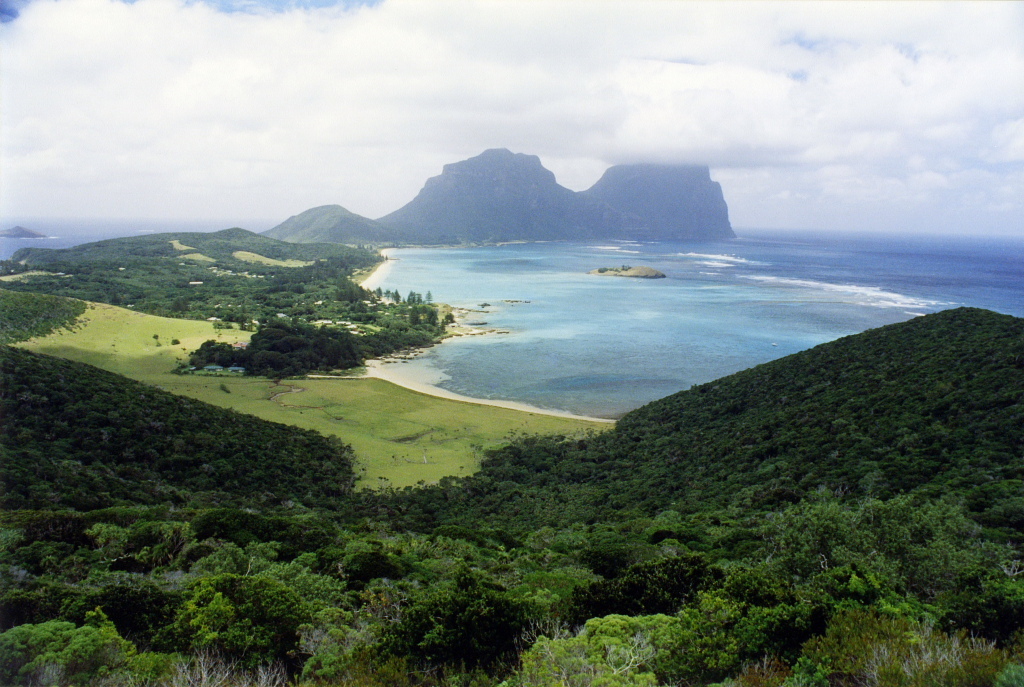
The Lord Howe Island Group, inscribed as a UNESCO World Heritage Site in 1982, presents a unique and captivating landscape that showcases the wonders of isolated oceanic islands. Situated approximately 600 kilometers east of mainland Port Macquarie, New South Wales, Australia, this volcanic archipelago offers a breathtaking spectacle of geological diversity and ecological richness.
More to come…UNESCO Description of the World Heritage Site
A remarkable example of isolated oceanic islands, born of volcanic activity more than 2,000 m under the sea, these islands boast a spectacular topography and are home to numerous endemic species, especially birds.
UNESCO Justification of the World Heritage Site
Criterion (vii): The Lord Howe Island Group is grandiose in its topographic relief and has an exceptional diversity of spectacular and scenic landscapes within a small area, including sheer mountain slopes, a broad arc of hills enclosing the lagoon and Balls Pyramid rising abruptly from the ocean. It is considered to be an outstanding example of an island system developed from submarine volcanic activity and demonstrates the nearly complete stage in the destruction of a large shield volcano. Having the most southerly coral reef in the world, it demonstrates a rare example of a zone of transition between algal and coral reefs. Many species are at their ecological limits, endemism is high, and unique assemblages of temperate and tropical forms cohabit. The islands support extensive colonies of nesting seabirds, making them significant over a wide oceanic region. They are the only major breeding locality for the Providence Petrel (Pterodroma solandri), and contain one of the world’s largest breeding concentrations of Red-tailed Tropicbird (Phaethon rubricauda).
Criterion (x): The Lord Howe Island Group is an outstanding example of the development of a characteristic insular biota that has adapted to the island environment through speciation. A significant number of endemic species or subspecies of plants and animals have evolved in a very limited area. The diversity of landscapes and biota and the high number of threatened and endemic species make these islands an outstanding example of independent evolutionary processes. Lord Howe Island supports a number of endangered endemic species or subspecies of plants and animals, for example the Lord Howe Woodhen, which at time of inscription was considered one of the world’s rarest birds. While sadly a number of endemic species disappeared with the arrival of people and their accompanying species, the Lord Howe Island Phasmid, the largest stick insect in the world, still exists on Balls Pyramid. The islands are an outstanding example of an oceanic island group with a diverse range of ecosystems and species that have been subject to human influences for a relatively limited period.
Encyclopedia Record: Lord Howe Island
Lord Howe Island is an irregularly crescent-shaped volcanic remnant in the Tasman Sea between Australia and New Zealand, part of the Australian state of New South Wales. It lies 600 km directly east of mainland Port Macquarie, 780 km northeast of Sydney, and about 900 km southwest of Norfolk Island. It is about 10 km (6.2 mi) long and between 0.3 and 2.0 km wide with an area of 14.55 km2, though just 3.98 km2 of that comprise the low-lying developed part of the island. The island is named after Richard Howe, 1st Earl Howe.Additional Site Details
Area: 146,300 hectares
Number of Components: 1
(x) — Contains most important habitats for biodiversity
Coordinates: -31.56555556 , 159.0883333
IUCN World Heritage Outlook
The 2025 Conservation Outlook on Lord Howe Island Group reports the following assessment:
Source: International Union for Conservation of Nature (IUCN) · View assessment
World Heritage Research
Discover scientific research and academic studies that deepen our understanding of Lord Howe Island Group from its history and significance to its conservation, management, and contemporary challenges.
-
Genetic assessment of the introduced rats found on Lord Howe Island post rodent eradication, new invaders or remnant survivors?
Genetic analysis reveals that black rats detected on Lord Howe Island (LHI) after a successful rodent eradication program are likely remnant survivors, not new invaders. Using mitochondrial DNA and microsatellite markers, researchers found that the post-eradication rats shared identical haplotypes with pre-eradication populations, while differing from mainland Australian and other Pacific island rat populations. Microsatellite data further showed that LHI's pre- and post-eradication rat populations were genetically distinct from mainland NSW populations, indicating limited gene flow despite potential dispersal routes. The low genetic diversity in post-eradication rats suggests they descend from a small number of survivors rather than new introductions.
Frankham, G. J., Helgen, K. M., & Eldridge, M. D. B. (2026). Genetic assessment of the introduced rats found on Lord Howe Island post rodent eradication, new invaders or remnant survivors? NeoBiota, 105, 25–45. https://doi.org/10.3897/neobiota.105.163728
View Publication Record | Read Publication -
Pleistocene Sea‐Level Fluctuation Shapes Archipelago‐Wide Population Structure in the Critically Endangered Lord Howe Island Cockroach Panesthia lata
Pleistocene sea-level fluctuations have significantly shaped the population structure of the critically endangered Lord Howe Island cockroach (Panesthia lata) across its archipelago, revealing historical faunal connectivity. The study, which analyzed nuclear single-nucleotide polymorphisms and complete mitochondrial genomes from four islands in the Lord Howe Island Group (LHIG), found that the lineage on Ball's Pyramid is highly divergent from others, while populations on Lord Howe Island, Roach Island, and Blackburn Island may have diverged as recently as the end of the last interglacial period. Surprisingly, a relict population of P. lata was discovered on Lord Howe Island, despite its presumed local extirpation by rodents, though this population shows high kinship indicative of a strong bottleneck. The findings suggest that genetic rescue from other islands could be a viable conservation strategy for this species and others similarly impacted by rodents.
Adams, M. W. D., Ewart, K. M., Carlile, N., Rose, H. A., Walker, J. A., Hutton, I., Ho, S. Y. W., & Lo, N. (2026). Pleistocene Sea‐Level Fluctuation Shapes Archipelago‐Wide Population Structure in the Critically Endangered Lord Howe Island Cockroach Panesthia lata. Ecology and Evolution, 16(3). Portico. https://doi.org/10.1002/ece3.72760
View Publication Record | Read Publication -
Biodiversity on the Intertidal Rocky Reefs of Oceanic Islands: the Lord Howe Island Marine Park as a Case Study
Intertidal rocky reefs of oceanic islands, such as those in the UNESCO-listed Lord Howe Island Marine Park (LHIMP), harbor exceptionally high biodiversity with a significant proportion of endemic and vulnerable species. This study reveals that rubble reefs support the greatest species richness, taxonomic diversity, and number of rare or habitat-restricted species, while topographic complexity emerges as the dominant driver of biodiversity patterns across reef types. However, these topographic effects are complex and variable, limiting their use as robust surrogates for broader biodiversity assessments. The research also identifies lagoonal reefs as particularly susceptible to cumulative human impacts. By integrating systematic biodiversity surveys with high-resolution drone-based photogrammetry, the study provides novel baseline data and practical management recommendations to safeguard these fragile ecosystems in the LHIMP and similar oceanic island environments.
Woods, C. (2026). Biodiversity on the Intertidal Rocky Reefs of Oceanic Islands: the Lord Howe Island Marine Park as a Case Study [University of Wollongong]. https://doi.org/10.71747/UOW-R3GK326M.32071869
View Publication Record | Read Publication -
Molecular Phylogeny of Tiny Land Snails From the Family Punctidae (Stylommatopohora, Punctoidea) in Australia
A comprehensive molecular phylogeny of Australian punctid snails reveals a rapid diversification event on the mainland around 5.5 million years ago, with basal groups comprising taxa from Tasmania, New Zealand, Macquarie Island, Lord Howe Island, and Norfolk Island. The study, utilizing mitochondrial (COI, 16S) and nuclear (ELAVI8, ITS2) markers, demonstrates that several genera are junior synonyms of Paralaoma, including Gratilaoma, Iotula, Laomavix, Miselaoma, Pseudiotula, Tescilaoma, Trocholaoma, and Westralaoma. Additionally, it clarifies the taxonomic placement of Pasmaditta jungermanniae, Pedicamista sp. ‘Bull Hill’, and Trocholaoma spiceri as part of Cystopeltidae, while Norfolk Island charopids Norfolcioconcha, Penescosta, Cryptocharopa, and Frustropa are shown to belong to Punctidae. Morphological data supported these findings, with shell dimensions analyzed using the Kruskal–Wallis rank-sum test.
Hyman, I. T., Zhang, G., & Köhler, F. (2026). Molecular Phylogeny of Tiny Land Snails From the Family Punctidae (Stylommatopohora, Punctoidea) in Australia. Zoologica Scripta. Portico. https://doi.org/10.1111/zsc.70067
View Publication Record | Read Publication -
Island Syndrome in the Critically Endangered Lord Howe Island Cockroach Panesthia lata
Research on the critically endangered Lord Howe Island cockroach, Panesthia lata, reveals novel evidence of behavioural island syndrome in an invertebrate. The study found a significantly lower incidence of male agonism and large aggregations of unrelated individuals in P. lata compared to its Australian sister species, P. cribrata. This aligns with previous findings of relaxed intraspecific aggression in island mammals and reptiles. Additionally, courtship behaviour did not vary between populations, suggesting potential for interbreeding—a promising outcome for the conservation of this fragmented species. The study used behavioural assays and nuclear single-nucleotide polymorphism analyses to compare P. lata with P. cribrata, providing insights into adaptive radiation and ecological release in island environments.
Coady, S. K., Adams, M. W. D., Rose, H. A., Walker, J. A., Hutton, I., Gloag, R., & Lo, N. (2025). Island Syndrome in the Critically Endangered Lord Howe Island Cockroach Panesthia lata. Ecology and Evolution, 15(11). Portico. https://doi.org/10.1002/ece3.72402
View Publication Record | Read Publication -
More than just a dot: the enigmatic ‘large’ Punctidae of Lord Howe Island (Gastropoda: Stylommatophora)
A comprehensive taxonomic revision of the 'large' Punctidae snails on Lord Howe Island reveals that three nominal genera—Dignamoconcha, Pernastela, and Charopella—belong to a single radiation. The study, using morpho-anatomy and phylogenetic analyses of mitochondrial (COI, 16S) and nuclear (ITS2, ELAVI8) DNA, synonymizes Pernastela and Charopella with Dignamoconcha, reducing the group to three accepted species: D. dulcissima, D. charon, and D. wilkinsoni. Additionally, it clarifies that Scelidoropa is not part of Cystopeltidae but is sister to (Charopidae + Punctidae), while other Charopidae species are reclassified as cystopeltids. Radular morphology aids in identifying higher-level groups like Punctidae and Scelidoropa but cannot distinguish between Cystopeltidae and Charopidae.
Hyman, I. T., & Köhler, F. (2025). More than just a dot: the enigmatic ‘large’ Punctidae of Lord Howe Island (Gastropoda: Stylommatophora). Zoological Journal of the Linnean Society, 205(4). https://doi.org/10.1093/zoolinnean/zlaf166
View Publication Record | Read Publication -
Local adaptation in the wedge-tailed shearwater (Puffinus pacificus)
Research on the wedge-tailed shearwater (Puffinus pacificus) reveals significant local adaptation driven by oceanographic conditions, challenging traditional speciation models reliant on physical barriers. The study found that seabirds breeding in distinct colonies exhibit divergent foraging behaviors and chick developmental patterns, with Heron Island birds adopting a 'dual-foraging' strategy due to less productive environments, while Lord Howe Island birds show faster growth despite lower meal mass per night. Morphological analyses highlighted sex-specific differences and disassortative mate choice based on bill width, suggesting selection rather than plasticity. Genetic markers indicated restricted gene flow, contrasting with historical connections, implying that environmental factors play a pivotal role in seabird diversity. This study underscores the importance of considering colonies independently for conservation and highlights the need to explore selection mechanisms further.
Peck, D. R. (2006). Local adaptation in the wedge-tailed shearwater (Puffinus pacificus) [James Cook University]. https://doi.org/10.25903/JDG8-WV69
View Publication Record | Read Publication