World Heritage Identification Number: 368
World Heritage since: 1986
Category: Natural Heritage
WHE Type: Natural Landscapes & Geographic Features
Transboundary Heritage: No
Endangered Heritage: No
Country: 🇦🇺 Australia
Continent: Oceania
UNESCO World Region: Asia and the Pacific
Map
Gondwana Rainforests of Australia: A Unique Tapestry of Biodiversity
The Gondwana Rainforests of Australia, officially recognized as a UNESCO World Heritage Site since 1986, represent one of the most extensive regions of subtropical rainforest globally. Spanning over 366,500 hectares, this vast network of protected areas stretches from Newcastle to Brisbane along Australia's eastern coastline.
More to come…UNESCO Description of the World Heritage Site
This site, comprising several protected areas, is situated predominantly along the Great Escarpment on Australia’s east coast. The outstanding geological features displayed around shield volcanic craters and the high number of rare and threatened rainforest species are of international significance for science and conservation.
UNESCO Justification of the World Heritage Site
Criterion (viii): The Gondwana Rainforests provides outstanding examples of significant ongoing geological processes. When Australia separated from Antarctica following the breakup of Gondwana, new continental margins developed. The margin which formed along Australia’s eastern edge is characterised by an asymmetrical marginal swell that runs parallel to the coastline, the erosion of which has resulted in the Great Divide and the Great Escarpment. This eastern continental margin experienced volcanicity during the Cenozoic Era as the Australian continental plate moved over one of the planet’s hot spots. Volcanoes erupted in sequence along the east coast resulting in the Tweed, Focal Peak, Ebor and Barrington volcanic shields. This sequence of volcanos is significant as it enables the dating of the geomorphic evolution of eastern Australia through the study of the interaction of these volcanic remnants with the eastern highlands. The Tweed Shield erosion caldera is possibly the best preserved erosion caldera in the world, notable for its size and age, for the presence of a prominent central mountain mass (Wollumbin/Mt Warning), and for the erosion of the caldera floor to basement rock. All three stages relating to the erosion of shield volcanoes (the planeze, residual and skeletal stages) are readily distinguishable. Further south, the remnants of the Ebor Volcano also provides an outstanding example of the ongoing erosion of a shield volcano.
Criterion (ix): TheGondwana Rainforests contains outstanding examples of major stages in the Earth’s evolutionary history as well as ongoing evolutionary processes. Major stages represented include the ‘Age of the Pteridophytes’ from the Carboniferous Period with some of the oldest elements of the world’s ferns represented, and the ‘Age of Conifers’ in the Jurassic Period with one of the most significant centres of survival for Araucarians (the most ancient and phylogenetically primitive of the world’s conifers). Likewise the property provides an outstanding record of the ‘Age of the Angiosperms’. This includes a secondary centre of endemism for primitive flowering plants originating in the Early Cretaceous, the most diverse assemblage of relict angiosperm taxa representing the primary radiation of dicotyledons in the mid-Late Cretaceous, a unique record of the evolutionary history of Australian rainforests representing the ‘golden age’ of the Early Tertiary, and a unique record of Miocene vegetation that was the antecedent of modern temperate rainforests in Australia. The property also contains an outstanding number of songbird species, including lyrebirds (Menuridae), scrub-birds (Atrichornithidae), treecreepers (Climacteridae) and bowerbirds and catbirds (Ptilonorhynchidae), belonging to some of the oldest lineages of passerines that evolved in the Late Cretaceous. Outstanding examples of other relict vertebrate and invertebrate fauna from ancient lineages linked to the break-up of Gondwana also occur in the property. The flora and fauna of the Gondwana Rainforests provides outstanding examples of ongoing evolution including plant and animal taxa which show evidence of relatively recent evolution. The rainforests have been described as ‘an archipelago of refugia, a series of distinctive habitats that characterise a temporary endpoint in climatic and geomorphological evolution’. The distances between these ‘islands’ of rainforest represent barriers to the flow of genetic material for those taxa which have low dispersal ability, and this pressure has created the potential for continued speciation.
Criterion (x): The ecosystems of the Gondwana Rainforests contain significant and important natural habitats for species of conservation significance, particularly those associated with the rainforests which once covered much of the continent of Australia and are now restricted to archipelagos of small areas of rainforest isolated by sclerophyll vegetation and cleared land. The Gondwana Rainforests provides the principal habitat for many species of plants and animals of outstanding universal value, including more than 270 threatened species as well as relict and primitive taxa. Rainforests covered most of Australia for much of the 40 million years after its separation from Gondwana. However, these rainforests contracted as climatic conditions changed and the continent drifted northwards. By the time of European settlement rainforests covered only 1% of the landmass and were restricted to refugia with suitable climatic conditions and protection from fire. Following European settlement, clearing for agriculture saw further loss of rainforests and only a quarter of the rainforest present in Australia at the time of European settlement remains. The Gondwana Rainforests protects the largest and best stands of rainforest habitat remaining in this region. Many of the rare and threatened flora and fauna species are rainforest specialists, and their vulnerability to extinction is due to a variety of factors including the rarity of their rainforest habitat. The Gondwana Rainforests also protects large areas of other vegetation including a diverse range of heaths, rocky outcrop communities, forests and woodlands. These communities have a high diversity of plants and animals that add greatly to the value of the Gondwana Rainforests as habitat for rare, threatened and endemic species. The complex dynamics between rainforests and tall open forest particularly demonstrates the close evolutionary and ecological links between these communities. Species continue to be discovered in the property including the re-discovery of two mammal species previously thought to have been extinct: the Hastings River Mouse (Pseudomys oralis) and Parma Wallaby (Macropus parma).
Encyclopedia Record: Gondwana Rainforests
The Gondwana Rainforests of Australia, formerly known as the Central Eastern Rainforest Reserves, are the most extensive area of subtropical rainforest in the world. Collectively, the rainforests are a World Heritage Site with fifty separate reserves totalling 366,500 hectares from Newcastle to Brisbane.Additional Site Details
Area: 370,000 hectares
Number of Components: 40
(ix) — Outstanding example representing ecological and biological processes
(x) — Contains most important habitats for biodiversity
Coordinates: -28.25 , 150.05
IUCN World Heritage Outlook
The 2025 Conservation Outlook on Gondwana Rainforests of Australia reports the following assessment:
Source: International Union for Conservation of Nature (IUCN) · View assessment
Image
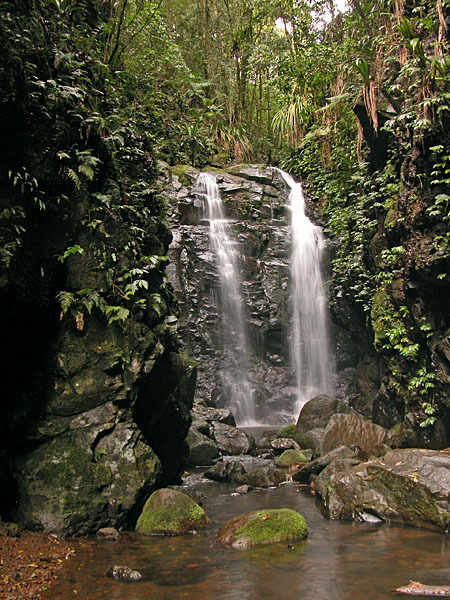
© Malcolm Jacobson, CC BY-SA 2.0 Resized from original. (This derivative is under the same CC BY-SA license.)
World Heritage Research
Discover scientific research and academic studies that deepen our understanding of Gondwana Rainforests of Australia from its history and significance to its conservation, management, and contemporary challenges.
-
Contraction–Expansion Dynamics Shape Refugia and Recolonisation Processes in the Gondwana Rainforests of Australia World Heritage Area
Climate stability and historical gene flow have shaped distinct refugial and recolonised areas within the Gondwana Rainforests of Australia World Heritage Area (GRWHA), with significant implications for future conservation. The study identified persistent refugia—regions of high climate stability, species richness, and genetic differentiation—and recolonised zones marked by lower stability but higher genetic diversity. Notably, the Clarence River Corridor acts as both a biogeographic barrier and a zone of admixture, homogenizing genetic signals. While rainforest suitability expanded post-Last Glacial Maximum (LGM), future projections indicate substantial contraction, particularly in southern regions, with high-altitude refugia emerging. This multi-species approach integrates climate modeling, landscape genomics, and intraspecific diversity metrics to inform regionally tailored restoration strategies, prioritizing provenancing guidance and assisted migration under climate change.
Dimon, R. J., Yap, J.-Y. S., Kooyman, R. M., Wilson, P. D., Henry, R. J., & Rossetto, M. (2026). Contraction–Expansion Dynamics Shape Refugia and Recolonisation Processes in the Gondwana Rainforests of Australia World Heritage Area. Applied Vegetation Science, 29(1). Portico. https://doi.org/10.1111/avsc.70059
View Publication Record | Read Publication -
Naarda turneri Tóth, 2026, sp. nov.
A new species of moth, Naarda turneri, has been discovered within the Gondwana Rainforests of Australia World Heritage Site. This species is distinguished by its unique male genitalia, featuring a strongly sclerotised structure at the tip of the valva, which sets it apart from related taxa like N. sonibacsi and N. calliceros. The holotype specimen, collected in Queensland's Lamington National Park, exhibits distinctive wing patterns, including a brown forewing with greyish shading, a light yellow reniform stigma, and a dark brown discal spot on the hindwing. The discovery highlights the biodiversity of this protected area, which has remained nearly untouched since its initial exploration. The species is named in honor of A. Jefferis Turner, a pioneer in Australian moth fauna research.
Tóth, B. (2026). Naarda turneri Tóth, 2026, sp. nov. Zenodo. https://doi.org/10.5281/ZENODO.21149261
View Publication Record | Read Publication -
Long-term demographic responses to historical logging and ongoing climate change in an upland subtropical rainforest
Historical logging and ongoing climate change continue to significantly impact the recovery of upland subtropical rainforests in southeast Queensland, part of Australia's Gondwana Rainforests World Heritage Site. Despite over 50 years since logging cessation, these forests show persistent structural and compositional differences compared to intact plots, with logged areas exhibiting higher recruitment of pioneer species but greater sensitivity to warming temperatures and extreme weather events. The study, utilizing a rare long-term dataset spanning 1962–2015, found that while logged plots demonstrate faster diameter growth initially, this slows as basal area increases. Intact plots, conversely, show growth concentrated in larger, cloud-water-intercepting trees. These findings highlight the enduring legacy of logging and the need for adaptive management strategies to mitigate climate change impacts on these critical biodiversity refugia.
Howell, S. R., Doley, D., McDonald, W. J. F., Radford-Smith, J., & Dwyer, J. M. (2026). Long-term demographic responses to historical logging and ongoing climate change in an upland subtropical rainforest. Forest Ecology and Management, 621, 124248. https://doi.org/10.1016/j.foreco.2026.124248
View Publication Record | Read Publication -
Environmental Controls of Rainforest Tree Communities: Climate Change Implications for the Gondwana Rainforests
A 15-year study of the Gondwana Rainforests of Australia reveals significant floristic changes driven by elevation-dependent environmental controls. High-elevation tree communities (≥ 900 m) show persistent in situ recruitment patterns, closely mirroring canopy composition, and are primarily influenced by precipitation and cloud water inputs, which mitigate moisture stress. In contrast, mid-to-low elevations (≤ 700 m) exhibit distinct understorey recruit compositions differing from the established canopy, linked to higher temperatures, evaporation, and lower humidity. These changes, particularly pronounced at low elevations (300 m), are exacerbated by drought and bushfires, suggesting a trajectory toward future community turnover. Climate projections indicate increasing moisture stress and fire risk, potentially threatening the Outstanding Universal Value of this UNESCO World Heritage Area. The study used multivariate analyses to examine shifts in tree community composition and their environmental drivers, providing critical insights for management strategies.
Laidlaw, M. J. (2026). Environmental Controls of Rainforest Tree Communities: Climate Change Implications for the Gondwana Rainforests. Applied Vegetation Science, 29(3). Portico. https://doi.org/10.1111/avsc.70088
View Publication Record | Read Publication -
Euastacus vanderwerfi sp. nov., a new dwarf spiny freshwater crayfish (Crustacea: Decapoda: Parastacidae) from the Gondwana Rainforests, Lamington National Park, Queensland, Australia
A new species of dwarf spiny freshwater crayfish, Euastacus vanderwerfi, has been discovered in the highland rainforests of Lamington National Park, Queensland, Australia. This species is distinguished from its closest relatives by unique morphological features and exhibits specific burrowing behavior and ecological preferences. The discovery highlights the biodiversity of the Gondwana Rainforests World Heritage Site and underscores the need for urgent conservation efforts, as Euastacus vanderwerfi is assessed as Critically Endangered due to significant population decline and habitat threats.
McCormack, R. (2025). Euastacus vanderwerfi sp. nov., a new dwarf spiny freshwater crayfish (Crustacea: Decapoda: Parastacidae) from the Gondwana Rainforests, Lamington National Park, Queensland, Australia. Memoirs of the Queensland Museum – Nature, 66, 27–44. https://doi.org/10.17082/vsnc7686
View Publication Record | Read Publication -
Population genomics of rainforest mountain frogs (Anura: Limnodynastidae: Philoria) severely impacted by the Australian megafires
The Australian megafires of 2019/20 severely impacted six of seven montane frog species in the genus Philoria, which are endemic to the Gondwana Rainforests of Australia. Population genomics analysis revealed that narrow-range species can be managed as single populations, while P. kundagungan, P. loveridgei, and P. sphagnicolus exhibit strong genetic differentiation between mountaintop populations, indicating limited natural dispersal. Fire-impacted populations, such as P. pughi and P. knowlesi, may face long-term threats due to reduced adaptive capacity. The study recommends prioritizing in situ conservation, genetic rescue, and translocation efforts to enhance resilience in these isolated, ancient frogs, emphasizing the need for updated fire buffer management in a changing climate.
Lin, S., Newell, D., Mitchell, N. J., Donnellan, S. C., Mahony, M., Bolitho, L. J., & Catullo, R. A. (2025). Population genomics of rainforest mountain frogs (Anura: Limnodynastidae: Philoria) severely impacted by the Australian megafires. Conservation Genetics, 26(5), 929–942. https://doi.org/10.1007/s10592-025-01713-2
View Publication Record | Read Publication -
Australian Rainforests—A Living Museum of Natural Product Chemical Diversity
Australian rainforests, among the oldest continuously forested ecosystems on Earth, are a 'living museum' of natural product chemical diversity. Despite covering only 0.024% of global land area, these rainforests host ~3,800 plant species from 187 families and 942 genera, with ancient biosynthetic lineages contributing to their remarkable chemical richness. While only 10% of species have been studied, they have yielded nearly 2,400 unique constituents, including highly bioactive compounds. This research highlights the significance of Australian rainforests in advancing our understanding of worldwide seed plant chemical diversity and introduces advanced NMR spectroscopic methods for identifying complex mixtures. The findings underscore the potential of these ancient ecosystems as reservoirs of high chemical diversity.
Carroll, A. R. (2025). Australian Rainforests—A Living Museum of Natural Product Chemical Diversity. Natural Product Diversity of Australian Rainforests, 1–331. https://doi.org/10.1007/978-3-031-90474-5_1
View Publication Record | Read Publication