World Heritage Identification Number: 1306
World Heritage since: 2010
Category: Cultural Heritage
WHE Type: Buildings & Architectural Ensembles
Transboundary Heritage: No
Endangered Heritage: No
Country: 🇦🇺 Australia
Continent: Oceania
UNESCO World Region: Asia and the Pacific
Map
Unraveling the History of Australian Convict Sites: A Legacy of Colonial Expansion
The Australian Convict Sites, inscribed into the UNESCO World Heritage List in 2010, stand as a testament to the intricate history of colonial expansion that shaped the Australian continent. This designation encompasses eleven significant penal sites, scattered across various regions of Australia, including Fremantle in Western Australia, Kingston and Arthur's Vale on Norfolk Island, and areas surrounding Sydney in New South Wales, as well as sites located in Tasmania. These sites offer a unique insight into the vast scale of convict transportation orchestrated by the British Empire during the 18th and 19th centuries.
The Australian Convict Sites serve as the best surviving examples of this era, providing a tangible connection to the past and offering valuable insights into the societal structures that underpinned the British penal system during this time. Approximately 166,000 men, women, and children were transported to Australia between 1787 and 1868, having been condemned by British justice for various offenses. These individuals were sent to the convict colonies, where they were subjected to punitive imprisonment and forced labor, contributing significantly to the development of the Australian settlements.
Each site within the Australian Convict Sites network held a distinct purpose, catering to both the penal and rehabilitative aspects of the colonial system. For instance, some sites functioned primarily as places of punishment, such as Norfolk Island, which served as a penal settlement for recidivist offenders. It was particularly notorious for its brutal conditions during the 1800s, which led to its later abandonment as a penal settlement.
In contrast, other sites, like those in Tasmania, first focused on rehabilitation through forced labor, enabling the establishment of agricultural communities and infrastructure projects. While Port Arthur’s penal settlement was initially established for convicts, it was also used later as a site for cruel secondary punishment, where convicts who had reoffended or been troublesome were sent.
One of the notable examples of convict-built infrastructure is the Old Great Sydney Road, which ran between Emu Plains and Parramatta in New South Wales. This stretch of road, constructed by convicts, played a key role in the development of the early European settlements, facilitating trade and communication between Sydney and the western regions of New South Wales. Though not an official part of the UNESCO-listed Australian Convict Sites, it stands as a poignant reminder of the forced labor that shaped Australia’s early colonial landscape.
Another notable site is the Port Arthur Historic Site in Tasmania, which was initially established as a penal settlement in 1830. Over time, it evolved into a self-contained community, complete with a hospital, church, and even a school. The site offers a fascinating glimpse into the daily lives of the convicts who resided there, revealing the complex social dynamics that existed within the confines of the penal colony.
The Australian Convict Sites represent more than just historical landmarks; they serve as poignant reminders of the human stories that lie at their core. The tales of the men, women, and children who were transported to Australia against their will, and the impact of their experiences on the development of the Australian continent, continue to resonate with visitors today. By preserving these sites and sharing their stories, we ensure that future generations remain connected to this rich and complex chapter in history.
UNESCO Description of the World Heritage Site
The property includes a selection of eleven penal sites, among the thousands established by the British Empire on Australian soil in the 18th and 19th centuries. The sites are spread across Australia, from Fremantle in Western Australia to Kingston and Arthur's Vale on Norfolk Island in the east; and from areas around Sydney in New South Wales in the north, to sites located in Tasmania in the south. Around 166,000 men, women and children were sent to Australia over 80 years between 1787 and 1868, condemned by British justice to transportation to the convict colonies. Each of the sites had a specific purpose, in terms both of punitive imprisonment and of rehabilitation through forced labour to help build the colony. The Australian Convict Sites presents the best surviving examples of large-scale convict transportation and the colonial expansion of European powers through the presence and labour of convicts.
UNESCO Justification of the World Heritage Site
Criterion (iv): The Australian convict sites constitute an outstanding example of the way in which conventional forced labour and national prison systems were transformed, in major European nations in the 18th and 19th centuries, into a system of deportation and forced labour forming part of the British Empire’s vast colonial project. They illustrate the variety of the creation of penal colonies to serve the many material needs created by the development of a new territory. They bear witness to a penitentiary system which had many objectives, ranging from severe punishment used as a deterrent to forced labour for men, women and children, and the rehabilitation of the convicts through labour and discipline.
Criterion (vi): The transportation of criminals, delinquents, and political prisoners to colonial lands by the great nation states between the 18th and 20th centuries is an important aspect of human history, especially with regard to its penal, political and colonial dimensions. The Australian convict settlements provide a particularly complete example of this history and the associated symbolic values derived from discussions in modern and contemporary European society. They illustrate an active phase in the occupation of colonial lands to the detriment of the Aboriginal peoples, and the process of creating a colonial population of European origin through the dialectic of punishment and transportation followed by forced labour and social rehabilitation to the eventual social integration of convicts as settlers.
Encyclopedia Record: Australian Convict Sites
Australian Convict Sites is a World Heritage property consisting of 11 remnant penal sites originally built within the British Empire during the 18th and 19th centuries on fertile Australian coastal strips at Sydney, Tasmania, Norfolk Island, and Fremantle; now representing "...the best surviving examples of large-scale convict transportation and the colonial expansion of European powers through the presence and labour of convicts".Additional Site Details
Area: 1,502.51 hectares
Number of Components: 11
(vi) — Directly associated with events or living traditions
Coordinates: -33.3783333333 , 150.9944444444
Image
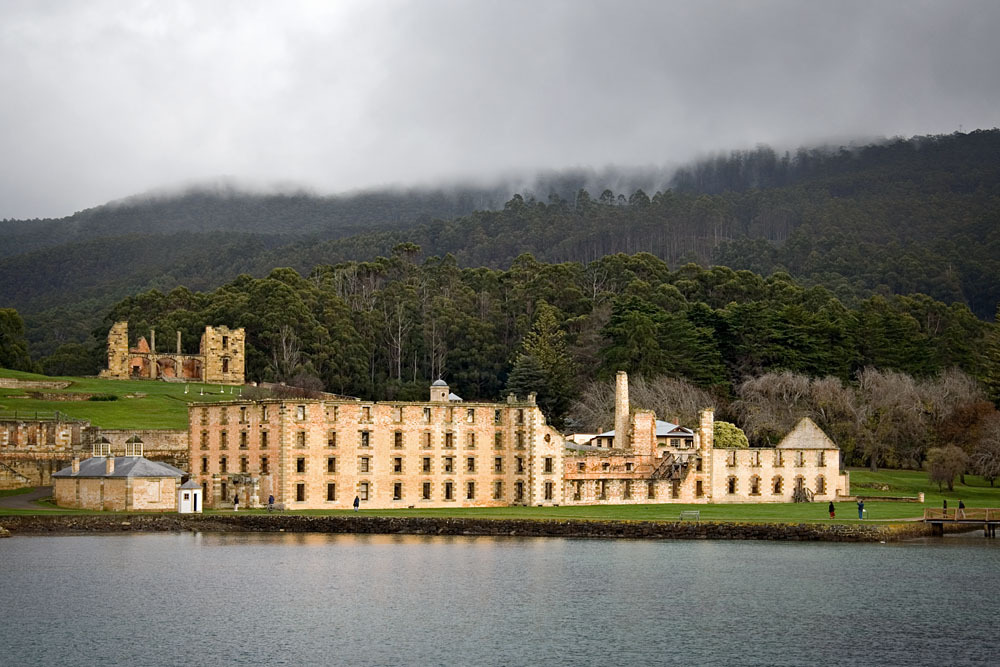
© Martybugs at en.wikipedia, CC BY-SA 3.0 Resized from original. (This derivative is under the same CC BY-SA license.)
World Heritage Research
Discover scientific research and academic studies that deepen our understanding of Australian Convict Sites from its history and significance to its conservation, management, and contemporary challenges.
-
The Lure of the Lash: Spectacular Violence and White Ethnonationalism at an Australian Convict Site
This study examines the transformation of Port Arthur Penal Settlement, a site of brutal convict labor in Tasmania, into a tourist destination that spectacularizes its violent history. Unlike U.S. plantations that suppress their pasts, Australian penal sites embrace brutality as spectacle, reflecting a unique form of white ethnonationalism where tourists identify with convicts rather than their oppressors. The research explores how this duality—revelry in violence and meticulous historical unearthing—coexists within the site's reinvention, highlighting the complexities of heritage narratives in Australia.
Sheard, M. J. (2023). The Lure of the Lash: Spectacular Violence and White Ethnonationalism at an Australian Convict Site. React/Review: A Responsive Journal for Art and Architecture, 3(0). https://doi.org/10.5070/r53061234
View Publication Record | Read Publication -
A bottom-up method for remixing narratives for virtual heritage experiences
A bottom-up approach for creating engaging virtual heritage experiences has been demonstrated, offering a method to remix narratives that resonate with diverse audiences. This study analyzed user-generated content, tourism materials, and historical data from 11 UNESCO World Heritage Australian Convict Sites using multimodal discourse analysis. The resulting interactive web documentary (iDoc) prototype revealed narrative themes aligned with prospective cultural heritage tourists' interests, providing a creative alternative to top-down narratives that often lack public engagement. This methodology ensures virtual experiences reflect broader societal perspectives while preserving historical integrity.
Basaraba, N. (2021). A bottom-up method for remixing narratives for virtual heritage experiences. Convergence: The International Journal of Research into New Media Technologies, 28(6), 1531–1554. https://doi.org/10.1177/13548565211048968
View Publication Record | Read Publication -
Legacies of Sectarianism and the Convict Past in Australia
Australia's unique embrace of its convict past, contrasting with the shame felt in other Western democracies, stems from a sectarian undercurrent that shaped its secular political culture. This study reveals how sympathy for convicts, often overlooked in national narratives, reflects broader tensions between the Catholic clergy and the Anglican Evangelical establishment during the 18th and 19th centuries. By analyzing historical records and cultural attitudes, it highlights the role of sectarianism in redefining moral order and public perception, offering new insights into Australia's societal evolution.
Carey, H. M. (2015). Legacies of Sectarianism and the Convict Past in Australia. Religion after Secularization in Australia, 33–48. https://doi.org/10.1057/9781137551382_2
View Publication Record | Read Publication -
Australian Convict Sites and the Heritage of Adaptation: The Case of Newcastle's Coal River Heritage Precinct
A significant insight from this study is that the historical significance of Australia's convict heritage can be found not only in surviving material remains but also in what has been destroyed, highlighting a process of adaptation and transformation over time. The research focuses on Newcastle’s Coal River Heritage Precinct, which was excluded from the Australian Government’s successful nomination of eleven ‘convict sites’ for World Heritage listing due to severe erosion of its material remains. By analyzing this case study, the authors argue that more progressive approaches are needed to fully capture the legacies of Australia's convict past, as traditional heritage criteria may overlook such adaptive processes. The study employs a comparative and reflective approach, drawing lessons from the excluded site to suggest broader implications for how convict history is preserved and interpreted.
Roberts, D. A., & Eklund, E. (2012). Australian Convict Sites and the Heritage of Adaptation: The Case of Newcastle’s Coal River Heritage Precinct. Australian Historical Studies, 43(3), 363–380. https://doi.org/10.1080/1031461x.2012.706620
View Publication Record | Read Publication -
A Preliminary Report on Archaeological Investigations at Two Western Australian Regional Convict Depots
Archaeological excavations at two Western Australian regional convict depots, York and Toodyay, revealed significant insights into the structural diversity and construction techniques of 19th-century convict-era buildings. The study uncovered four structures in York, including a previously unknown privy, and seven in Toodyay, such as barracks, a hospital, and the Superintendent’s quarters. These findings highlight the variability in construction styles, attributed to limited supervision and fluctuating skill levels among the convict workforce. Despite the challenges in confidently attributing deposits to the convict era—with less than 30% of contexts and only about 10% of deposits definitively linked—the research provides a rare glimpse into the material culture and lifeways of convict depots, offering new perspectives on the regional characteristics of Australia’s convict system.
Winter, S. (2011). A Preliminary Report on Archaeological Investigations at Two Western Australian Regional Convict Depots. Australian Archaeology, 73(1), 65–68. https://doi.org/10.1080/03122417.2011.11961926
View Publication Record | Read Publication -
Australian Prison Tourism: A Question of Narrative Integrity
Prison tourism in Australia, rooted in the nation's history as a penal colony, presents unique challenges to narrative integrity at former prison sites. The study reveals that prevailing social attitudes and stakeholder influences skew historical narratives, undermining the sites' authenticity and social significance. This analysis highlights the need for balanced storytelling to preserve the historical and cultural integrity of these UNESCO World Heritage Sites.
Wilson, J. (2011). Australian Prison Tourism: A Question of Narrative Integrity. History Compass, 9(8), 562–571. Portico. https://doi.org/10.1111/j.1478-0542.2011.00789.x
View Publication Record | Read Publication