World Heritage Identification Number: 166
World Heritage since: 2007
Category: Cultural Heritage
WHE Type: Buildings & Architectural Ensembles
Transboundary Heritage: No
Endangered Heritage: No
Country: 🇦🇺 Australia
Continent: Oceania
UNESCO World Region: Asia and the Pacific
Map
The Iconic Sydney Opera House: A Masterpiece of Modern Architecture
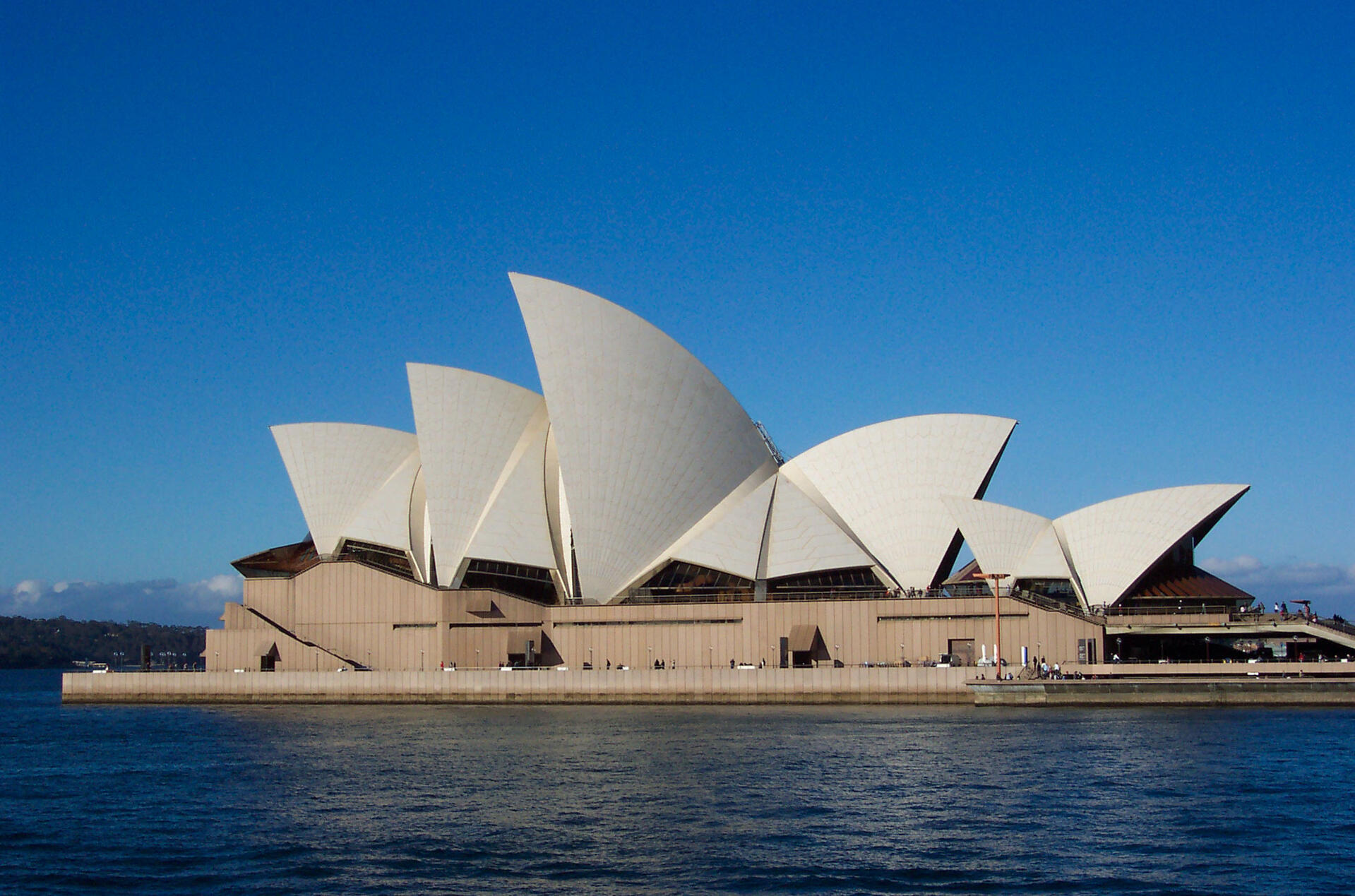
The Sydney Opera House, inaugurated in 1973, stands as a testament to the fusion of artistic creativity, innovative design, and engineering prowess. This architectural marvel, situated at the tip of a peninsula overlooking Sydney Harbour, has left an indelible mark on the global landscape of modern architecture.
Inscribed as a UNESCO World Heritage Site in 2007, the Sydney Opera House embodies a radical departure from traditional construction methods. The brainchild of Danish architect Jørn Utzon, the project won an international competition in 1957, marking a turning point in architectural history. Utzon's vision for the Opera House was to create a harmonious blend of art, technology, and nature, resulting in a structure that transcends mere functionality and becomes a living, breathing work of art.
The Opera House is composed of a series of precast concrete shells, arranged in two main groups that form the roofs of the Concert Hall and Opera Theatre, along with smaller shells covering ancillary spaces, including dining areas such as the renowned Bennelong Restaurant. These shells rest on a massive podium, surrounded by terraced pedestrian concourses. This unique design not only provides a striking visual spectacle but also allows for seamless integration between the indoor performance spaces and the outdoor harbor setting.
One of the most captivating aspects of the Sydney Opera House is its distinctive silhouette against the backdrop of Sydney Harbour. The shells, with their curved forms and intricate patterns, create a dynamic and ever-changing visual experience, particularly during sunrise, sunset, or when illuminated at night. This aesthetic appeal, combined with the building's exceptional acoustics, contributes to its status as one of the world's premier performing arts centers.
The construction of the Sydney Opera House was fraught with challenges, including cost overruns, delays, and disputes between Utzon and the project's Australian partners. Despite these obstacles, the Opera House was finally completed in 1973, five years behind schedule and significantly over budget. However, the finished product more than justified the effort and expense, earning widespread acclaim for its beauty, ingenuity, and cultural significance.
Today, the Sydney Opera House continues to thrive as a vibrant hub of artistic expression, hosting a diverse range of performances, exhibitions, and events. It serves as a symbol of Australia's rich cultural heritage and a beacon of inspiration for artists, architects, and visitors alike. As a UNESCO World Heritage Site, the Sydney Opera House stands as a reminder of the power of human imagination, perseverance, and the ability to create something truly extraordinary.
UNESCO Description of the World Heritage Site
Inaugurated in 1973, the Sydney Opera House is a great architectural work of the 20th century that brings together multiple strands of creativity and innovation in both architectural form and structural design. A great urban sculpture set in a remarkable waterscape, at the tip of a peninsula projecting into Sydney Harbour, the building has had an enduring influence on architecture. The Sydney Opera House comprises three groups of interlocking vaulted ‘shells’ which roof two main performance halls and a restaurant. These shell-structures are set upon a vast platform and are surrounded by terrace areas that function as pedestrian concourses. In 1957, when the project of the Sydney Opera House was awarded by an international jury to Danish architect Jørn Utzon, it marked a radically new approach to construction.
UNESCO Justification of the World Heritage Site
Criterion (i): The Sydney Opera House is a great architectural work of the 20th century. It represents multiple strands of creativity, both in architectural form and structural design, a great urban sculpture carefully set in a remarkable waterscape and a world famous iconic building.
Encyclopedia Record: Sydney Opera House
The Sydney Opera House is a multi-venue performing arts centre in Sydney, New South Wales, Australia. Located on the foreshore of Sydney Harbour, it is widely regarded as one of the world's most famous and distinctive buildings, and a masterpiece of 20th-century architecture.Additional Site Details
Area: 5.8 hectares
Number of Components: 1
Coordinates: -33.8566666667 , 151.2152777777
World Heritage Research
Discover scientific research and academic studies that deepen our understanding of Sydney Opera House from its history and significance to its conservation, management, and contemporary challenges.
-
Digital Heritage Construction:Creating a Virtual Reality Experience of the Construction of the Sydney Opera House
Virtual reality can significantly enhance the interpretation of architectural heritage by revealing the cultural significance embedded in construction processes. A study on the Sydney Opera House demonstrates that immersive digital environments, created through 3D reconstruction and analysis of original construction drawings, effectively communicate the historical value of construction methods and temporary activities. This approach expands heritage interpretation beyond the completed building, supporting education and public engagement. The project, which won a National Trust Heritage Award in 2024, showcases how digital tools can bridge the gap between past construction practices and contemporary understanding.
Stracchi, P., Globa, A., & Cardellicchio, L. (2026). Digital Heritage Construction:Creating a Virtual Reality Experience of the Construction of the Sydney Opera House. The University of Sydney. https://doi.org/10.25910/WTV4-C232
View Publication Record | Read Publication -
The Sydney Opera House – a modern heritage site’s response to climate change
Over the past three decades, the Sydney Opera House has successfully integrated climate action into its heritage management without compromising its tangible or intangible values. This study demonstrates that sustainable practices—such as governance-driven climate initiatives, community engagement through creative programming, and participatory risk planning—can both mitigate climate risks and enhance a site's cultural significance. By setting and achieving environmental benchmarks while respecting heritage constraints, the Opera House serves as a model for balancing conservation with modern sustainability challenges.
Matarese, L., & Bombonato, E. (2025). The Sydney Opera House – a modern heritage site’s response to climate change. Built Heritage, 9(1). https://doi.org/10.1186/s43238-025-00185-0
View Publication Record | Read Publication -
Architect Yuzo Mikami’s Traces in the Sydney Opera House
Newly uncovered primary sources—including drawings, notes, and letters—reveal the significant but underappreciated contributions of Japanese architect Yuzo Mikami to the design of Sydney Opera House. Mikami's involvement spanned three distinct phases (Utzon, Arup, and Hall periods), during which he played a key role in shaping architectural elements such as concourse beams, shell roofs, warped surfaces, and glass walls. Analysis of these materials demonstrates that Mikami’s archives are invaluable for historical and technological studies of the landmark. This research sheds light on a previously overlooked aspect of the Opera House's design process.
OKAZAKI, H., & MOTOOKA, N. (2025). シドニーオペラハウスにおける建築家三上祐三の事跡. Journal of Architecture and Planning (Transactions of AIJ), 90(836), 2304–2314. https://doi.org/10.3130/aija.90.2304
View Publication Record | Read Publication -
Sydney Opera House, 1957–1973
The Sydney Opera House, renowned for its iconic silhouette, exemplifies the evolution of research-led design in architecture. Its North Foyer window, initially proposed by Jørn Utzon but completed under Peter Hall's guidance, showcases a complex geometric and material innovation that was pioneering at the time. This window, the largest glazed element, represents a transition from Utzon’s poetic vision to Hall’s more compromised yet structurally intricate solution. The study highlights how this design trajectory set a precedent for contemporary high-level building practices, blending tectonic complexity, sensory materials, and spatial uplift. Despite its compromised final form, the window remains a testament to the interplay of architectural ambition and practical execution.
Utzon, J., & Hall, P. (2024). Sydney Opera House, 1957–1973. Great Windows in Modern Architecture, 202–214. https://doi.org/10.4324/9780429341977-19
View Publication Record | Read Publication -
A piè di Opera. La fabbrica delle vele per la Sydney Opera House
Recently uncovered documents and drawings challenge the canonical history of the Sydney Opera House's iconic 'sails,' revealing sophisticated manufacturing solutions that underpin its structural design. These materials, including formwork blueprints, temporary structure designs, site images, and contractor notes, demonstrate a combination of structural ingenuity and manufacturing flexibility that contradicts the long-standing narrative of a 'spherical solution.' The findings highlight the importance of re-evaluating the historical accounts of this UNESCO World Heritage Site's construction, offering new insights into its architectural and engineering achievements.
Stracchi, P., Cardellicchio, L., & Tombesi, P. (2023). A piè di Opera. La fabbrica delle vele per la Sydney Opera House. Visioni Strutturali, 32–43. https://doi.org/10.2307/jj.4688111.6
View Publication Record | Read Publication -
Structural reality and architectural editing: the four invisible columns of the Sydney Opera House
A critical examination of the Sydney Opera House's architectural narrative reveals the omission of four key structural columns, challenging the idealized perception of this UNESCO World Heritage Site. The study argues that such exclusions reflect a broader trend in architecture to abstract away engineering details, prioritizing aesthetic and symbolic significance over functional reality. By analyzing the building's documented history, the research highlights the importance of acknowledging even minor yet structurally significant elements in architectural discourse. This work prompts a reevaluation of how canonical narratives are constructed, emphasizing the value of embracing technical specifics to enrich our understanding of iconic structures.
Tombesi, P., Stracchi, P., & Cardellicchio, L. (2023). Structural reality and architectural editing: the four invisible columns of the Sydney Opera House. Architectural Research Quarterly, 27(1), 49–60. https://doi.org/10.1017/s1359135523000052
View Publication Record | Read Publication -
Form, Function and Monumentality: A Critical Analysis of Jørn Utzon’s Late Work on the Sydney Opera House
Jørn Utzon's reengagement with the Sydney Opera House in 1999 challenged preconceived notions about its status as either an 'unfinished' or 'salvaged' masterpiece, revealing a more complex narrative of architectural evolution and monumentality. The study analyzes Utzon’s late work and his successors', including a controversial proposal for a New Opera Theatre, demonstrating how the building could adapt to evolving functional needs without compromising its iconic form. This research highlights inherent contradictions in the concept of a 'modern monument,' where fixed external aesthetics must balance with dynamic internal requirements. Through three key projects, Utzon’s reintegration signaled his recognition of these challenges and offered a path for the Opera House's continued relevance.
Nobis, P., Komac, U., & London, K. (2023). Form, Function and Monumentality: A Critical Analysis of Jørn Utzon’s Late Work on the Sydney Opera House. Fabrications, 33(1), 196–219. https://doi.org/10.1080/10331867.2023.2237756
View Publication Record | Read Publication