World Heritage Identification Number: 167
World Heritage since: 1981
Category: Mixed Cultural Heritage and Natural Heritage
WHE Type: Natural Landscapes & Geographic Features
Transboundary Heritage: No
Endangered Heritage: No
Country: 🇦🇺 Australia
Continent: Oceania
UNESCO World Region: Asia and the Pacific
Map
Exploring the Willandra Lakes Region: A Unique Landmark in Human History
The Willandra Lakes Region, located in the far southwest of New South Wales, Australia, is an extraordinary landscape shaped by ancient lakes, changing climates, human occupation, and the history of Australia's distinctive wildlife. Inscribed on the UNESCO World Heritage List in 1981, the property preserves an exceptional record of the Pleistocene epoch, including ancient lake systems, fossil remains, and some of the earliest evidence of human activity on the Australian continent.
Because of its unique combination of natural and human history, the Willandra Lakes Region, which covers approximately 2,400 square kilometers (930 square miles), is officially classified by UNESCO as a mixed World Heritage site. It meets criteria for both its exceptional natural features, preserving an outstanding record of the Pleistocene landscape and ancient lake geomorphology, and its profound cultural significance, providing exceptional testimony to tens of thousands of years of human occupation, ritual, and adaptation
The Willandra Lakes Region is the traditional Country of the Barkandji/Paakantyi, Mutthi Mutthi, and Ngiyampaa peoples, who have maintained a deep connection with the landscape for at least 50,000 years. Their relationship with the region extends beyond the archaeological record and continues today through cultural knowledge, custodianship, and involvement in the protection and management of the area.
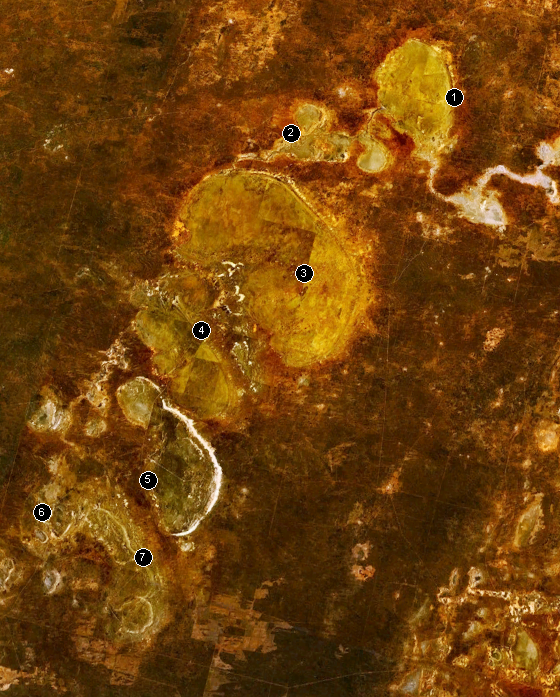
The landscape consists of a series of ancient lakes, now largely dry, together with distinctive sand dunes and crescent-shaped formations known as lunettes. These features developed during the Pleistocene and preserve evidence of major environmental and climatic changes. During wetter periods, the lakes held freshwater and supported a variety of plants, animals, and human communities; as the climate became increasingly dry, the lakes gradually contracted and ceased to function as lake ecosystems approximately 18,500 years ago, leaving behind the sediments and landforms visible today.
One of the most intriguing aspects of the Willandra Lakes Region is its wealth of fossil remains. The ancient lake sediments have preserved evidence of Australia's extinct megafauna, including Diprotodon optatum, the largest known marsupial, which could weigh up to several tons. Other notable species include Thylacoleo carnifex, a large predatory marsupial commonly known as the marsupial lion, and Zygomaturus trilobus, a large herbivorous marsupial related to modern wombats. These fossils provide valuable insights into the animals that inhabited Australia during the Pleistocene and the ecosystems in which they lived.
In addition to its paleontological significance, the Willandra Lakes Region has a rich archaeological record. Evidence indicates that Aboriginal people have occupied the region for 45,000–60,000 years, providing valuable insights into the early history of human settlement in Australia. Archaeological discoveries include stone tools, grinding stones, hearths, pigments, shell deposits, and human burials, revealing aspects of the lives and cultural practices of the people who lived around the ancient lakes.
Lake Mungo is one of the best-known parts of the World Heritage property and has produced some of its most significant archaeological discoveries. Its ancient shoreline includes the Walls of China, a striking crescent-shaped lunette formed from layers of sand and sediment deposited around the former lake. These layers preserve evidence of changing environmental conditions as well as traces of Aboriginal occupation.
The region is particularly well known for one of the earliest known ritual cremations in the world: the remains of Mungo Woman, whose cremation burial dates to at least 42,000 years ago. Mungo Man, who was buried in an ochre-rich grave of similar antiquity, provides further evidence of the cultural practices of the region's early Aboriginal inhabitants. Together, these discoveries offer important insights into Aboriginal cultural traditions and the long history of human occupation in Australia. The remains of Mungo Man and other Aboriginal people from the Willandra Lakes were returned to the Traditional Owners in 2017.
The archaeological record also reveals how Aboriginal communities adapted to a changing environment. When the lakes held freshwater, they provided resources that supported human communities, while the gradual drying of the lake system transformed the landscape and the resources available within it. The sediments and lunettes preserve evidence of these environmental changes alongside traces of human activity, allowing researchers to examine the relationship between climate, landscape, wildlife, and human adaptation over thousands of years.
The significance of the Willandra Lakes Region extends beyond its archaeological and scientific evidence, because the landscape remains part of the living cultural heritage of its Traditional Owners. The Barkandji/Paakantyi, Mutthi Mutthi, and Ngiyampaa peoples maintain enduring connections with Country, and their knowledge contributes to the understanding and protection of the region's cultural sites and landscapes. This continuing relationship gives the area a significance that reaches beyond the ancient remains preserved in its soils and sediments.
The natural landscape of the Willandra Lakes Region remains largely semi-arid, with dry lake beds surrounded by bluebush, saltbush, mallee, cypress pine, and grasses. Although the ancient lakes no longer function as permanent freshwater systems, their sediments and surrounding landforms continue to provide valuable evidence of the region's former environments. The World Heritage property also faces conservation challenges, including erosion, invasive species, grazing pressure, and the need to protect sensitive archaeological and cultural sites.
The Willandra Lakes Region offers an exceptional record of the interaction between people and a changing Australian landscape. Its fossil deposits reveal a vanished world of giant marsupials, while its archaeological sites document some of the earliest known human activities on the continent. At the same time, the continuing cultural connection of the Barkandji/Paakantyi, Mutthi Mutthi, and Ngiyampaa peoples gives the landscape a living heritage that extends far beyond its archaeological remains. Protecting the Willandra Lakes Region therefore means preserving not only an extraordinary record of Australia's past but also a landscape that remains culturally significant to its Traditional Owners today.
UNESCO Description of the World Heritage Site
The fossil remains of a series of lakes and sand formations that date from the Pleistocene can be found in this region, together with archaeological evidence of human occupation dating from 45–60,000 years ago. It is a unique landmark in the study of human evolution on the Australian continent. Several well-preserved fossils of giant marsupials have also been found here.
UNESCO Justification of the World Heritage Site
Criterion (iii): The drying up of the Willandra Lakes some 18,500 years BP allowed the survival of remarkable evidence of the way early people interacted with their environment. The undisturbed stratigraphy has revealed evidence of Homo sapiens sapiens in this area from nearly 50,000 years BP, including the earliest known cremation, fossil trackways, early use of grindstone technology and the exploitation of fresh water resources, all of which provide an exceptional testimony to human development during the Pleistocene period.
Criterion (viii): The Australian geological environment, with its low topographic relief and low energy systems, is unique in the longevity of the landscapes it preserves, and the Willandra Lakes provides an exceptional window into climatic and related environmental changes over the last 100,000 years. The Willandra Lakes, largely unmodified since they dried out some 18,500 years BP, provide excellent conditions for recording the events of the Pleistocene Epoch, and demonstrate how non-glaciated zones responded to the major glacial-interglacial fluctuations. The demonstration at this site of the close interconnection between landforms and pedogenesis, palaeochemistry, climatology, archaeology, archaeomagnetism, radiocarbon dating, palaeoecology and faunal extinction, represents a classic landmark in Pleistocene research in the Australasian area. Willandra Lakes Region is also of exceptional importance for investigating the period when humans became dominant in Australia, and the large species of wildlife became extinct, and research continues to elucidate what role humans played in these events.
Encyclopedia Record: Willandra Lakes Region
The Willandra Lakes Region is a World Heritage Site in the Far West region of New South Wales, Australia. The Willandra Lakes Region is the traditional meeting place of the Muthi Muthi, Ngiyampaa and Paakantyi Aboriginal peoples. The 2,400-square-kilometre (930 sq mi) area was inscribed on the World Heritage List at the 5th Session of the World Heritage Committee in 1981.Additional Site Details
Area: 240,000 hectares
Number of Components: 1
(viii) — Outstanding example representing major earth stages
Coordinates: -34 , 143
IUCN World Heritage Outlook
The 2025 Conservation Outlook on Willandra Lakes Region reports the following assessment:
Source: International Union for Conservation of Nature (IUCN) · View assessment
Image
Unknown, Public domain
World Heritage Research
Discover scientific research and academic studies that deepen our understanding of Willandra Lakes Region from its history and significance to its conservation, management, and contemporary challenges.
-
Long‐term hydrologic connectivity on the Australian dryland margins: Evidence from the Willandra Lakes World Heritage Area over the last 60 ky
A new study reveals that the Willandra Lakes Region experienced rapid and extreme hydrologic shifts during the Last Glacial Maximum (LGM), despite lower precipitation and increased evaporation. Unlike prior periods where permanent lakes persisted due to higher catchment precipitation, the LGM saw rapid cycles of lake filling and drying, driven by seasonal snowmelt from highland headwaters and reduced vegetation cover, which enhanced runoff efficiency. This research integrates sediment-based chronologies, water-flux modeling, and palaeoclimate reconstructions to quantify thresholds for lake system filling and reconstruct past hydroclimatic conditions over the last 60,000 years.
Fitzsimmons, K. E., Fischer, M. L., Smith, T., Lauer, T., Nowatzki, M., Mishra, K., & Murray‐Wallace, C. V. (2025). Long‐term hydrologic connectivity on the Australian dryland margins: Evidence from the Willandra Lakes World Heritage Area over the last 60 ky. Journal of Quaternary Science, 40(5), 876–892. Portico. https://doi.org/10.1002/jqs.3717
View Publication Record | Read Publication -
Radiocarbon and luminescence age estimate database for the Willandra Lakes Region World Heritage Area: a reliability-assurance assessment
A reliability-assured chronostratigraphic framework for the Willandra Lakes Region World Heritage Area reveals distinct palaeoenvironmental phases spanning from 56.2 ± 3.0 to 17.2 ± 0.7 ka, based on high-confidence optically stimulated luminescence (OSL) and radiocarbon age estimates. The study identified three lacustrine phases: a system-wide high-water period (~55–35 ka cal BP), a short pulse reaching Lake Outer Arumpo (~29–24 ka cal BP), and a final saline phase at Lake Mungo (~21–17 ka cal BP) while freshwater conditions persisted at Lake Mulurulu. Only 62 of 143 radiocarbon ages linked to archaeological features were deemed reliable, highlighting gaps in documenting land-use history. The research compiled and ranked 661 age estimates (radiocarbon, OSL, thermoluminescence), emphasizing the need for expanded, contextually diverse geochronological data to clarify both palaeoenvironmental change and human occupancy patterns.
Jankowski, N. R., Stern, N., Foley, E., Jacobsen, G., Cadd, H., & Smith, T. (2025). Radiocarbon and luminescence age estimate database for the Willandra Lakes Region World Heritage Area: a reliability-assurance assessment. Quaternary Geochronology, 89, 101678. https://doi.org/10.1016/j.quageo.2025.101678
View Publication Record | Read Publication -
Introduction: Southern Hemisphere records of Late Quaternary climate change, people and dust
A Special Issue of the Journal of Quaternary Science explores Late Quaternary climate change, human-environment interactions, and dust records across the Southern Hemisphere. The research highlights diverse regional studies, including investigations into peatland initiation in Subantarctic Islands, palaeolake dynamics in southern Africa, marine bioerosion traces in Argentina, and glacial fluctuations in the Andes. Australian contributions focus on hydroclimatic variability in the Kimberley region, lake level history in the Willandra Lakes World Heritage area, and vegetation shifts on Minjerribah and K'gari islands. The studies utilize a range of methods such as sedimentology, geochemistry, pollen analysis, luminescence dating, and multi-proxy approaches to reconstruct past environmental conditions and provide insights into ongoing climate change impacts.
Newnham, R., Fitzsimmons, K. E., Knight, J., MacKenzie, L., & Moss, P. (2025). Introduction: Southern Hemisphere records of Late Quaternary climate change, people and dust. Journal of Quaternary Science, 41(1), 1–3. Portico. https://doi.org/10.1002/jqs.70026
View Publication Record | Read Publication -
Treading lightly on Country: developing a co-designed pathway for the study of the Willandra’s ancient environments
A groundbreaking co-designed research protocol for the Willandra Lakes Region World Heritage Area (WLRWHA) establishes a framework for Earth Science studies that prioritizes Indigenous knowledge and collaboration with Traditional Owners. This approach, developed alongside the Willandra Lakes Region Aboriginal Advisory Group (WLRAAG), addresses historical colonial biases in geological research by integrating Research Principals and practical guidance into study protocols. The protocol ensures respectful engagement with the landscape while advancing scientific understanding of ancient environments. It serves as a model for decolonizing Earth Science research through trust-building, mutual learning, and sustainable practices that 'tread lightly' on Country.
Jankowski, N., & Willandra Lakes Region Aboriginal Advisory Group. (2025). Treading lightly on Country: developing a co-designed pathway for the study of the Willandra’s ancient environments. University of Wollongong. https://doi.org/10.71747/UOW-R3GK326M.30633059
View Publication Record | Read Publication -
A revised chronology and depositional history for the Outer Arumpo lunette, Willandra Lakes Region World Heritage Area, NSW
Lakes in the Willandra Lakes Region World Heritage Area exhibit distinct hydrologic histories, challenging the long-held assumption that Lake Mungo's depositional record is representative of the entire system. A new study reveals that the Outer Arumpo (OA) lunette experienced significant lake level fluctuations between ~40–38 ka ago, contrasting with the relatively stable conditions at Lake Mungo during the same period. Bayesian modeling of 52 single-grain OSL ages and sediment micromorphological analysis across seven stratigraphic units demonstrates that OA's hydrologic history is unique, with lake filling occurring from ~80–56 ka ago and subsequent rapid fluctuations. This research underscores the need for site-specific stratigraphic frameworks to accurately interpret landscape changes in multi-lake systems.
Jankowski, N., Turnbull, M., Cadd, H., Stern, N., & Willandra Lakes Region Aboriginal Advisory Group. (2025). A revised chronology and depositional history for the Outer Arumpo lunette, Willandra Lakes Region World Heritage Area, NSW. University of Wollongong. https://doi.org/10.71747/UOW-R3GK326M.30633092
View Publication Record | Read Publication -
Lead (Pb) isotope signatures for silcrete sources from the Willandra Lakes region, Australia: A pilot study of a new method for provenancing silcrete artefacts
A pilot study demonstrates that lead (Pb) isotope analysis can effectively differentiate silcrete sources within the UNESCO World Heritage-listed Willandra Lakes Region, Australia. The research reveals distinct Pb isotope signatures between silcrete sources, enabling potential provenance tracking of artefacts. While intra-source variation lacks spatial patterning, inter-source differences are clear, particularly for more distant sources. This method offers a promising new approach to investigate how silcrete was utilized and transported across landscapes in prehistoric times.
Kurpiel, R., Pickering, R., Maas, R., & Stern, N. (2019). Lead (Pb) isotope signatures for silcrete sources from the Willandra Lakes region, Australia: A pilot study of a new method for provenancing silcrete artefacts. La Trobe. https://doi.org/10.26181/28880924
View Publication Record | Read Publication -
Life stories
Archaeological discoveries at the Willandra Lakes Region, a UNESCO World Heritage Site in western New South Wales, have reshaped our understanding of Australia's human history. The skeletal remains of Mungo Lady (WLH 1) and Mungo Man (WLH 3), dated to approximately 42,000 years ago during the late Pleistocene era, were found by geologist Jim Bowler in 1968 and 1974, respectively. These findings challenged the prevailing belief that Aboriginal Australians had arrived on the continent only a few thousand years prior, demonstrating instead a deep temporal continuity spanning tens of thousands of years. The discoveries, made during a geomorphological study of the region's interconnected lake system, also highlight the significance of Indigenous knowledge and land management practices in shaping the landscape over millennia.
Allbrook, M. (2024). Life stories. Reframing Indigenous Biography, 18–21. https://doi.org/10.4324/9781003351863-2
View Publication Record | Read Publication