World Heritage Identification Number: 32
World Heritage since: 1978
Category: Cultural Heritage
WHE Type: Buildings & Architectural Ensembles
Transboundary Heritage: No
Endangered Heritage: No
Country: 🇵🇱 Poland
Continent: Europe
UNESCO World Region: Europe and North America
Map
Wieliczka and Bochnia Royal Salt Mines: A Journey Through Time in Southern Poland
The Wieliczka and Bochnia Royal Salt Mines, inscribed as a UNESCO World Heritage Site in 1978, offer a unique glimpse into the rich history of salt mining in Europe. Located in the towns of Wieliczka and Bochnia, near Kraków in southern Poland, these mines represent one of the oldest and most significant industrial endeavors in the continent's history.
More to come…UNESCO Description of the World Heritage Site
The deposit of rock salt in Wieliczka and Bochnia has been mined since the 13th century. This major industrial undertaking has royal status and is the oldest of its type in Europe. The site is a serial property consisting of Wieliczka and Bochnia salt mines and Wieliczka Saltworks Castle. The Wieliczka and Bochnia Royal Salt Mines illustrate the historic stages of the development of mining techniques in Europe from the 13th to the 20th centuries: both mines have hundreds of kilometers of galleries with works of art, underground chapels and statues sculpted in the salt, making a fascinating pilgrimage into the past. The mines were administratively and technically run by Wieliczka Saltworks Castle, which dates from the medieval period and has been rebuilt several times in the course of its history.
UNESCO Justification of the World Heritage Site
Criterion (iv): The Wieliczka and Bochnia Royal Salt Mines illustrate the historic stages of the development of mining techniques in Europe, from the 13th to the 20th centuries. The galleries, the subterranean chambers arranged and decorated in ways that reflect the miners’ social and religious traditions, the tools and machinery, and the Saltworks Castle which administered the establishment for centuries, provide outstanding testimony about the socio-technical system involved in the underground mining of rock salt.
Encyclopedia Record: Wieliczka Salt Mine
The Wieliczka Salt Mine is a salt mine in the town of Wieliczka, near Kraków in southern Poland.Additional Site Details
Area: 1,104.947 hectares
Number of Components: 3
Coordinates: 49.9791666667 , 20.0638888889
Image
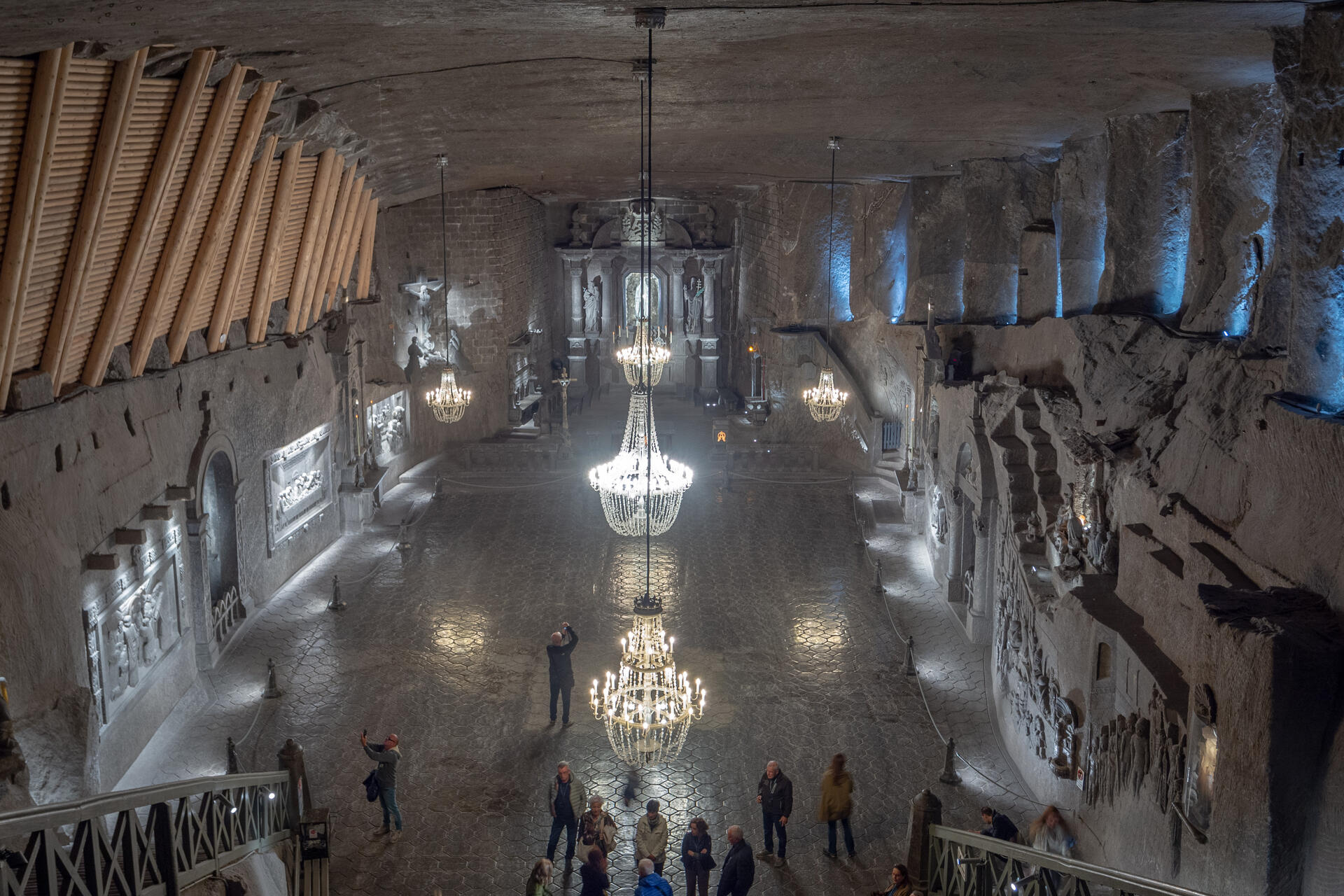
© C messier, CC BY-SA 4.0 Resized from original. (This derivative is under the same CC BY-SA license.)
World Heritage Research
Discover scientific research and academic studies that deepen our understanding of Wieliczka and Bochnia Royal Salt Mines from its history and significance to its conservation, management, and contemporary challenges.
-
Study on the Cultural Value of the World Heritage of Salt Industry
Salt industry heritage sites, including Poland's Wieliczka and Bochnia Royal Salt Mines, France's Ark-Sennan Royal Saltwork, and Austria's Salzkammergut Cultural Landscape, exhibit significant cultural value that aligns with UNESCO World Heritage Assessment Standards. These sites, primarily selected under the cultural heritage criterion (iv), demonstrate authenticity and irreplaceability in their representation of salt culture. The study highlights the importance of integrating these sites more systematically with international standards to better reflect their unique contributions to global heritage. While other countries, such as China, also possess rich salt industry relics, Europe remains a focal point for these World Heritage designations.
Yang, L., & Li, K. (2019). Study on the Cultural Value of the World Heritage of Salt Industry. Proceedings of the 4th International Conference on Economy, Judicature, Administration and Humanitarian Projects (JAHP 2019). https://doi.org/10.2991/jahp-19.2019.28
View Publication Record | Read Publication -
Heterogeniczność przestrzeni miast salinarnych Bochni i Wieliczki w dobie przedprzemysłowej
The spatial organization and social dynamics of the Wieliczka and Bochnia Royal Salt Mines, two UNESCO World Heritage Sites, were significantly influenced by salt mining activities during the pre-industrial era. Urbanistic analysis reveals distinct layouts: Bochnia's plan from 1253 suggests a transverse-oriented square with centralized religious and public functions, mirroring earlier designs like Legnica, while Wieliczka's later incorporation (1290) features a rectangular market square with power structures and sacred spaces at its periphery. The study highlights the impact of royal investments, such as the construction of a canal linking Krakow and Bochnia, on urban development and economic growth. It also explores the evolution of suburbs, new settlements, and religious complexes, particularly in response to Austrian administrative changes post-1778, which included road network expansions and secular transformations. The research underscores the heterogeneous nature of these salt towns, shaped by mining, governance, and cultural dynamics.
Krasnowolski, B. (2016). Heterogeniczność przestrzeni miast salinarnych Bochni i Wieliczki w dobie przedprzemysłowej. Archaeologia Historica Polona, 23, 229. https://doi.org/10.12775/ahp.2015.010
View Publication Record | Read Publication -
„Rodzime i obce” w krajobrazie kulturowym średniowiecznych ziem polskich
The Wieliczka and Bochnia Royal Salt Mines played a pivotal role in the economic transformation of Central Eastern Europe during the late Middle Ages. This study reveals that the intensification of mining activities, particularly salt extraction, was not merely a result of Western influence but also driven by local demand for non-ferrous metals and regional economic development. The research highlights the complex interplay between 'domestic' and 'foreign' elements in shaping the cultural landscape, with Western patterns adapting to local realities while maintaining distinct social and economic functions. By analyzing archaeological evidence and historical records, the study demonstrates that mining centers like Wieliczka and Bochnia were integral to the commercialization process, supported by new rural settlements and fortified castles. The findings underscore the nuanced nature of cultural exchange during this period, challenging simplistic narratives of Western dominance.
Piekalski, J., & Wachowski, K. (2014). „Rodzime i obce” w krajobrazie kulturowym średniowiecznych ziem polskich. Archaeologia Historica Polona, 21(0), 127. https://doi.org/10.12775/ahp.2013.007
View Publication Record | Read Publication