World Heritage Identification Number: 29
World Heritage since: 1978
Category: Cultural Heritage
WHE Type: Historic Cities & Urban Areas
Transboundary Heritage: No
Endangered Heritage: No
Country: 🇵🇱 Poland
Continent: Europe
UNESCO World Region: Europe and North America
Map
The Historic Centre of Kraków: A Cultural Treasure Trove
The Historic Centre of Kraków, inscribed as one of the first 12 sites on the inaugural UNESCO World Heritage List in 1978, stands as a remarkable testament to Poland’s rich cultural heritage. Situated at the foot of the Royal Wawel Castle, a complex of Gothic and Renaissance architecture, this historic centre preserves the legacy of Poland’s former capital, offering a captivating blend of architectural styles, historical landmarks, and vibrant urban life.
At the heart of the Historic Centre lies the Main Market Square (Rynek Główny), one of the largest medieval town squares in Europe. This bustling hub is surrounded by a variety of historic buildings, including houses, palaces, and churches, many with interiors reflecting centuries of artistic achievement. While some structures date back to the 13th century, providing a tangible link to the town's intriguing past, others were rebuilt or renovated over time, providing a layered glimpse into the city’s evolving history.
Dominating the square is St. Mary’s Basilica, a Gothic church famous for its stunning wooden altarpiece by Veit Stoss, widely regarded as one of the world’s greatest works of Gothic art. Another prominent landmark is the Cloth Hall (Sukiennice), a Renaissance building that has long served as a center of trade and now houses shops selling local goods and crafts.
Beyond St. Mary’s Basilica, Kraków’s Historic Centre is home to several other notable churches and cultural spaces that enrich the city’s architectural and spiritual landscape. The Church of St. Peter and Paul, a striking Baroque structure, and the Romanesque Church of St. Adalbert near the Main Market Square, showcase the city’s stylistic diversity across centuries.
Beyond the market square, the Historic Centre reveals further layers of history. Remnants of 14th-century fortifications and defensive walls can still be seen, offering a glimpse into Kraków’s medieval defenses. These are linked by the Planty Park, a unique horseshoe-shaped garden that encircles the Old Town on the site of the former city walls. The city’s streets and squares are alive with festivals, markets, and performances, while local traditions, crafts, and culinary specialties reflect Kraków’s enduring cultural spirit.
The medieval Kazimierz district, located in the southern part of the town, is another significant area. Established in the 14th century as a separate city, it was once home to a thriving Jewish community. Today, Kazimierz preserves several ancient synagogues, serving as a poignant reminder of the region's religious diversity.
Two other key landmarks within the Historic Centre are the Jagiellonian University and the Gothic cathedral known as Wawel Cathedral. Founded in 1364, the Jagiellonian University is one of the oldest universities in the world and has played a pivotal role in shaping Polish intellectual life. Wawel Cathedral, on the other hand, has served for centuries as the coronation site and burial place of Polish monarchs, embodying the soul of the nation.
Altogether, the Historic Centre of Kraków offers a unique blend of history, culture, and urban vitality. With its grand castles, bustling market squares, ancient synagogues, and prestigious universities, this UNESCO World Heritage Site provides a captivating window into Poland's rich past and enduring spirit. Whether you're a history enthusiast, a culture seeker, or simply someone looking for a memorable travel experience, the Historic Centre of Kraków promises an unforgettable journey through time.
UNESCO Description of the World Heritage Site
The Historic Centre of Kraków, the former capital of Poland, is situated at the foot of the Royal Wawel Castle. The 13th-century merchants' town has Europe's largest market square and numerous historical houses, palaces and churches with their magnificent interiors. Further evidence of the town's fascinating history is provided by the remnants of the 14th-century fortifications and the medieval site of Kazimierz with its ancient synagogues in the southern part of town, Jagellonian University and the Gothic cathedral where the kings of Poland were buried.
UNESCO Justification of the World Heritage Site
Criterion (iv): Kraków is an urban architectural ensemble of outstanding quality, in terms of both its townscape and its individual monuments. The historic centre of the town admirably illustrates the process of continuous urban growth from the Middle Ages to the present day.
Encyclopedia Record: Kraków Old Town
Kraków Old Town is the historic part of the city of Kraków within the Planty Park, Poland.Additional Site Details
Area: 149.65 hectares
Number of Components: 1
Coordinates: 50.0613888889 , 19.9372222222
Image
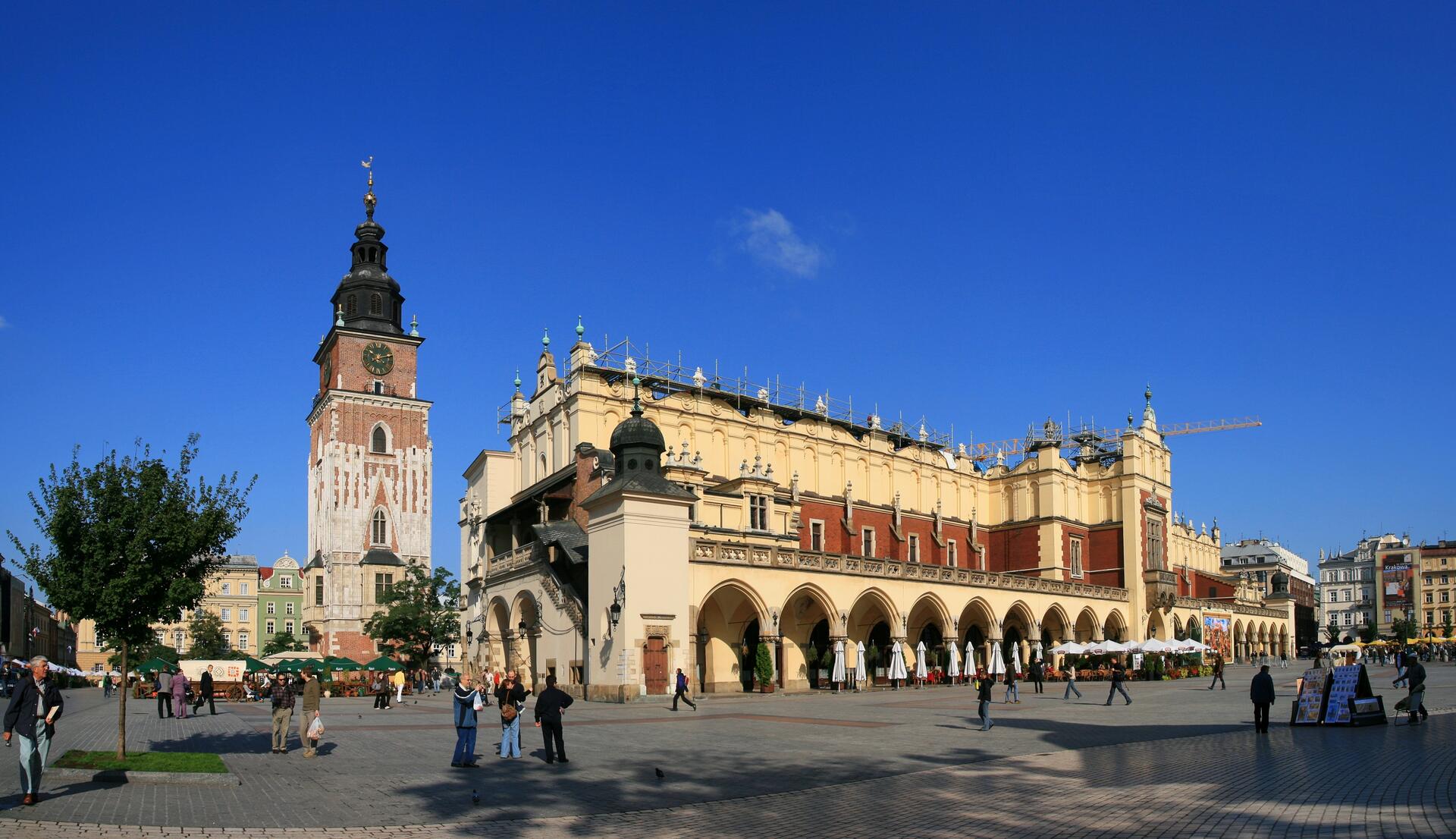
© Lestat (Jan Mehlich), CC BY-SA 3.0 Resized from original. (This derivative is under the same CC BY-SA license.)
World Heritage Research
Discover scientific research and academic studies that deepen our understanding of Historic Centre of Kraków from its history and significance to its conservation, management, and contemporary challenges.
-
Tourism-led regeneration projects in World Heritage Cities through the Historic Urban Landscape lens: a street-level comparative analysis of Kraków, Poland and Yazd, Iran
A comparative analysis of tourism-led regeneration projects in two UNESCO World Heritage Cities—Kraków, Poland, and Yazd, Iran—reveals that the maturity level of tourism significantly influences project outcomes. The study, employing a street-level lens and the Historic Urban Landscape (HUL) approach, demonstrates that context-sensitive planning is crucial for effective regeneration. Using statistical methods like the Mann–Whitney U test and effect-size analysis, researchers propose a staged HUL framework to guide future urban development in both emerging and mature World Heritage Cities. This framework aims to balance conservation with sustainable tourism growth, offering practical insights for heritage management.
Aslani, E., & Kapusta, A. (2026). Tourism-led regeneration projects in World Heritage Cities through the Historic Urban Landscape lens: a street-level comparative analysis of Kraków, Poland and Yazd, Iran. Town Planning Review, 1–31. https://doi.org/10.3828/tpr.2026.4
View Publication Record | Read Publication -
Quantifying authenticity in historic districts: an integrated framework of morphological indicators and social perception based on Scenes Theory
Excessive commercialization undermines the authenticity of historic districts, while moderate commercial activity can enhance perceived authenticity. This study applies Scenes Theory to quantify how facility configuration and activity types influence authenticity in Kraków’s Old Town and Kazimierz District. By integrating morphological indicators (Morpho system) with social perception data via OLS regression, researchers identified cultural facilities and interactive activities as key drivers of local, state, and ethnic authenticity. Residential functions also positively contribute to rational authenticity. The findings suggest Scenes Theory can serve as a spatial heritage management tool, bridging objective analysis and subjective experience. Additionally, authentic environments may foster youth cultural identity and place attachment.
Guo, Z., He, S., Li, Y., Ye, C., Xing, C., Xia, J., Yuan, F., & Xie, J. (2026). Quantifying authenticity in historic districts: an integrated framework of morphological indicators and social perception based on Scenes Theory. Humanities and Social Sciences Communications. https://doi.org/10.1057/s41599-026-08683-x
View Publication Record | Read Publication -
Kraków prawobrzeżny. Przemiany historyczno-kraj obrazowe krakowskich Łagiewnik
Łagiewniki, once a rural village south of Kraków, has undergone significant historical and landscape transformations since the Middle Ages. Originally serving as a support settlement for the duke’s castle at Wawel Hill, it evolved into an industrial suburb with distinct urban complexes by the 20th century. The study reveals that while urbanization and industrial development have altered its historic character, remnants of medieval town layouts, traditional houses, and architectural enclaves from the early 1900s persist. Notably, the area’s landscape has been marred by industrial waste dumps and modern constructions, contrasting with its earlier picturesque setting along the Wilga River. The research highlights the tension between preserving historic elements and the impacts of modernization, offering insights into the complex urban evolution of Kraków’s right-bank districts.
Firlet, E. (2026). Kraków prawobrzeżny. Przemiany historyczno-kraj obrazowe krakowskich Łagiewnik. Krzysztofory. Zeszyty Naukowe Muzeum Historycznego Miasta Krakowa, 19, 47–70. https://doi.org/10.32030/krzy.1992.05
View Publication Record | Read Publication -
Pierwszy „Wielki Kraków” – proces „pęknięcia” murów obronnych Krakowa 1791–1802
The year 1802 marked a pivotal shift in Kraków's spatial development, effectively 'splitting' the city's medieval boundaries and expanding its territory. This transformation, driven by the dismantling of defensive walls, incorporated pre-town areas like Groble and Nowy Świat while integrating older settlements such as Kazimierz and Kleparz with mixed reactions. The study highlights how this expansion, though politically constrained in some directions, set the trajectory for Kraków's growth along the Prądnik axis until the mid-19th century. It also notes the contrasting attitudes of western suburbs (e.g., Czarna Wieś) compared to eastern ones (Grzegórzki), and underscores the enduring centrality of the Old Town in Kraków's identity. The research relies on historical, architectural, and urban planning analyses, emphasizing the significance of 1802 as a turning point comparable only to the 1257 Great Location.
Niezabitowski, M. (2026). Pierwszy „Wielki Kraków” – proces „pęknięcia” murów obronnych Krakowa 1791–1802. Krzysztofory. Zeszyty Naukowe Muzeum Historycznego Miasta Krakowa, 23, 71–78. https://doi.org/10.32030/krzy.2005.06
View Publication Record | Read Publication -
Sustainability Tourism Policy as a Tool to Minimise the Negative Effects of Overtourism: Case – UNESCO City of Kraków
Kraków faces significant challenges due to overtourism, with nearly 15 million visitors in 2024. While tourism contributes 8% to the city's GDP and supports 40,000 jobs, it has led to negative impacts on residents' quality of life and the transformation of historic districts into commercial zones. To address these issues, the local government implemented a sustainable tourism policy strategy in 2020, focusing on attracting affluent tourists, developing congresses, and managing areas such as night-time economy, short-term rentals, visitor dispersion, respect for locality, responsible behavior, and city reputation. This case study provides examples of actions taken to balance tourism development, offering insights into effective strategies for minimizing the negative effects of overtourism in UNESCO-listed cities.
Kruczek, Z., Walas, B., & Matyasik, J. (2025). Sustainability Tourism Policy as a Tool to Minimise the Negative Effects of Overtourism: Case – UNESCO City of Kraków. Tourism Cases. https://doi.org/10.1079/tourism.2025.0047
View Publication Record | Read Publication -
Fashion Places, Spaces, and Actors in Two Major Polish Cities. Taking a Closer Look at the Fashion Ecosystem at the Local Level
Urban fashion ecosystems in second-tier Polish cities, such as Kraków and Poznań, are more than just commercial hubs; they also play significant roles in shaping city images and social dynamics. This study reveals that fashion-related actors—ranging from independent designers to educational institutions—cluster in historic quarters, contributing to the cultural identity of these areas beyond mere economic activity. By analyzing field mappings and interviews, researchers identified how these clusters influence urban spaces, particularly in inner cities and historic centres, highlighting their broader impact on city character and fashion landscape.
Działek, J., Murzyn-Kupisz, M., Kocaj, A., & Miśkowiec, M. (2025). Fashion Places, Spaces, and Actors in Two Major Polish Cities. Taking a Closer Look at the Fashion Ecosystem at the Local Level. Changing Geographies of Fashion in the European Semi-Periphery, 417–478. https://doi.org/10.1007/978-3-031-89254-7_9
View Publication Record | Read Publication -
Atlas Niematerialnego Dziedzictwa Krakowa
A pioneering research programme, 'An Atlas of Kraków’s Intangible Heritage,' aims to comprehensively document and safeguard the intangible cultural heritage of Kraków, Poland. The project identifies and studies phenomena such as legends, folk tales, rites, customs, and musical folklore that align with UNESCO's 2003 Convention for the Safeguarding of Intangible Cultural Heritage. Through an interdisciplinary approach involving historians, ethnologists, and cultural anthropologists, the programme employs a robust research apparatus, including field observations, in-depth interviews (IDI), focus group interviews (FGI), and surveys. The initial phase focuses on former villages and jurydyki west of Kraków’s Old Town, incorporated in the 19th and 20th centuries. The project seeks to not only inventory these cultural phenomena but also interpret, present, and popularize them among the public, ensuring their preservation for future generations.
Szoka, A. I. (2025). Atlas Niematerialnego Dziedzictwa Krakowa. Krzysztofory. Zeszyty Naukowe Muzeum Historycznego Miasta Krakowa, 43, 145–160. https://doi.org/10.32030/krzy.2025.10
View Publication Record | Read Publication