World Heritage Identification Number: 905
World Heritage since: 1999
Category: Cultural Heritage
WHE Type: Buildings & Architectural Ensembles
Transboundary Heritage: No
Endangered Heritage: No
Country: 🇵🇱 Poland
Continent: Europe
UNESCO World Region: Europe and North America
Map
Kalwaria Zebrzydowska: A Spiritual Haven of Mannerist Architecture and Park Landscape
Kalwaria Zebrzydowska, inscribed as a UNESCO World Heritage Site in 1999, stands as a remarkable testament to the fusion of art, architecture, and faith. Located in southern Poland, this Mannerist architectural and park landscape complex serves as a significant pilgrimage site that continues to draw visitors from around the world.
More to come…UNESCO Description of the World Heritage Site
Kalwaria Zebrzydowska is a breathtaking cultural landscape of great spiritual significance. Its natural setting – in which a series of symbolic places of worship relating to the Passion of Jesus Christ and the life of the Virgin Mary was laid out at the beginning of the 17th century – has remained virtually unchanged. It is still today a place of pilgrimage.
UNESCO Justification of the World Heritage Site
Criterion (ii): Kalwaria Zebrzydowska is an exceptional cultural monument in which the natural landscape was used as the setting for a symbolic representation (in the form of chapels and paths) of the events of the Passion of Christ. The result is a cultural landscape of great beauty and spiritual quality in which natural and human-made elements combine in a harmonious manner.
Criterion (iv): The Counter-Reformation of the late 16th century led to a flowering in the creation of Calvaries in Europe. Kalwaria Zebrzydowska is an outstanding example of this type of large-scale landscape design, which incorporates natural beauty with spiritual objectives and the principles of Baroque park design.
Encyclopedia Record: Kalwaria Zebrzydowska Park
Kalwaria Zebrzydowska Park is a Mannerist architectural and park landscape complex and pilgrimage park, built in the 17th century as the Counter Reformation in the late 16th century led to prosperity in the creation of calvaries in Catholic Europe.Additional Site Details
Area: 380 hectares
Number of Components: 1
(iv) — Outstanding example of a type of building or landscape
Coordinates: 49.86668 , 19.676361
Image
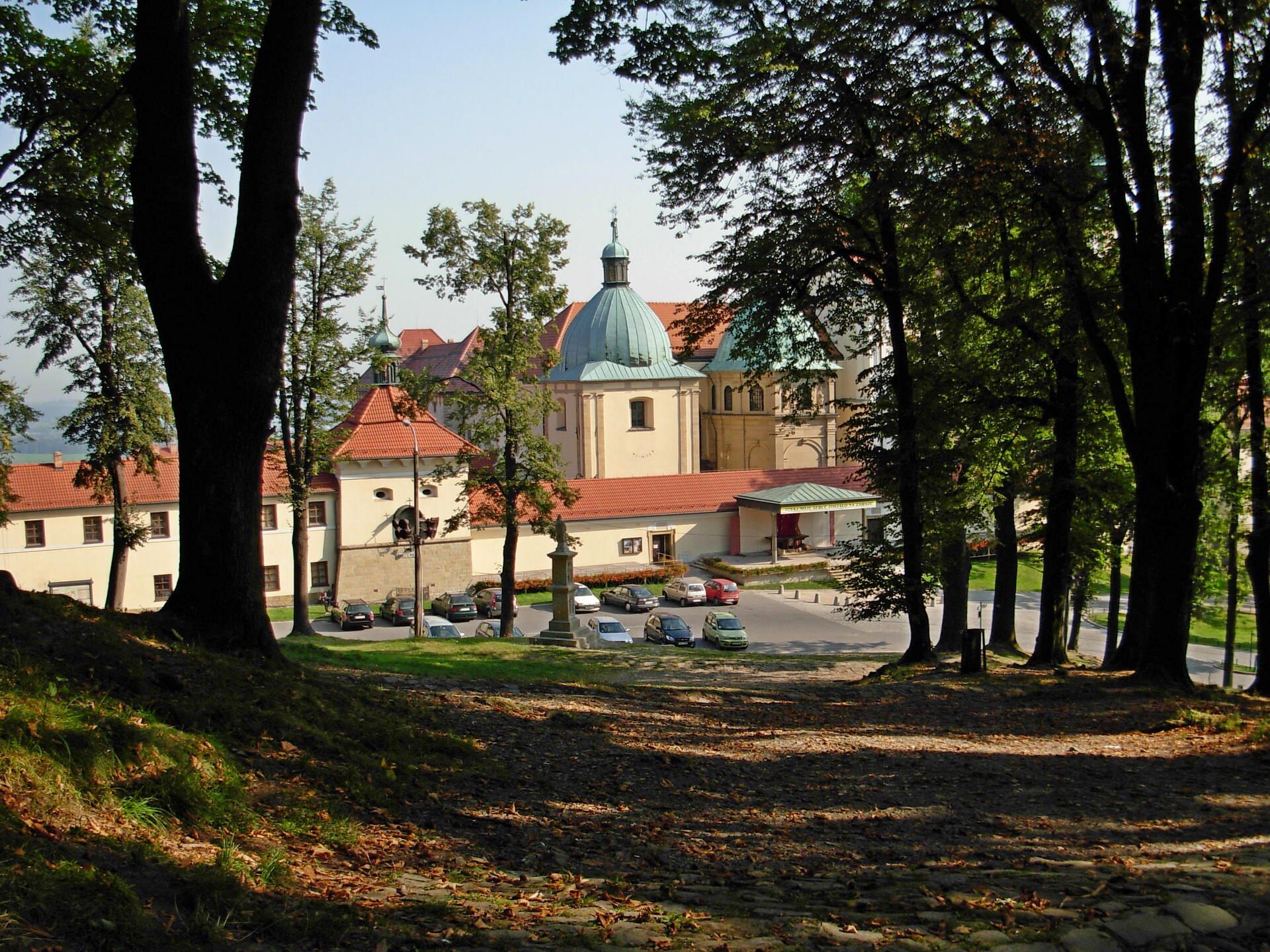
© Pliszka-GP, CC BY-SA 4.0 Resized from original. (This derivative is under the same CC BY-SA license.)
World Heritage Research
Discover scientific research and academic studies that deepen our understanding of Kalwaria Zebrzydowska: the Mannerist Architectural and Park Landscape Complex and Pilgrimage Park from its history and significance to its conservation, management, and contemporary challenges.
-
Heritage Decorative Wooden Flooring Restoration—Systemotechnical Approach and Risk Analysis
A structured risk analysis approach significantly enhances the restoration of historic wooden floors, enabling the retention of approximately 85% of original material while ensuring technical reliability and environmental sensitivity. The study, conducted on a late nineteenth to early twentieth-century parquet floor in Kalwaria Zebrzydowska's Monastery, demonstrates that phase-based, risk-informed decision-making can effectively mitigate risks such as moisture variability and material compatibility. This systemotechnical framework integrates diagnostic investigations, workshop renovation, subfloor reconstruction, reinstallation, and post-intervention monitoring, offering a sustainable model for heritage conservation applicable across diverse cultural and climatic contexts.
Juszczyk, M., Ustinovichius, L., Pyzalski, M., Buda, P., & Murzyn, P. (2026). Heritage Decorative Wooden Flooring Restoration—Systemotechnical Approach and Risk Analysis. Materials, 19(3), 631. https://doi.org/10.3390/ma19030631
View Publication Record | Read Publication -
Cykle grafik autorstwa Hieronymusa Wierixa jako inspiracja dla przedstawień dzieciństwa Jezusa w dawnych kościołach cystersów na tle innych zakonów na terenach nowożytnej Rzeczypospolitej
A study reveals that the engravings of Hieronymus Wierix, created before 1619, significantly influenced the depiction of Christ's childhood and related events in early modern religious art. Specifically, two series by Wierix inspired paintings in Cistercian churches in Sulejów and Oliwa, as well as compositions for the Order of Friars Minor (Bernardines) at Kalwaria Zebrzydowska and a painting in the altarpiece of Kraków's Dominican monastery. The research highlights how these engravings served as a shared artistic language across different religious orders, illustrating the hidden life of Jesus and the Blessed Virgin within the broader context of Polish monastic art.
Ponińska, K. (2025). Cykle grafik autorstwa Hieronymusa Wierixa jako inspiracja dla przedstawień dzieciństwa Jezusa w dawnych kościołach cystersów na tle innych zakonów na terenach nowożytnej Rzeczypospolitej. Dzieje I Kultura Cystersów W Polsce, 285–309. https://doi.org/10.12797/9788383681382.13
View Publication Record | Read Publication -
Waloryzacja i ocena potencjału turystyczno-kulturowego odcinka szlaku Romea Strata w woj. małopolskim
A segment of the international pilgrimage and cultural trail Romea Strata, spanning from Strzegowa to Groń Jana Pawła II near Wadowice in Małopolska, Poland, has been identified as a high-potential tourist and cultural route with a score of 741 points. This assessment, conducted using Armin Mikos von Rohrscheidt's point-based bonitation method, highlights the trail's strong appeal, coordination, and infrastructure while also revealing areas needing improvement. Researchers from the 'European Cultural Trails: Space and History' team evaluated the route's organization, thematic focus (centered around Sts. Peter, Paul, and John Paul II), tourist attractiveness, accessibility, and service quality between May 2023 and September 2024. The study combines cartographic, descriptive-analytical, and dynamic-comparative methods to provide actionable insights for future development.
Mróz, F. T., Kolasińska, A., & Siwek, M. (2025). Waloryzacja i ocena potencjału turystyczno-kulturowego odcinka szlaku Romea Strata w woj. małopolskim. Turystyka Kulturowa, 1(134), 222. https://doi.org/10.62875/tk.v1i134.1539
View Publication Record | Read Publication -
Między doświadczeniem wspólnot a samotnością. Interpretacja listownych próśb modlitewnych wysyłanych przez wiernych do Kalwarii Zebrzydowskiej w latach 70. XX wieku
A study of prayer requests sent to Kalwaria Zebrzydowska in the 1970s reveals that loneliness, while predominantly negative, also expressed hope and faith. The analysis, blending historical and ethnological approaches, identifies two key communities—family and Church—as sources of solace for senders, particularly during political tension with communism. The research characterizes these letters as a unique historical source, offering insights into the solitary attitudes of faithful individuals in post-war Poland. By introducing 'monoseology,' a term for the study of loneliness, the author bridges philosophical reflection with empirical evidence from epistolary data.
Gapiński, B. (2024). Między doświadczeniem wspólnot a samotnością. Interpretacja listownych próśb modlitewnych wysyłanych przez wiernych do Kalwarii Zebrzydowskiej w latach 70. XX wieku. Rocznik Przemyski. Historia, 1 (30), 345–367. https://doi.org/10.4467/24497347rph.24.015.20519
View Publication Record | Read Publication -
Kalwarie polskie. Perspektywa komunikacyjna
Kalwaria Zebrzydowska stands out among Poland's calvaries due to its unique Mannerist architectural and park landscape complex. This study highlights the significance of Kalwaria Zebrzydowska alongside other notable Polish calvaries, ranging from 17th-century sites like Pakoska and Wejherowska to lesser-known 19th and early 20th-century structures, as well as modern additions from the late 20th and 21st centuries. The research employs a communicative perspective to analyze these sites, emphasizing their architectural and landscape features while providing a comprehensive overview of their historical development. This approach underscores Kalwaria Zebrzydowska's enduring cultural and historical importance within Poland.
Prejs, M. (2022). Kalwarie polskie. Perspektywa komunikacyjna. https://doi.org/10.31338/uw.9788323554059
View Publication Record | Read Publication -
Nowy Zebrzydów – przykład miasta kalwaryjnego położonego w cieniu symbolicznego Miasta Świętego
Kalwaria Zebrzydowska stands as the oldest example of a 'miasteczko kalwaryjne' (calvary town) in Poland. This study refines its definition by analyzing its unique role as both an economic and symbolic center, serving as a smaller counterpart to the larger, symbolic Jerusalem complex designed by Christian van Adrichema. The research reveals that Zebrzydów's development disrupted traditional urban planning norms when Mikołaj Zebrzydowski allocated prime agricultural lands for the calvary complex, displacing peasants who later became the town's merchant class. This shift introduced a blend of agricultural culture and pilgrimage-driven trade as primary economic pillars, while enforcing strict religious exclusivity—banning Jews and heretics—to mirror the purity of Jerusalem. The study underscores Zebrzydów's dual function: a practical settlement rooted in peasant migration and a devotional space embodying Catholic ideals.
Płonka, M. (2022). Nowy Zebrzydów – przykład miasta kalwaryjnego położonego w cieniu symbolicznego Miasta Świętego. TECHNE. Seria Nowa, (9), 201–218. https://doi.org/10.18778/2084-851x.13.10
View Publication Record | Read Publication -
Obrazy o treściach mariologicznych w kaplicy Grobu Matki Boskiej w zespole Kalwarii Zebrzydowskiej. Z badań nad recepcją grafiki w malarstwie polskim XVII w.
A previously undocumented series of 37 Marian-themed paintings, depicting Mary and symbolic objects such as hearts, buildings, and gardens, has been identified within the Chapel of Our Lady's Tomb at Kalwaria Zebrzydowska. These late-Renaissance works, located on the choir parapet and galleries, have never been referenced in existing literature, guidebooks, or maintenance records. The study analyzes their symbolism in a broader context, offering new insights into the reception of graphics in Polish 17th-century painting. This discovery enriches our understanding of the architectural and artistic landscape of this UNESCO-listed site.
Dzik, J. (2024). Mariological paintings in the Chapel of Our Lady’s Tomb in the Kalwaria Zebrzydowska compound. From studies on the reception of graphics in Polish 17th century painting. Folia Historica Cracoviensia, 14, 50–74. https://doi.org/10.15633/fhc.1147
View Publication Record | Read Publication