
World Heritage Identification Number: 1424
World Heritage since: 2013
Category: Cultural Heritage
WHE Type: Buildings & Architectural Ensembles
Transboundary Heritage: Yes
Endangered Heritage: No
Country: Poland, Ukraine
Continent: Europe
UNESCO World Region: Europe and North America
Map
Wooden Tserkvas of the Carpathian Region: A Testament to Eastern European Architectural Tradition
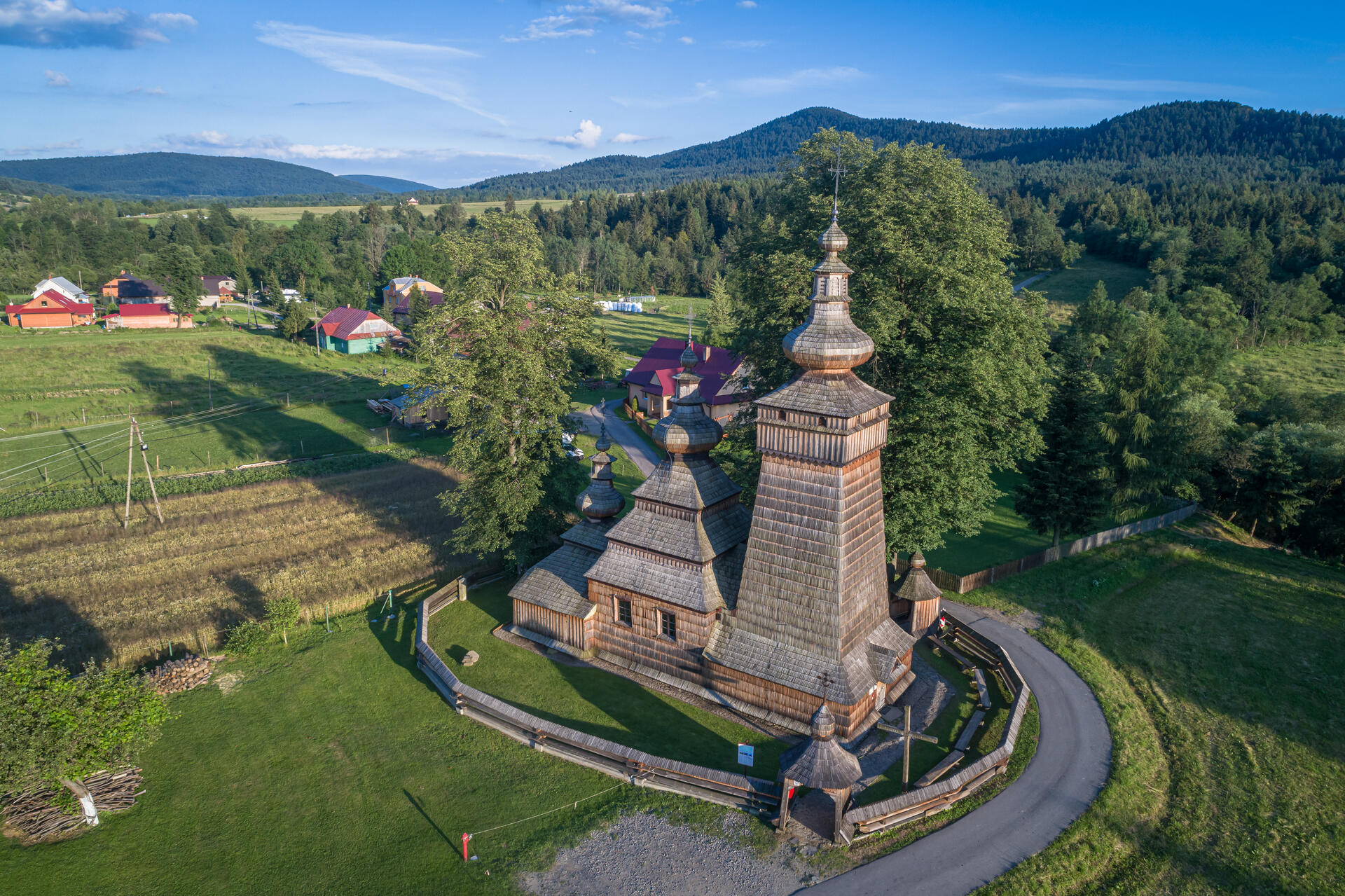
The Wooden Tserkvas of the Carpathian Region in Poland and Ukraine, inscribed on the UNESCO World Heritage List in 2013, represent a unique blend of architectural tradition, cultural identity, and religious significance. These sixteen churches, built between the 16th and 19th centuries, stand as a testament to the ingenuity and craftsmanship of communities of Orthodox and Greek Catholic faiths in the eastern fringes of Central Europe.
More to come…UNESCO Description of the World Heritage Site
Situated in the eastern fringe of Central Europe, the transnational property numbers a selection of sixteen tserkvas (churches). They were built of horizontal wooden logs between the 16th and 19th centuries by communities of Orthodox and Greek Catholic faiths. The tserkvas bear testimony to a distinct building tradition rooted in Orthodox ecclesiastic design interwoven with elements of local tradition, and symbolic references to their communities’ cosmogony. The tserkvas are built on a tri-partite plan surmounted by open quadrilateral or octagonal domes and cupolas. Integral to tserkvas are iconostasis screens, interior polychrome decorations, and other historic furnishings. Important elements of some tserkvas include wooden bell towers, churchyards, gatehouses and graveyards.
UNESCO Justification of the World Heritage Site
Criterion (iii): The tserkvas bear exceptional testimony to a distinct ecclesiastical building tradition, which is grounded in the mainstream traditions of the Orthodox Church interwoven with local architectural language. The structures, designs and decorative schemes are characteristic for the cultural traditions of the resident communities in the Carpathian region and illustrate a multiplicity of symbolic references and sacred meanings related to the traditions.
Criterion (iv): The tserkvas are an outstanding example of a group of buildings in traditional log construction type which represents an important historical stage of architectural design in the Carpathian Region. Based on building traditions for Orthodox ecclesiastical purposes which were adapted in accordance with the local cultural traditions, the tserkvas, as they evolved from the 16th to the 19th centuries, reflect the sacred references of the resident communities.
Encyclopedia Record: Wooden tserkvas of the Carpathian region in Poland and Ukraine
The Wooden tserkvas of the Carpathian region in Poland and Ukraine are a group of wooden mainly Greek Catholic churches located in Poland and Ukraine which were inscribed in 2013 on the UNESCO World Heritage List which explains:built of horizontal wooden logs between the 16th and 19th centuries by communities of Orthodox and Greek Catholic faiths. The tserkvas bear testimony to a distinct building tradition rooted in Orthodox ecclesiastic design interwoven with elements of local tradition, and symbolic references to their communities’ cosmogony. — World Heritage CentreAdditional Site Details
Area: 7.03 hectares
Number of Components: 16
(iv) — Outstanding example of a type of building or landscape
Coordinates: 49.5338888889 , 21.0322222222
World Heritage Research
Discover scientific research and academic studies that deepen our understanding of Wooden Tserkvas of the Carpathian Region in Poland and Ukraine from its history and significance to its conservation, management, and contemporary challenges.
-
Architectural and planning features of wooden orthodox Churches of Bukovyna using the example of the assumption church, 2 Novoushytska street, Chernivtsi
Wooden Orthodox churches of Bukovyna, particularly the Assumption Church in Chernivtsi, exemplify the preservation of medieval folk architectural traditions. These structures, characterized by their cross-shaped plans and steep tent roofs, have been recognized for their cultural significance, with some included in UNESCO's World Heritage List. The study analyzes the Assumption Church's architectural features, which retain authenticity since 1876, serving as a model for researchers and restoration efforts. It explores historical, cultural, and social influences on its design and employs modern 3D scanning technologies to document its condition and create digital models. This approach offers valuable insights into the conservation of such heritage sites.
Korotun, I., Yuriychuk, R., & Stoyan, S. (2024). Architectural and planning features of wooden orthodox Churches of Bukovyna using the example of the assumption church, 2 Novoushytska street, Chernivtsi. Current Problems of Architecture and Urban Planning, (69), 236–251. https://doi.org/10.32347/2077-3455.2024.69.236-251
View Publication Record | Read Publication