World Heritage Identification Number: 917
World Heritage since: 2000
Category: Natural Heritage
WHE Type: Natural Landscapes & Geographic Features
Transboundary Heritage: No
Endangered Heritage: No
Country: 🇦🇺 Australia
Continent: Oceania
UNESCO World Region: Asia and the Pacific
Map
The Greater Blue Mountains Area: A Unique Expression of Evolutionary Adaptation and Biodiversity
The Greater Blue Mountains Area, a sprawling expanse of over one million hectares, stands as a testament to the remarkable adaptability and diversification of the eucalyptus trees in the isolated Australian continent. This World Heritage Site, located in the picturesque Blue Mountains of New South Wales, was inscribed onto the prestigious World Heritage List during the 24th Session of the World Heritage Committee in Cairns in 2000.
Comprising eight distinct protected areas, the Greater Blue Mountains Area encompasses a diverse array of landscapes, from towering sandstone plateaus and rugged escarpments to deep, verdant gorges. The region is dominated by temperate eucalypt forests, which serve as a vital habitat for an astounding variety of plant and animal life. While earlier records cited 91 eucalypt taxa, scientific verifications as of 2025 confirm that the area supports at least 101 eucalypt species within this expansive ecosystem, each exhibiting unique characteristics that reflect their evolutionary journey in the post-Gondwana era.
One of the most notable features of the Greater Blue Mountains Area is its exceptional expression of the structural and ecological diversity of the eucalypts. This diversity is a direct result of the wide range of habitats found within the region, from the drier, more open woodlands to the denser, rainforest-like environments found in the deeper gorges. This diversity extends beyond the eucalypts themselves, with the region providing significant representation of Australia's overall biodiversity.
Around ten percent of Australia’s vascular plant species can be found within the Greater Blue Mountains Area, making it a veritable treasure trove for botanists and nature enthusiasts alike. Among these are several endemic and evolutionary relict species, such as the iconic Wollemi pine. Discovered in 1994, the Wollemi pine is a living fossil, believed to have originated some 200 million years ago. Its discovery within the Greater Blue Mountains Area underscores the region's importance as a refuge for ancient and rare species.
In addition to its rich flora, the Greater Blue Mountains Area supports a diverse array of fauna, including numerous rare, threatened, and endemic species. Examples include the spotted-tailed quoll, koala, greater glider, and platypus, which thrive in the region’s varied habitats. Birdlife is abundant, with over 260 species recorded, including the superb lyrebird, wedge-tailed eagle, and various parrots and cockatoos. Reptiles and amphibians are also well represented, with species such as the blue-tongued skink, eastern water dragon, and several endemic frog species.
The Greater Blue Mountains Area is not only a haven for plants and animals but also boasts a wealth of cultural and historical significance. Indigenous Australians have inhabited the region for thousands of years, leaving behind a rich tapestry of rock art and other cultural artifacts. The area spans the traditional Country of six Aboriginal language groups: the Darkinjung, Dharawal, Dharug, Gundungurra, Wiradjuri, and Wonnarua peoples. European settlers arrived in the 1800s, and remnants of this period, including historic tracks and structures, remain within parts of the region.
Today, the Greater Blue Mountains Area remains a vital conservation priority, with ongoing efforts being made to protect and preserve its unique ecosystems and biodiversity. Visitors to the region can explore its many trails and lookouts, marveling at the breathtaking vistas and the incredible diversity of plant and animal life that call this extraordinary place home. Whether you're a nature lover, a history buff, or simply seeking a unique and unforgettable travel experience, the Greater Blue Mountains Area offers something for everyone.
UNESCO Description of the World Heritage Site
The Greater Blue Mountains Area consists of 1.03 million ha of sandstone plateaux, escarpments and gorges dominated by temperate eucalypt forest. The site, comprised of eight protected areas, is noted for its representation of the evolutionary adaptation and diversification of the eucalypts in post-Gondwana isolation on the Australian continent. Ninety-one eucalypt taxa occur within the Greater Blue Mountains Area which is also outstanding for its exceptional expression of the structural and ecological diversity of the eucalypts associated with its wide range of habitats. The site provides significant representation of Australia's biodiversity with ten percent of the vascular flora as well as significant numbers of rare or threatened species, including endemic and evolutionary relict species, such as the Wollemi pine, which have persisted in highly-restricted microsites.
UNESCO Justification of the World Heritage Site
Criterion (ix): The Greater Blue Mountains include outstanding and representative examples in a relatively small area of the evolution and adaptation of the genus Eucalyptus and eucalypt-dominated vegetation on the Australian continent. The site contains a wide and balanced representation of eucalypt habitats including wet and dry sclerophyll forests and mallee heathlands, as well as localised swamps, wetlands and grassland. It is a centre of diversification for the Australian scleromorphic flora, including significant aspects of eucalypt evolution and radiation. Representative examples of the dynamic processes in its eucalypt-dominated ecosystems cover the full range of interactions between eucalypts, understorey, fauna, environment and fire. The site includes primitive species of outstanding significance to the evolution of the earth’s plant life, such as the highly restricted Wollemi pine (Wollemia nobilis) and the Blue Mountains pine (Pherosphaera fitzgeraldii). These are examples of ancient, relict species with Gondwanan affinities that have survived past climatic changes and demonstrate the highly unusual juxtaposition of Gondwanan taxa with the diverse scleromorphic flora.
Criterion (x): The site includes an outstanding diversity of habitats and plant communities that support its globally significant species and ecosystem diversity (152 plant families, 484 genera and c. 1,500 species). A significant proportion of the Australian continent’s biodiversity, especially its scleromorphic flora, occur in the area. Plant families represented by exceptionally high levels of species diversity here include Myrtaceae (150 species), Fabaceae (149 species), and Proteaeceae (77 species). Eucalypts (Eucalyptus, Angophora and Corymbia, all in the family Myrtaceae) which dominate the Australian continent are well represented by more than 90 species (13% of the global total). The genus Acacia (in the family Fabaceae) is represented by 64 species. The site includes primitive and relictual species with Gondwanan affinities (Wollemia, Pherosphaera, Lomatia, Dracophyllum, Acrophyllum, Podocarpus and Atkinsonia) and supports many plants of conservation significance including 114 endemic species and 177threatened species. The diverse plant communities and habitats support more than 400 vertebrate taxa (of which 40 are threatened), comprising some 52 mammal, 63 reptile, over 30 frog and about one third (265 species) of Australia’s bird species. Charismatic vertebrates such as the platypus and echidna occur in the area. Although invertebrates are still poorly known, the area supports an estimated 120 butterfly and 4,000 moth species, and a rich cave invertebrate fauna (67 taxa).
Encyclopedia Record: Greater Blue Mountains Area
The Greater Blue Mountains Area is a World Heritage Site located in the Blue Mountains of New South Wales, Australia. The 1,032,649-hectare (2,551,730-acre) area was placed on the World Heritage List at the 24th Session of the World Heritage Committee, held in Cairns in 2000.Additional Site Details
Area: 1,032,649 hectares
Number of Components: 1
(x) — Contains most important habitats for biodiversity
Coordinates: -33.7 , 150
IUCN World Heritage Outlook
The 2025 Conservation Outlook on Greater Blue Mountains Area reports the following assessment:
Source: International Union for Conservation of Nature (IUCN) · View assessment
Image
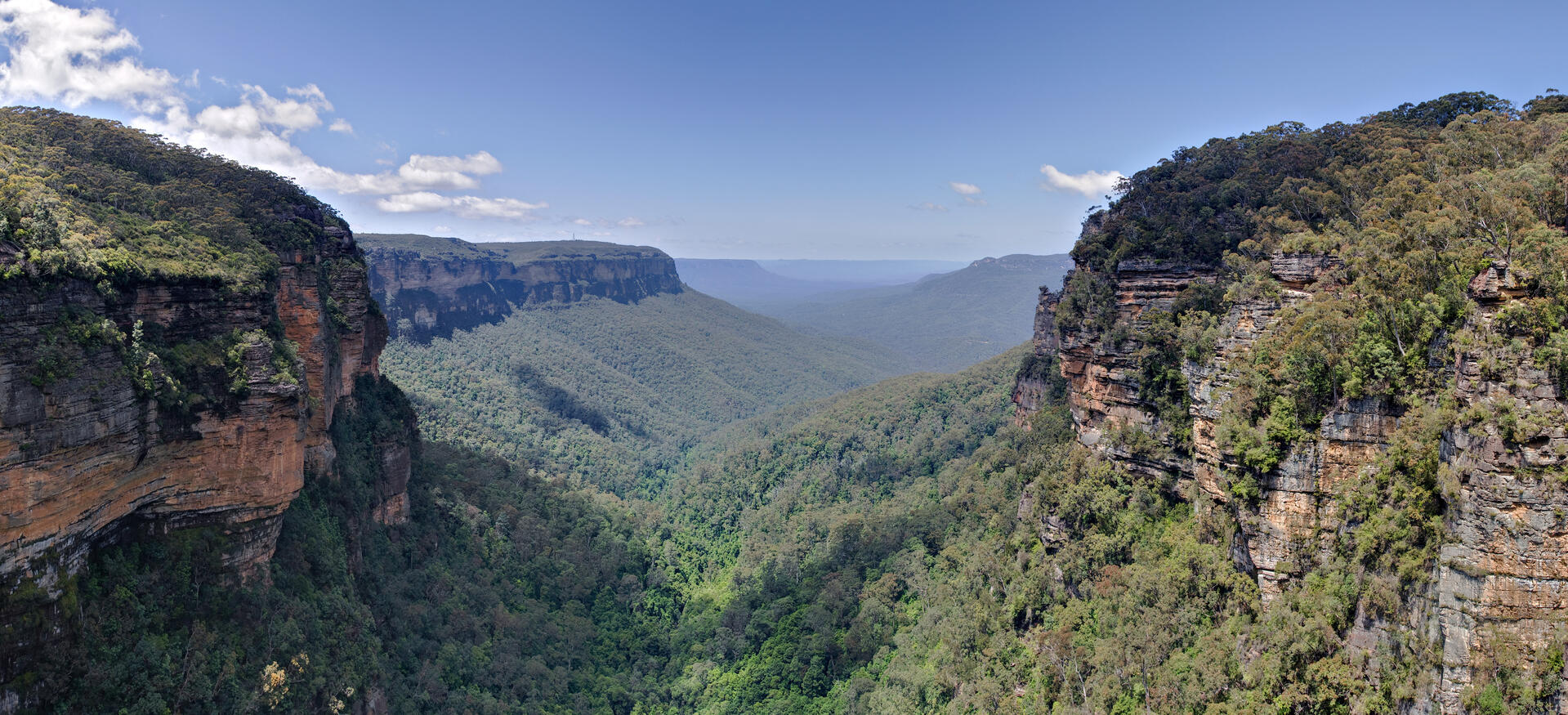
© Diliff, CC BY-SA 3.0 Resized from original. (This derivative is under the same CC BY-SA license.)