World Heritage Identification Number: 364
World Heritage since: 1986
Category: Cultural Heritage
WHE Type: Archaeological Sites
Transboundary Heritage: No
Endangered Heritage: No
Country: 🇿🇼 Zimbabwe
Continent: Africa
UNESCO World Region: Africa
Map
The Great Zimbabwe National Monument: A Testimony to Ancient African Civilization
The Great Zimbabwe National Monument, inscribed as a UNESCO World Heritage Site in 1986, stands as a remarkable testament to the rich cultural heritage and architectural prowess of the ancient Bantu civilization, particularly the Shona people. Located in the southeastern hills of present-day Zimbabwe, near the city of Masvingo, this expansive stone city offers a fascinating glimpse into the history and legacy of one of Africa's most significant pre-colonial societies.
More to come…UNESCO Description of the World Heritage Site
The ruins of Great Zimbabwe – the capital of the Queen of Sheba, according to an age-old legend – are a unique testimony to the Bantu civilization of the Shona between the 11th and 15th centuries. The city, which covers an area of nearly 80 ha, was an important trading centre and was renowned from the Middle Ages onwards.
UNESCO Justification of the World Heritage Site
Criterion (i): A unique artistic achievement, this great city has struck the imagination of African and European travellers since the Middle Ages, as evidenced by the persistent legends which attribute to it a Biblical origin.
Criterion (iii): The ruins of Great Zimbabwe bear a unique testimony to the lost civilisation of the Shona between the 11th and 15th centuries.
Criterion (vi): The entire Zimbabwe nation has identified with this historically symbolic ensemble and has adopted as its emblem the steatite bird, which may have been a royal totem.
Encyclopedia Record: Great Zimbabwe
Great Zimbabwe was a city in the south-eastern hills of the modern country of Zimbabwe, near Masvingo. It was settled from around 1000 CE, and served as the capital of the Kingdom of Great Zimbabwe from the 13th century. It is the largest stone structure in precolonial Southern Africa. Major construction on the city began in the 11th century until the 15th century, and it was abandoned in the 16th or 17th century. The edifices were erected by ancestors of the Shona people, currently located in Zimbabwe and nearby countries. The stone city spans an area of 7.22 square kilometres (2.79 sq mi) and could have housed up to 18,000 people at its peak, giving it a population density of approximately 2,500 inhabitants per square kilometre (6,500/sq mi). The Zimbabwe state centred on it likely covered 50,000 km². It is recognised as a World Heritage Site by UNESCO.Additional Site Details
Area: 722 hectares
Number of Components: 1
(iii) — Unique or exceptional testimony to a cultural tradition
(vi) — Directly associated with events or living traditions
Coordinates: -20.271169952 , 30.9332689726
Image
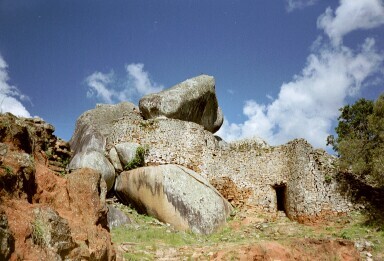
© Unknown, CC BY-SA 3.0 Resized from original. (This derivative is under the same CC BY-SA license.)
World Heritage Research
Discover scientific research and academic studies that deepen our understanding of Great Zimbabwe National Monument from its history and significance to its conservation, management, and contemporary challenges.
-
Mapping Global Patterns and Trends in Wellness-Tourism: A Systematic Review for the Development of Rural Tourism in Zimbabwe
Zimbabwe is emerging as a significant destination for wellness tourism, leveraging its rich cultural heritage and natural beauty. The Great Zimbabwe University Medical School (GZU), established in 2023, plays a pivotal role by integrating traditional medicine with modern healthcare, attracting both local and international patients. This systematic review highlights the intersection of medical tourism with rural development strategies, including infrastructure improvements, sustainable practices, and stakeholder interventions. The study identifies key factors such as demographic changes, economic structures, and gastronomy that enhance the competitiveness of rural medical tourism. By establishing supply chains within rural communities and addressing natural disasters, Zimbabwe can position itself as a holistic destination for health and wellness seekers, aligning with its Education 5.0 philosophy and Vision 2030.
Kademeteme, E. (2026). Mapping Global Patterns and Trends in Wellness-Tourism: A Systematic Review for the Development of Rural Tourism in Zimbabwe (Version 1). figshare. https://doi.org/10.6084/M9.FIGSHARE.33965239.V1
View Publication Record | Read Publication -
Understanding Cultural Landscape at Great Zimbabwe
A groundbreaking approach to understanding the cultural landscape of Great Zimbabwe reveals how African knowledge systems challenge Western archaeological narratives. By integrating Karanga/Kalanga cosmology and philosophy, the study decolonializes archaeology, exposing the impact of colonial legislation on heritage interpretation. It demonstrates that landscapes hold collective memory beyond human recollection, emphasizing the role of indigenous perspectives in shaping cultural identity. This work bridges African and Western debates, advocating for diverse knowledge systems to reform archaeological practices and heritage management in Africa.
Sinamai, A. (2025). Understanding Cultural Landscape at Great Zimbabwe (, Ed.). The Rowman & Littlefield Publishing Group. https://doi.org/10.5040/9781978747395
View Publication Record | Read Publication -
Geological and geotechnical challenges on the Great Dyke of Zimbabwe and their impact on hardrock pillar design
Current mining practices on the Great Dyke of Zimbabwe, known for its rich platinum group metal deposits, lack advanced geostatistical and artificial intelligence (AI) techniques that could significantly improve hardrock pillar stability. The study highlights that traditional empirical methods and numerical modeling fail to address the geological complexity, including diverse rock types and structural features like joints and faults. Geostatistical techniques such as kriging and AI-driven data analysis offer more precise estimates of rock quality and predictive capabilities, while real-time sensor integration enables dynamic risk management. Adopting these advanced methods could enhance safety and efficiency in underground mining operations on the Great Dyke.
Zvarivadza, T., Grobler, H., Onifade, M., & Khandelwal, M. (2025). Geological and geotechnical challenges on the Great Dyke of Zimbabwe and their impact on hardrock pillar design. Deep Underground Science and Engineering, 5(2), 506–538. Portico. https://doi.org/10.1002/dug2.70024
View Publication Record | Read Publication -
The Prospects and Challenges of Developing Sustainable Agritourism in the Southeast Lowveld of Zimbabwe
A significant potential exists for sustainable agritourism development in Zimbabwe's southeast lowveld, particularly around commercial agro-sugar enterprises, due to abundant farmland resources such as citrus plantations, sugarcane farms, and cattle-ranching operations. These farms, strategically located near the Gonarezhou National Park, Great Zimbabwe monuments, and Tugwi-Mukosi Dam, could attract tourists and generate economic benefits for local communities. While farm owners expressed willingness to integrate agritourism into their ventures, challenges such as limited overnight accommodation, mosquito infestation, and land tenure uncertainties hinder progress. The study underscores the need for revised tourism policies that prioritize agritourism in fringe areas to align with global trends favoring unspoilt farm tourism. Conducted through qualitative surveys of tourism stakeholders across multiple sites, this research provides actionable insights for policymakers to craft micro-level sustainable agritourism frameworks.
Zhou, Z. (2024). The Prospects and Challenges of Developing Sustainable Agritourism in the Southeast Lowveld of Zimbabwe. Agritourism for Sustainable Development, 62–76. https://doi.org/10.1079/9781800623705.0005
View Publication Record | Read Publication -
The Dilemma of the Presence of Great Zimbabwe Hotel within the Great Zimbabwe Monuments Cultural Landscape.
The presence of the Great Zimbabwe Hotel (GZH) within the Great Zimbabwe Monuments (GZM) cultural landscape exacerbates tensions in postcolonial Zimbabwe, compromising heritage conservation and local community relations. The study reveals that colonial-era developments like the GZH disrupt the harmony between the site's historical significance and modern urban encroachment. Using the National Museums and Monuments of Zimbabwe (NMMZ) Act, semi-structured interviews, and focus group discussions, researchers identified patterns of conflict, including visual intrusion, noise pollution, and economic disparities that alienate locals from their cultural environment. These findings underscore the need for balanced urban planning to preserve GZM's integrity while addressing contemporary challenges.
Zihove, T. (2024). The Dilemma of the Presence of Great Zimbabwe Hotel within the Great Zimbabwe Monuments Cultural Landscape. International Journal of Research and Innovation in Social Science, VIII(V), 242–251. https://doi.org/10.47772/ijriss.2024.805017
View Publication Record | Read Publication -
Design and Social Influence of the Great Zimbabwe Ruins
The architectural design of the Great Zimbabwe ruins has significantly influenced the social and cultural sustainable development of local communities. This study reveals that the site's landscape architecture plays a pivotal role in shaping the identity, customs, and economic activities of the Shona people. Unlike previous research which focused on historical narratives, this paper delves into the temporal comparative analysis of the site's influence, employing qualitative methods such as site visits, questionnaires, and interviews, alongside quantitative data on tourist trends. The findings underscore the enduring value of Great Zimbabwe to society, bridging gaps in understanding its cultural and economic impact.
Mushandu, T. A., & Zhang, R. (2024). Design and Social Influence of the Great Zimbabwe Ruins. Open Journal of Social Sciences, 12(08), 465–493. https://doi.org/10.4236/jss.2024.128029
View Publication Record | Read Publication -
Great Zimbabwe in the Shadow of Robert Mugabe and the ZANU-PF: An Analysis of the Political On-site Use of Great Zimbabwe during the Period 2000–2025
During Zimbabwe's economic downturn from 2000 to 2025, the Great Zimbabwe National Monument became a strategic site for political identity-building and nationalism under ZANU-PF rule. The monument was instrumental in reinforcing party hegemony and promoting the ideologies of leaders Robert Mugabe and Emmerson Mnangagwa, as revealed through four key on-site events analyzed using Critical Heritage Studies. This study highlights how cultural heritage was politicized to strengthen national identity amid economic challenges, offering insights into the intersection of politics, archaeology, and heritage in post-colonial contexts.
Andersson, A. (2024). Great Zimbabwe in the Shadow of Robert Mugabe and the ZANU-PF: An Analysis of the Political On-site Use of Great Zimbabwe during the Period 2000–2025. Public Archaeology, 23(1-4), 50–69. https://doi.org/10.1080/14655187.2025.2475622
View Publication Record | Read Publication