World Heritage Identification Number: 915
World Heritage since: 1999
Category: Cultural Heritage
WHE Type: Archaeological Sites
Transboundary Heritage: No
Endangered Heritage: No
Country: 🇿🇦 South Africa
Continent: Africa
UNESCO World Region: Africa
Map
Unraveling Human Evolution: A Journey Through the Fossil Hominid Sites of South Africa
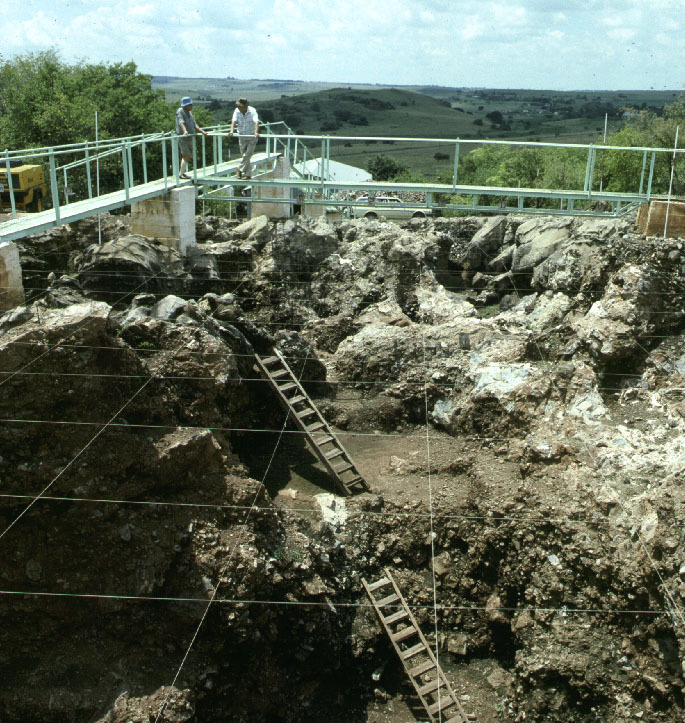
The Fossil Hominid Sites of South Africa, inscribed as a UNESCO World Heritage Site in 1999, offer a captivating glimpse into the origins and evolution of humanity. This serial paleoanthropological site, collectively known as the Cradle of Humankind, comprises a group of fossil-bearing localities primarily located about 50 kilometers northwest of Johannesburg, spanning parts of Gauteng and North West provinces. The core area covers approximately 47,000 hectares and contains one of the most significant concentrations of early human ancestral remains discovered anywhere in the world.
The sites preserve an extraordinary fossil record dating back millions of years, providing crucial insights into the biological and behavioral evolution of early hominins. Among the most important components of the World Heritage Site is the Taung Skull Fossil Site, renowned for the discovery of the celebrated Taung Skull in 1924. This fossil, classified as Australopithecus africanus, played a pivotal role in reshaping scientific understanding of human evolution by demonstrating that early human ancestors originated in Africa.
Another important extension of the World Heritage Site is Makapan Valley, located in present-day Limpopo Province. This area contains a series of archaeological and fossil-bearing caves with evidence of hominin activity dating back approximately 3.3 million years. Fossils recovered from Makapan and other sites within the broader World Heritage property include remains of early hominins such as Australopithecus and Paranthropus robustus, which inhabited southern Africa between roughly 2.8 million and 1.2 million years ago.
One of the most intriguing discoveries associated with the Fossil Hominid Sites concerns the early controlled use of fire by our ancestors. Evidence from caves such as Swartkrans suggests that early hominins began domesticating fire between approximately 1.8 million and 1 million years ago. This development had profound implications for survival, enabling warmth, protection from predators, and the cooking of food, which in turn influenced biological and cultural evolution.
In addition to these landmark discoveries, the Fossil Hominid Sites of South Africa continue to provide researchers with exceptional opportunities to uncover new insights into human evolution. The region’s vast network of limestone caves—including well-known sites such as Sterkfontein, Swartkrans, Kromdraai, and Drimolen—remains the focus of ongoing scientific excavation and study.
In recent years, the discovery of the Rising Star Cave System has added a startling new chapter to this narrative. It led to the identification of Homo naledi, a species with a unique mix of primitive and modern features. Rsearchers have suggested that this small-brained hominin may have practiced intentional burials and created rock art as early as 240,000 to 335,000 years ago. These interpretations remain the subject of active scientific debate, as they challenge long-held assumptions about the relationship between brain size and cultural behavior.
In summary, the Fossil Hominid Sites of South Africa stand as a powerful testament to humanity’s deep and complex past. Through the preservation of these precious sites and continued scientific research, we can further illuminate the mysteries of our evolutionary journey and the processes that shaped modern humans from their early hominin ancestors.
UNESCO Description of the World Heritage Site
The Taung Skull Fossil Site, part of the extension to the site inscribed in 1999, is the place where in 1924 the celebrated Taung Skull – a specimen of the species Australopithecus africanus – was found. Makapan Valley, also in the site, features in its many archaeological caves traces of human occupation and evolution dating back some 3.3 million years. The area contains essential elements that define the origin and evolution of humanity. Fossils found there have enabled the identification of several specimens of early hominids, more particularly of Paranthropus, dating back between 4.5 million and 2.5 million years, as well as evidence of the domestication of fire 1.8 million to 1 million years ago.
UNESCO Justification of the World Heritage Site
Criterion (iii): The nominated serial site bears exceptional testimony to some of the most important Australopithecine specimens dating back more than 3.5 million years. This therefore throws light on to the origins and then the evolution of humankind, through the hominisation process.
Criterion (vi): The serially nominated sites are situated in unique natural settings that have created a suitable environment for the capture and preservation of human and animal remains that have allowed scientists a window into the past. Thus, this site constitutes a vast reserve of scientific data of universal scope and considerable potential, linked to the history of the most ancient periods of humankind.
Encyclopedia Record: Cradle of Humankind
The Cradle of Humankind is a paleoanthropological site that is located about 50 km (31 mi) northwest of Johannesburg, South Africa, in the Gauteng province. Declared a World Heritage Site by UNESCO in 1999, the site is home to the largest known concentration of human ancestral remains anywhere in the world. The site currently occupies 47,000 hectares and contains a complex system of limestone caves. The registered name of the site in the list of World Heritage Sites is Fossil Hominid Sites of South Africa.Additional Site Details
Area: Not available
Number of Components: 3
(vi) — Directly associated with events or living traditions
Coordinates: -24.15861 , 29.17694
Image
© english Wikipedia user, CC BY-SA 3.0 Resized from original. (This derivative is under the same CC BY-SA license.)
World Heritage Research
Discover scientific research and academic studies that deepen our understanding of Fossil Hominid Sites of South Africa from its history and significance to its conservation, management, and contemporary challenges.
-
Iconic Swartkrans fossils and hominid taxonomy, I: SK 15 mandible
A critical re-evaluation of the Swartkrans hominid mandible, SK 15, challenges its classification within Paranthropus, proposing instead alternative taxonomic placements that better reflect its morphological traits. The study scrutinizes a high-profile claim that SK 15 should be reclassified as Paranthropus capensis, arguing for a more nuanced approach to hominid taxonomy at this pivotal South African site. Swartkrans, renowned for its Oldowan tools and butchered bones, holds significant implications for understanding early hominid behavior and evolution. The research combines morphological analysis with taxonomic reassessment, aiming to clarify the evolutionary relationships of key fossils from one of palaeoanthropology’s most important sites.
Clarke, R. J., & Pickering, T. R. (2026). Iconic Swartkrans fossils and hominid taxonomy, I: SK 15 mandible. Transactions of the Royal Society of South Africa, 81(1), 7–13. https://doi.org/10.1080/0035919x.2026.2625163
View Publication Record | Read Publication -
Evaluating Random Forest Model Performance for Cave and Sinkhole Prediction in the Cradle of Humankind, South Africa: Preliminary Analysis and Variable Importance Assessments
A Random Forest model achieved 81.6% accuracy and an AUC of 0.912 in predicting cave and sinkhole locations in the Cradle of Humankind, South Africa, offering a promising tool for fossil site surveying in karst landscapes. The study analyzed multispectral imagery, DEMs, and geologic data to identify key predictive variables, with distance to faults, Chuniespoort Group location, dolomite/chert presence, and elevation proving most influential. Only three of 48 variables contributed less than random chance, highlighting their potential for refining models in future research and applications across similar regions.
Furtner, M. J., Anemone, R. L., Wang, L., & Brophy, J. K. (2026). Evaluating Random Forest Model Performance for Cave and Sinkhole Prediction in the Cradle of Humankind, South Africa: Preliminary Analysis and Variable Importance Assessments. Journal of Archaeological Method and Theory, 33(3). https://doi.org/10.1007/s10816-025-09761-1
View Publication Record | Read Publication -
Muographic Imaging and Cosmic-Rays Geodating at the Cradle of Humankind
Muographic imaging, leveraging atmospheric muons, offers a noninvasive method to visualize the internal structures of large, inaccessible objects. This technique, applied at the Fossil Hominid Sites of South Africa (Cradle of Humankind), demonstrates its potential for geodating and understanding complex geological formations without disturbing the site. By utilizing cosmic-ray muons, researchers can penetrate dense materials, providing detailed images that aid in the study of fossil-bearing strata. This approach enhances our ability to explore and date these significant paleoanthropological sites, contributing valuable insights into human evolution.
Bonechi, L., Bruschi, M., Frosin, C., Grafström, P., & Rabaglia, S. (2026). Muographic Imaging and Cosmic-Rays Geodating at the Cradle of Humankind. Nuclear Physics News, 36(1), 20–24. https://doi.org/10.1080/10619127.2026.2614258
View Publication Record | Read Publication -
Taung and beyond: The mining history, geology and taphonomy of Australopithecus in South Africa
South Africa's fossil hominid sites, including Taung and the Sterkfontein and Makapan Valleys, hold the world's richest early hominin fossil record, particularly of Australopithecus africanus. This study marks the centenary of the Taung Child discovery by reviewing the landscape formation, mining history, geochronology, and taphonomy that shaped this record. It critically examines the impact of extractive practices on research, highlighting exclusionary practices in mining-centered studies. The sites offer a unique window into early australopith environments, preserved through karstic landscapes. Future research is recommended to standardize excavation techniques and develop new dating methods for cave deposits, aiming to deepen understanding of early hominin evolution and environmental change.
Weij, R., Baker, S. E., Edwards, T. R., Kibii, J., Luti, G., & Pickering, R. (2025). Taung and beyond: The mining history, geology and taphonomy of Australopithecus in South Africa. South African Journal of Science, 121(1/2). https://doi.org/10.17159/sajs.2025/18509
View Publication Record | Read Publication -
The large mammal fossil fauna of the Cradle of Humankind, South Africa: a review
A review of the large mammal fossil fauna from South Africa's Cradle of Humankind reveals that while hominin fossils have been extensively studied, the site's abundant non-hominin faunal assemblages have been largely overlooked despite their potential for Plio-Pleistocene palaeoenvironmental reconstructions. The study highlights a trend across eight radiometrically dated sites—Bolt's Farm, Cooper's Cave, Drimolen, Haasgat, Hoogland, Malapa, Sterkfontein, and Swartkrans—that shows wooded landscapes transitioning to grasslands over time, primarily based on faunal abundance data. The review also underscores the need for more precise dating and comprehensive faunal reporting to better contextualize these sites, many of which have not been revisited or reanalyzed in decades.
Malherbe, M., Pickering, R., Stynder, D., & Haeusler, M. (2025). The large mammal fossil fauna of the Cradle of Humankind, South Africa: a review. PeerJ, 13, e18946. Portico. https://doi.org/10.7717/peerj.18946
View Publication Record | Read Publication -
Out of Africa: Learning from Teaching in the Cradle of Humankind
A decade-long teaching experience in the Cradle of Humankind, South Africa's Fossil Hominid Sites, reveals that integrating architectural heritage with sustainable development requires a recalibrated mindset and adaptive pedagogy. The study highlights the need to balance the preservation of local architectural memory with future-oriented sustainability, using autoethnographic methodology to intertwine personal observations, academic experiences in DR Congo and Rwanda, and literature reviews. This approach fosters inclusive learning that transcends boundaries, addressing renewed challenges for architects while enhancing students' awareness of their potential.
Michieletto, M. (2025). Out of Africa: Learning from Teaching in the Cradle of Humankind. Advances in the Integration of Technology and the Built Environment, 214–222. https://doi.org/10.1007/978-981-96-4749-1_25
View Publication Record | Read Publication -
Characterising the spatio-temporal patterns of water quality parameters in the cradle of humankind world heritage site using Sentinel-2 and random forest regressor
A combination of Sentinel-2 satellite data and random forest regression models successfully predicted water quality parameters with high accuracy, particularly dissolved oxygen (DO) under low-flow conditions (R² = 0.88) and electrical conductivity (EC) (R² = 0.63). The study, conducted in the Cradle of Humankind World Heritage Site, revealed distinct seasonal variations in optically active (e.g., suspended solids) and non-optically active parameters (e.g., DO, EC), influenced by runoff dynamics and upstream pollution. Model 2, incorporating spectral bands and indices, outperformed Model 1 for most parameters, demonstrating the potential of remote sensing and machine learning to monitor freshwater ecosystems dynamically. These findings highlight the importance of high-resolution data in assessing water quality in ecologically significant areas.
Ngamile, S., Kganyago, M., Madonsela, S., & Mvandaba, V. (2025). Characterising the spatio-temporal patterns of water quality parameters in the cradle of humankind world heritage site using Sentinel-2 and random forest regressor. Frontiers in Remote Sensing, 6. https://doi.org/10.3389/frsen.2025.1631403
View Publication Record | Read Publication