World Heritage Identification Number: 1079
World Heritage since: 2003
Category: Cultural Heritage
WHE Type: Religious Sites & Sacred Architecture
Transboundary Heritage: No
Endangered Heritage: No
Country: 🇲🇽 Mexico
Continent: Americas
UNESCO World Region: Latin America and the Caribbean
Map
A Journey Through Time: The Franciscan Missions in the Sierra Gorda of Querétaro
The Franciscan Missions in the Sierra Gorda of Querétaro, nestled within the rugged landscapes of central Mexico, offer a captivating glimpse into the past. These five missions, constructed between 1750 and 1760, stand as a testament to the enduring spirit of the indigenous people and the tireless efforts of the Franciscan missionaries. In 2003, these missions were recognized by UNESCO as a World Heritage Site, acknowledging their significant cultural, historical, and architectural value.
More to come…UNESCO Description of the World Heritage Site
The five Franciscan missions of Sierra Gorda were built during the last phase of the conversion to Christianity of the interior of Mexico in the mid-18th century and became an important reference for the continuation of the evangelization of California, Arizona and Texas. The richly decorated church façades are of special interest as they represent an example of the joint creative efforts of the missionaries and the Indios. The rural settlements that grew around the missions have retained their vernacular character.
UNESCO Justification of the World Heritage Site
Criterion (ii) The Sierra Gorda Missions exhibit an important interchange of values in the process of evangelization of central and northern Mexico, and the western United States.
Criterion (iii) The five Sierra Gorda Missions bear witness to the cultural encounter of the European missions with the nomadic populations of central Mexico, remaining a significant testimony to this second phase of evangelisation in North America.
Encyclopedia Record: Franciscan Missions in the Sierra Gorda of Querétaro
The Franciscan missions of the Sierra Gorda of Querétaro are five missions built in Mexico between 1750 and 1760. The foundation of the missions is attributed to Junípero Serra, who also founded the most important missions in California. They were declared a World Heritage Site by UNESCO in 2003.Additional Site Details
Area: 103.7 hectares
Number of Components: 5
(iii) — Unique or exceptional testimony to a cultural tradition
Coordinates: 21.20438889 , -99.46411111
Image
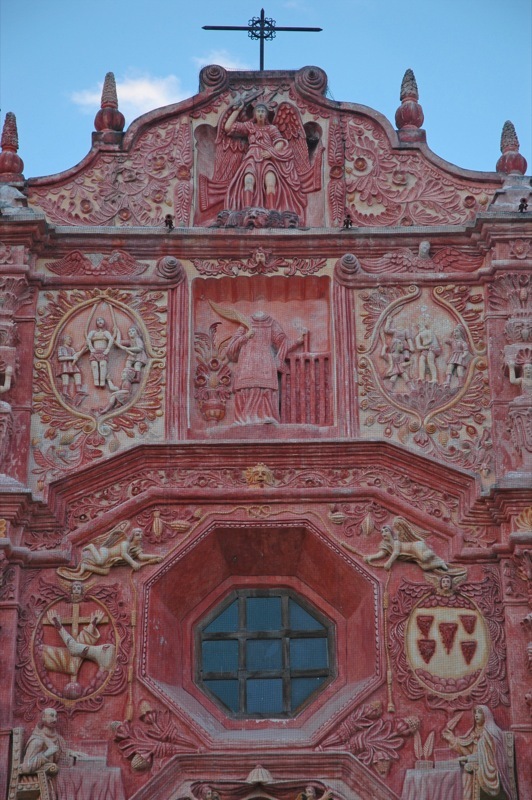
© Unknown, CC BY-SA 3.0 Resized from original. (This derivative is under the same CC BY-SA license.)
World Heritage Research
Discover scientific research and academic studies that deepen our understanding of Franciscan Missions in the Sierra Gorda of Querétaro from its history and significance to its conservation, management, and contemporary challenges.
-
The Worlds of Junípero Serra: Historical Contexts and Cultural Representations ed. by Steven W. Hackel
Junípero Serra's early missionary career, particularly his work in Mallorca and Mexico City before his time in California, is revealed to have significantly shaped his approach to evangelization. This collection of essays, edited by Steven W. Hackel, challenges the dominant narrative that focuses primarily on Serra's California missions. It highlights his deep-rooted Franciscan traditions, his dual ministry to Indigenous peoples and Europeans, and the complex interplay between peaceful conversion and coercion in his missionary practices. The book also critically examines the 'Spanish Craze' in the U.S., where Serra was mythologized as a founding father, often at the expense of Mexican and Indigenous perspectives. This work provides a nuanced understanding of Serra's legacy, contextualizing it within broader historical and cultural representations.
Cohen, T. M. (2022). The Worlds of Junípero Serra: Historical Contexts and Cultural Representations ed. by Steven W. Hackel. The Catholic Historical Review, 108(1), 229–230. https://doi.org/10.1353/cat.2022.0029
View Publication Record | Read Publication -
The Worlds of Junípero Serra: Historical Contexts and Cultural Representations
This volume offers a nuanced exploration of Junípero Serra's life and legacy, challenging polarizing narratives by contextualizing his missionary career within the complex political, cultural, and religious landscapes of early modern Majorca, New Spain, and 19th-century United States. It reveals how Serra's use of baroque aesthetics shaped Catholic spaces on empire's fringes and highlights miscommunications between his paternal authority model and Native Californian practices, underscoring the intentional withholding of knowledge by Indigenous peoples. The collection also examines Anglo-American reappropriations of Serra while noting an opportunity to further explore Mexican interpretations and broader imperial contexts.
Sussman, N. (2019). The Worlds of Junípero Serra: Historical Contexts and Cultural Representations. Hispanic American Historical Review, 99(3), 561–563. https://doi.org/10.1215/00182168-7573728
View Publication Record | Read Publication -
Pames, Jonaces, and Franciscans in the Sierra Gorda: Mecos and Missionaries
Robert H. Jackson's work, 'Pames, Jonaces, and Franciscans in the Sierra Gorda: Mecos and Missionaries,' offers a nuanced exploration of two centuries of interaction between Franciscan missionaries and the Pames and Jonaces, indigenous Chichimeca groups in Mexico's Sierra Gorda region. The study adopts a mission history and historical demography approach, focusing on the establishment and demographic impact of missions while also examining the transformation of sacred landscapes and native ways of life. Jackson contrasts his findings with earlier mission models from Michoacán and Oaxaca, revealing how missions were superimposed onto pre-Hispanic political structures. While the primary emphasis lies on mission buildings and congregations, the work provides valuable insights into the power dynamics between colonizers and indigenous populations during this period.
Rangel Silva, J. A. (2018). Pames, Jonaces, and Franciscans in the Sierra Gorda: Mecos and Missionaries. Hispanic American Historical Review, 98(3), 513–514. https://doi.org/10.1215/00182168-6933644
View Publication Record | Read Publication