World Heritage Identification Number: 302
World Heritage since: 1984
Category: Natural Heritage
WHE Type: Protected Areas & National Parks
Transboundary Heritage: No
Endangered Heritage: No
Country: 🇿🇼 Zimbabwe
Continent: Africa
UNESCO World Region: Africa
Map
Mana Pools National Park, Sapi and Chewore Safari Areas: A Wildlife Haven in Zimbabwe
The Mana Pools National Park, Sapi and Chewore Safari Areas, located in northern Zimbabwe, form a vast wildlife conservation area that spans approximately 219,600 hectares (543,000 acres). This region, nestled along the banks of the mighty Zambezi River, is a testament to the rich biodiversity and scenic beauty that Africa has to offer. Inscribed as a UNESCO World Heritage Site in 1984, this protected area is renowned for its remarkable concentration of diverse wildlife species and breathtaking landscapes.
More to come…UNESCO Description of the World Heritage Site
On the banks of the Zambezi, great cliffs overhang the river and the floodplains. The area is home to a remarkable concentration of wild animals, including elephants, buffalo, leopards and cheetahs. An important concentration of Nile crocodiles is also be found in the area.
UNESCO Justification of the World Heritage Site
Criterion (vii): The annual congregation of animals in riparian parkland alongside the broad Zambezi constitutes one Africa's outstanding wildlife spectacles.
Criterion (ix): The 'sand-bank' environment constitutes a good example of erosion and deposition by a large seasonal river (despite changes in river flow due to the Kariba Dam). There is a clear pattern of vegetation succession on the alluvial deposits. Seasonal movements of large mammals within the valley are of great ecological interest both because of interspecies and intraspecies differences.
Criterion (x): At time of inscription the justification for this criterion was that the area is one of the most important refuges for black rhino in Africa as well as a number of other species considered threatened at that time. Today, the black rhino has now disappeared from the reserve although the property still contains important populations of threatened species including elephant and hippopotamus, as well as other threatened species such as lion, cheetah and wild dog. Leopard and brown hyena, classified as near threatened, and a large population of Nile crocodile, are also protected within the property. The area is also considered an important refuge for a number of plants and birds.
Encyclopedia Record: Mana Pools National Park
Mana Pools National Park is a 2,196-square-kilometre (848 sq mi) wildlife conservation area and national park in northern Zimbabwe. It is a region of the lower Zambezi in Zimbabwe where the floodplain turns into a broad expanse of lakes after each rainy season. As the lakes gradually dry up and recede, the region attracts many large animals in search of water, making it one of Africa's most renowned game-viewing regions.Additional Site Details
Area: 676,600 hectares
Number of Components: 1
(ix) — Outstanding example representing ecological and biological processes
(x) — Contains most important habitats for biodiversity
Coordinates: -15.81944444 , 29.40805556
IUCN World Heritage Outlook
The 2025 Conservation Outlook on Mana Pools National Park, Sapi and Chewore Safari Areas reports the following assessment:
Source: International Union for Conservation of Nature (IUCN) · View assessment
Image
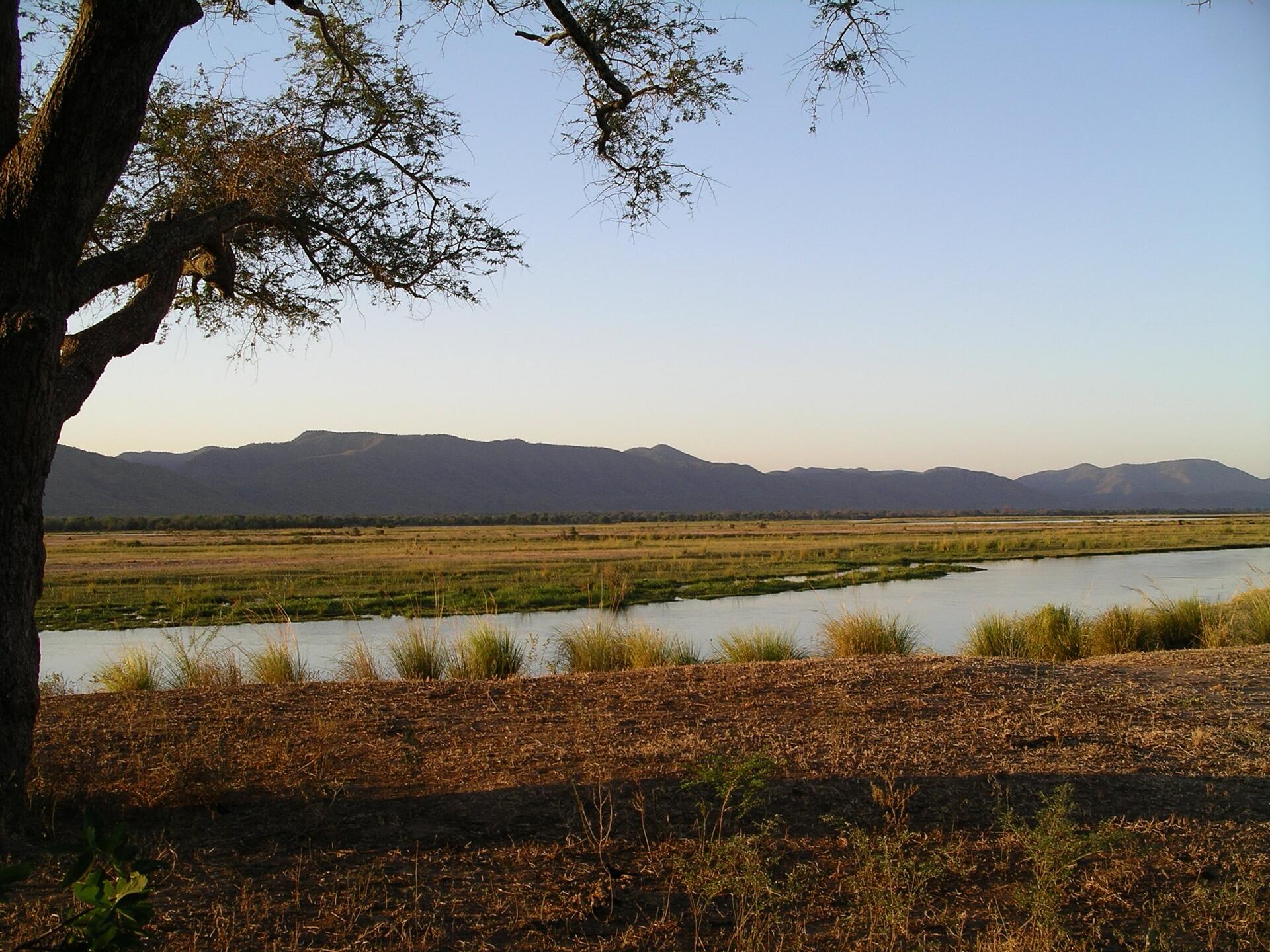
Unknown, Public domain
World Heritage Research
Discover scientific research and academic studies that deepen our understanding of Mana Pools National Park, Sapi and Chewore Safari Areas from its history and significance to its conservation, management, and contemporary challenges.
-
Spatial and temporal wildfire variations within the Mid Zambezi protected areas
Wildfires in the Mid Zambezi protected areas, including Mana Pools National Park and adjacent safari zones, show pronounced clustering along highways, indicating significant anthropogenic influence. A study analyzing fire data from 2001 to 2022 found that early-season burning reduces the spatial extent of intense wildfires by over 90%, affecting a mean area of just 119 km² compared to late-season fires covering 1108 km² on average. The research used NASA's FIRMS active fire data and spatial analysis tools like QGIS and Getis-Ord Gi* statistic to map fire distribution, frequency, and hotspots. These findings highlight the critical role of early burning as a fire management strategy while emphasizing the need to reduce human encroachment and raise community awareness to mitigate wildfire risks in these UNESCO World Heritage Sites.
Chakuya, J., Mugova, E. Y., Nyapundo, C. T., & Mangwanya, C. D. (2026). Spatial and temporal wildfire variations within the Mid Zambezi protected areas. Sustainable Environment, 12(1). https://doi.org/10.1080/27658511.2026.2708431
View Publication Record | Read Publication -
Commodity crops in biodiversity-rich production landscapes: Friends or foes? The example of cotton in the Mid Zambezi Valley, Zimbabwe
A shift from cotton farming to livestock production in Zimbabwe's Mid Zambezi Valley, driven by declining cotton profitability, has led to significant land cover changes and wildlife population declines. Research combining panel survey data, land cover analysis, and secondary data revealed that open vegetation expanded from 10% to 20% between 2007 and 2020, coinciding with a drastic reduction in cotton farming (from 1.79 ± 2.05 ha per farm to 0.72 ± 0.90 ha) and a surge in livestock numbers. While wildlife populations have declined, this cannot be solely attributed to land cover changes; however, increasing human-wildlife conflicts pose a threat to long-term coexistence. The study suggests that commodity crops can present conservation opportunities if they support a 'living income' for local communities.
Baudron, F., Guerrini, L., Chimimba, E., Chimusimbe, E., & Giller, K. E. (2022). Commodity crops in biodiversity-rich production landscapes: Friends or foes? The example of cotton in the Mid Zambezi Valley, Zimbabwe. Biological Conservation, 267, 109496. https://doi.org/10.1016/j.biocon.2022.109496
View Publication Record | Read Publication -
Spatial Monitoring and Reporting Tool (SMART) in Mid‐Zambezi Valley, Zimbabwe: Implementation challenges and practices
A new study highlights the significant potential of the Spatial Monitoring and Reporting Tool (SMART) for enhancing biodiversity conservation, particularly for persecuted species like African elephants. However, its implementation faces substantial challenges, including technical ineptness among field staff, resistance to new technology, and uneven resource distribution. Researchers analyzed firsthand experiences from training workshops, interviews with field staff, and observations in the Mid-Zambezi Valley, Zimbabwe, where SMART adoption is being piloted by the Zimbabwe Parks and Wildlife Management Authority (ZPWMA). Despite these hurdles, most protected areas in the region have begun using SMART for law enforcement and data collection. The study proposes solutions such as developing an integrated implementation plan, motivating field staff, and learning from successful models to overcome these barriers.
Kavhu, B., & Mpakairi, K. S. (2021). Spatial Monitoring and Reporting Tool (SMART) in Mid‐Zambezi Valley, Zimbabwe: Implementation challenges and practices. Conservation Science and Practice, 3(9). Portico. https://doi.org/10.1111/csp2.492
View Publication Record | Read Publication -
Ranger perceptions of, and engagement with, monitoring of elephant poaching
Ranger-based monitoring holds significant potential for global conservation, yet its effectiveness hinges on the engagement and ownership of those collecting the data. A study in Mana Pools National Park, Zimbabwe, revealed that while rangers viewed biodiversity data collection as a routine duty crucial for guiding patrol strategies, they lacked active engagement with data management or utilization. The research identified key drivers of their behavior: a strong sense of duty, deference to authority, and adherence to organizational hierarchies. To enhance monitoring sustainability, the study proposes leveraging existing ranger culture while fostering appreciation for data collection and addressing challenges related to well-being, resources, and capacity.
Kuiper, T., Massé, F., Ngwenya, N. A., Kavhu, B., Mandisodza‐Chikerema, R. L., & Milner‐Gulland, E. J. (2020). Ranger perceptions of, and engagement with, monitoring of elephant poaching. People and Nature, 3(1), 148–161. Portico. https://doi.org/10.1002/pan3.10154
View Publication Record | Read Publication