World Heritage Identification Number: 150
World Heritage since: 1981
Category: Natural Heritage
WHE Type: Protected Areas & National Parks
Transboundary Heritage: No
Endangered Heritage: No
Country: 🇺🇸 United States of America
Continent: Americas
UNESCO World Region: Europe and North America
Map
Mammoth Cave National Park: A Unique Subterranean Wonder in Kentucky
Mammoth Cave National Park, situated in south-central Kentucky, United States of America, stands as a testament to nature's grandeur and the intricate beauty hidden beneath our feet. Inscribed as a UNESCO World Heritage Site in 1981, this subterranean wonder is home to the world's longest known cave system, offering a captivating exploration into the depths of limestone formations.
The name "Mammoth Cave" refers to the cave system's immense size; the word "mammoth" was used in the 19th century to describe something exceptionally large or extraordinary. The park spans more than 52,000 acres (21,000 hectares), with the majority lying within Edmonson County, while smaller sections extend eastward into Hart and Barren counties. The Green River meanders through the park, its waters nurturing diverse ecosystems above ground, while the Nolin River joins the Green just inside the park's boundaries.
The formation of Mammoth Cave began hundreds of millions of years ago, when layers of limestone were deposited in a shallow inland sea during the Mississippian Period. Over millions of years, groundwater gradually dissolved the soluble rock, creating an extensive karst landscape of underground passages, chambers, sinkholes, and springs. The continuing interaction between water and limestone shaped the remarkable cave system that exists today, making Mammoth Cave an outstanding example of long-term geological processes.
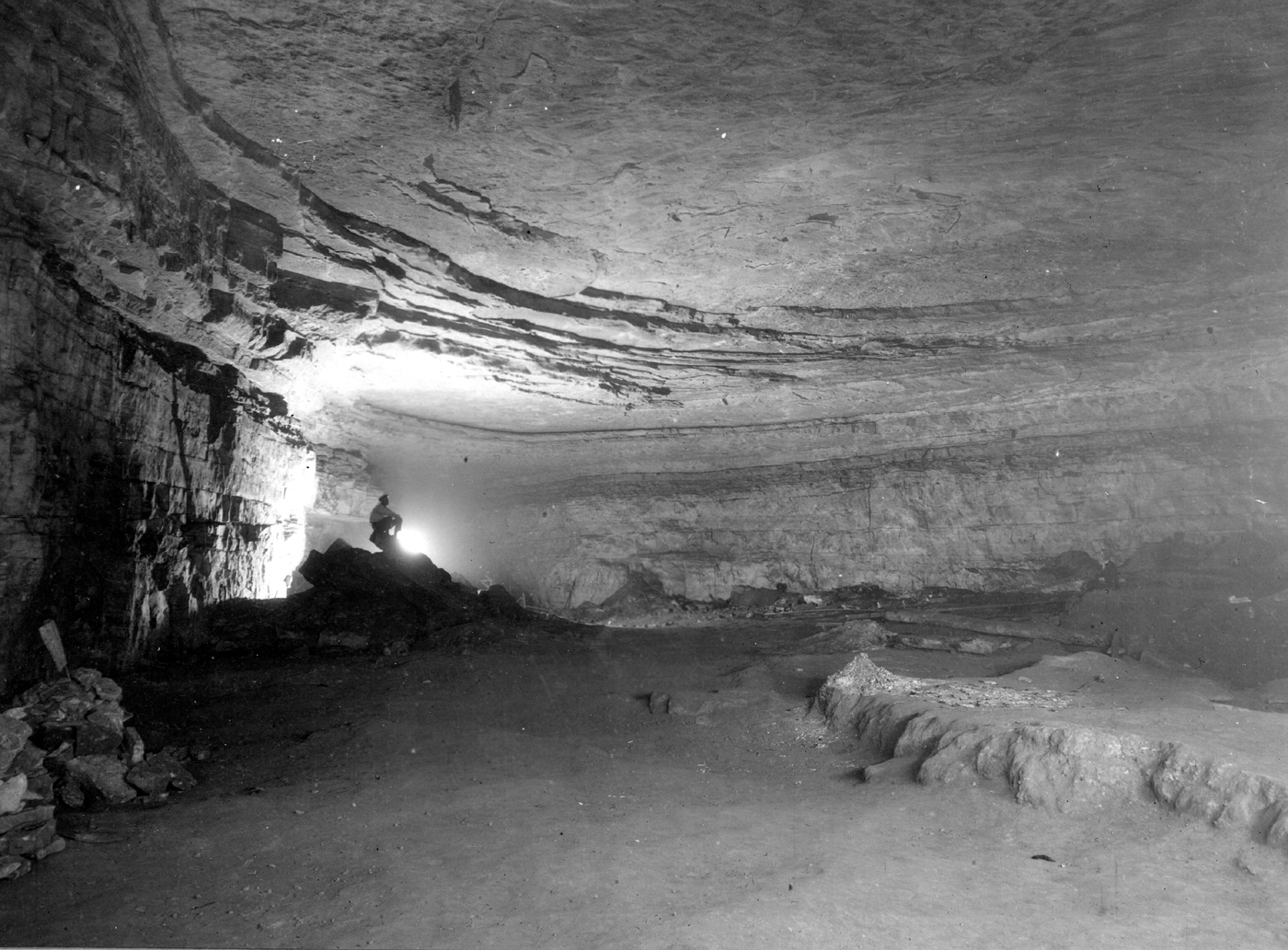
The park's most renowned feature lies beneath the surface—the extensive network of caves and passageways that make up Mammoth Cave. With more than 685 kilometers (426 miles) of surveyed passages, and new sections continuing to be discovered, it holds the distinction of being the world's longest known cave system. These labyrinthine corridors reveal a remarkable variety of geological features, including vast underground chambers, deep canyons, gypsum formations, and, in some areas, delicate stalactites, stalagmites, flowstones, and draperies formed over millions of years.
Inhabiting these subterranean realms are a variety of unique animals, many specially adapted to life in perpetual darkness. The cave provides habitat for species such as the endangered Indiana bat, the gray bat, and the southeastern myotis, as well as rare cave-dwelling fish, crayfish, beetles, and other invertebrates found nowhere else. These fragile ecosystems are among the most biologically diverse of any cave system in the world.
Mammoth Cave also preserves a rich record of human history. Indigenous peoples explored parts of the cave more than 4,000 years ago, leaving evidence of early mineral extraction activities. During the early 19th century, the cave became an important source of saltpeter, a key ingredient in gunpowder production during the War of 1812. Commercial tours began in the 19th century, making Mammoth Cave one of the oldest continuously operating tourist attractions in the United States and contributing to its enduring cultural significance.
Visitors to Mammoth Cave National Park can embark on guided tours to delve into the depths of this subterranean marvel. Tours range from easy, wheelchair-accessible excursions to challenging, multi-hour expeditions that require climbing and crawling. Regardless of the chosen tour, each journey offers a glimpse into the fascinating geology, ecology, and human history of this extraordinary site.
Beyond the caves, Mammoth Cave National Park offers opportunities for hiking, camping, canoeing, kayaking, fishing, horseback riding, and birdwatching. The park's forests, rivers, and grasslands support a rich diversity of wildlife, including white-tailed deer, wild turkeys, river otters, and hundreds of bird species. Its varied landscapes are also home to numerous wildflowers and native orchids, including the showy orchid and the white-fringed orchid, providing ample opportunities for nature enthusiasts to explore and appreciate the beauty of Kentucky's natural world.
The international importance of Mammoth Cave extends beyond its extraordinary size. UNESCO recognized the park as a World Heritage Site because it represents an exceptional example of the geological processes that create karst landscapes and because of the remarkable diversity of life adapted to underground environments. In addition, the park was designated a UNESCO Biosphere Reserve in 1990, reflecting the importance of protecting both its subterranean ecosystems and the diverse forests, rivers, and habitats found above ground.
Altogether, Mammoth Cave National Park offers a remarkable blend of subterranean wonders and above-ground splendor. As a UNESCO World Heritage Site, it preserves one of Earth's most extraordinary geological landscapes, serving as a reminder of the breathtaking natural phenomena hidden beneath our feet and the importance of protecting these unique environments for future generations to discover and enjoy.
UNESCO Description of the World Heritage Site
Mammoth Cave National Park, located in the state of Kentucky, has the world's largest network of natural caves and underground passageways, which are characteristic examples of limestone formations. The park and its underground network of more than 560 surveyed km of passageways are home to a varied flora and fauna, including a number of endangered species.
UNESCO Justification of the World Heritage Site
Criterion (vii): Mammoth Cave is the longest cave system in the world. The long passages with huge chambers, vertical shafts, stalagmites and stalactites, splendid forms of beautiful gypsum flowers, delicate gypsum needles, rare mirabilite flowers and other natural features of the cave system are all superlative examples of their type. No other known cave system in the world offers a greater variety of sulfate minerals.
Criterion (viii): Mammoth Cave exhibits 100 million years of cave-forming action and presents nearly every type of cave formation known. Geological processes involved in their formation continue. Today, this huge and complex network of cave passages provides a clear, complete and accessible record of the world’s geomorphic and climatic changes. Outside the cave, the karst topography is superb, with fascinating landscapes and all of the classic features of a karst drainage system: vast recharge area, complex network of underground conduits, sink holes, cracks, fissures, and underground rivers and springs.
Criterion (x): The flora and fauna of the cave is the richest caverniculous wildlife known, numbering over 130 species, of which 14 species of troglobites and troglophiles are known only to exist here.
Encyclopedia Record: Mammoth Cave National Park
Mammoth Cave National Park is a national park of the United States in south-central Kentucky. It encompasses portions of Mammoth Cave, the longest known cave system in the world. The park's 52,007 acres (21,046 ha) are located primarily in Edmonson County, with small areas extending eastward into Hart and Barren counties. The Green River runs through the park, with a tributary called the Nolin River feeding into the Green just inside the park.Additional Site Details
Area: 21,191 hectares
Number of Components: 1
(viii) — Outstanding example representing major earth stages
(x) — Contains most important habitats for biodiversity
Coordinates: 37.18722222 , -86.10305556
IUCN World Heritage Outlook
The 2025 Conservation Outlook on Mammoth Cave National Park reports the following assessment:
Source: International Union for Conservation of Nature (IUCN) · View assessment
Image
Willis Thomas Lee, Public domain
World Heritage Research
Discover scientific research and academic studies that deepen our understanding of Mammoth Cave National Park from its history and significance to its conservation, management, and contemporary challenges.
-
Effects of stream permanence on stonefly (Insecta, Plecoptera) community structure at Mammoth Cave National Park, Kentucky, USA
Stonefly communities at Mammoth Cave National Park, Kentucky, USA, exhibit significant differences based on stream permanence. The study found that 88% of the 34 stonefly species collected had univoltine-fast life cycles and 79% likely experienced extended egg or larval diapause, enabling survival in intermittent habitats. Spring runs, spring seeps, and summer dry streams harbored distinct assemblages compared to upland perennial streams, with larger lotic system species filtered out due to habitat limitations. The research employed a 14-month sampling regime (December 2018–November 2019) across 45 sites, including both adult and larval collections, to assess these patterns.
McRoberts, T., & Grubbs, S. (2021). Effects of stream permanence on stonefly (Insecta, Plecoptera) community structure at Mammoth Cave National Park, Kentucky, USA. Biodiversity Data Journal, 9. https://doi.org/10.3897/bdj.9.e62242
View Publication Record | Read Publication -
Landscape-scale distribution of tree roosts of the northern long-eared bat in Mammoth Cave National Park, USA
Female northern long-eared bats (Myotis septentrionalis) in Mammoth Cave National Park, USA, predominantly select roost sites within 2000 meters of known hibernacula, favoring higher elevations in mesic upland deciduous forests near water sources and road corridors. This landscape-scale pattern, identified through mist-netting and radiotelemetry from 2015 to 2016, challenges traditional microhabitat-focused conservation strategies by highlighting the importance of broader spatial considerations for effective maternity habitat management. The study underscores the need for empirically-based, large-scale assessments to inform policies aimed at conserving this declining species.
Thalken, M. M., Lacki, M. J., & Yang, J. (2018). Landscape-scale distribution of tree roosts of the northern long-eared bat in Mammoth Cave National Park, USA. Landscape Ecology, 33(7), 1103–1115. https://doi.org/10.1007/s10980-018-0659-3
View Publication Record | Read Publication -
Shifts in Assemblage of Foraging Bats at Mammoth Cave National Park following Arrival of White-nose Syndrome
White-nose syndrome (WNS), which arrived in North America in 2006, has significantly altered the foraging bat assemblage at Mammoth Cave National Park. A study analyzing mist net capture data from 2009 to 2016 revealed a notable shift in species abundance. The Northern Long-eared Myotis (Myotis septentrionalis), once the most common species, declined to 18.5% of its pre-WNS levels. Conversely, the Evening Bat (Nycticeius humeralis) showed the largest increase in capture success post-WNS arrival, followed by the Big Brown Bat (Eptesicus fuscus) and Eastern Red Bat (Lasiurus borealis). These changes suggest that WNS is reshaping foraging bat communities, with less affected species potentially occupying niche space vacated by those severely impacted by the disease. The study highlights the broader ecological implications of WNS on forest-dwelling bats.
Thalken, M. M., Lacki, M. J., & Johnson, J. S. (2018). Shifts in Assemblage of Foraging Bats at Mammoth Cave National Park following Arrival of White-nose Syndrome. Northeastern Naturalist, 25(2), 202–214. https://doi.org/10.1656/045.025.0203
View Publication Record | Read Publication -
A Descriptive Study of Guided Tours at Mammoth Cave National Park
A recent decline in cave tour attendance across the United States has been partially addressed through a study at Mammoth Cave National Park, revealing that guided tours are highly valued by visitors despite low crowding levels. The research, conducted via a mail-back survey of 660 visitors, found high approval ratings and perceived value for the fee paid, suggesting potential strategies to counteract attendance drops. This study highlights the importance of understanding social aspects of visitation in cave settings, where guided tours are often the sole means of exploration.
Morgan, M., & Walker, C. (2011). A Descriptive Study of Guided Tours at Mammoth Cave National Park. Journal of Interpretation Research, 16(1), 25–34. https://doi.org/10.1177/109258721101600103
View Publication Record | Read Publication -
Historical GIS as a Platform for Public Memory at Mammoth Cave National Park
A historical GIS platform for Mammoth Cave National Park reveals the landscape's transition from a farming community to a protected national park, preserving public memory of its pre-park inhabitants. The Mammoth Cave Historical GIS (MCHGIS) overlays 1920 census data at the household level with streaming topographic maps and georeferences Civilian Conservation Corps photographs, enabling visualization and analysis of population dynamics on the eve of park establishment. This web-based interface broadens access to archival holdings while integrating public participation GIS techniques to create a virtual site of public memory, supplementing institutional history with privately donated materials.
Algeo, K., Epperson, A., & Brunt, M. (2011). Historical GIS as a Platform for Public Memory at Mammoth Cave National Park. International Journal of Applied Geospatial Research, 2(4), 19–37. https://doi.org/10.4018/jagr.2011100102
View Publication Record | Read Publication