World Heritage Identification Number: 442
World Heritage since: 1987
Category: Cultural Heritage
WHE Type: Buildings & Architectural Ensembles
Transboundary Heritage: No
Endangered Heritage: No
Country: 🇺🇸 United States of America
Continent: Americas
UNESCO World Region: Europe and North America
Map
Monticello and the University of Virginia in Charlottesville: Architectural Masterpieces of Thomas Jefferson
Monticello and the University of Virginia in Charlottesville represent two significant architectural masterpieces designed by Thomas Jefferson, a founding father, statesman, and architect of the United States. These sites, inscribed as a UNESCO World Heritage Site in 1987, showcase Jefferson's unique blend of classical architecture and innovative design principles.
More to come…UNESCO Description of the World Heritage Site
Thomas Jefferson (1743–1826), author of the American Declaration of Independence and third president of the United States, was also a talented architect of neoclassical buildings. He designed Monticello (1769–1809), his plantation home, and his ideal 'academical village' (1817–26), which is still the heart of the University of Virginia. Jefferson's use of an architectural vocabulary based upon classical antiquity symbolizes both the aspirations of the new American republic as the inheritor of European tradition and the cultural experimentation that could be expected as the country matured.
UNESCO Justification of the World Heritage Site
Criterion (i): Both Monticello and the University of Virginia reflect Jefferson’s wide reading of classical and later works on architecture and design and also his careful study of the architecture of late 18th-century Europe. As such they illustrate his wide diversity of interests.
Criterion (iv): With these buildings Thomas Jefferson made a significant contribution to Neoclassicism, the 18th-century movement that adapted the forms and details of classical architecture to contemporary buildings.
Criterion (vi): Monticello and the key buildings of the University of Virginia are directly and materially associated with the ideas and ideals of Thomas Jefferson. Both the University buildings and Monticello were directly inspired by principles derived from his deep knowledge of classical architecture and philosophy.
Encyclopedia Record: Monticello
Monticello was the primary residence and plantation of Thomas Jefferson, a Founding Father, author of the Declaration of Independence, and the third president of the United States. Jefferson began designing Monticello after inheriting land from his father at the age of 14. Located just outside Charlottesville, Virginia, in the Piedmont region, the plantation was originally 5,000 acres (20 km2), with Jefferson using the forced labor of enslaved black people for extensive cultivation of tobacco and mixed crops, later shifting from tobacco cultivation to wheat in response to changing markets. Due to its architectural and historic significance, the property has been designated a National Historic Landmark. In 1987, Monticello and the nearby University of Virginia, also designed by Jefferson, were together designated a UNESCO World Heritage Site. The United States nickel has featured a depiction of Monticello on its reverse every year since 1938 with the exception of 2004-05.Additional Site Details
Area: 795.96 hectares
Number of Components: 2
(iv) — Outstanding example of a type of building or landscape
(vi) — Directly associated with events or living traditions
Coordinates: 38.03277778 , -78.50388889
Image
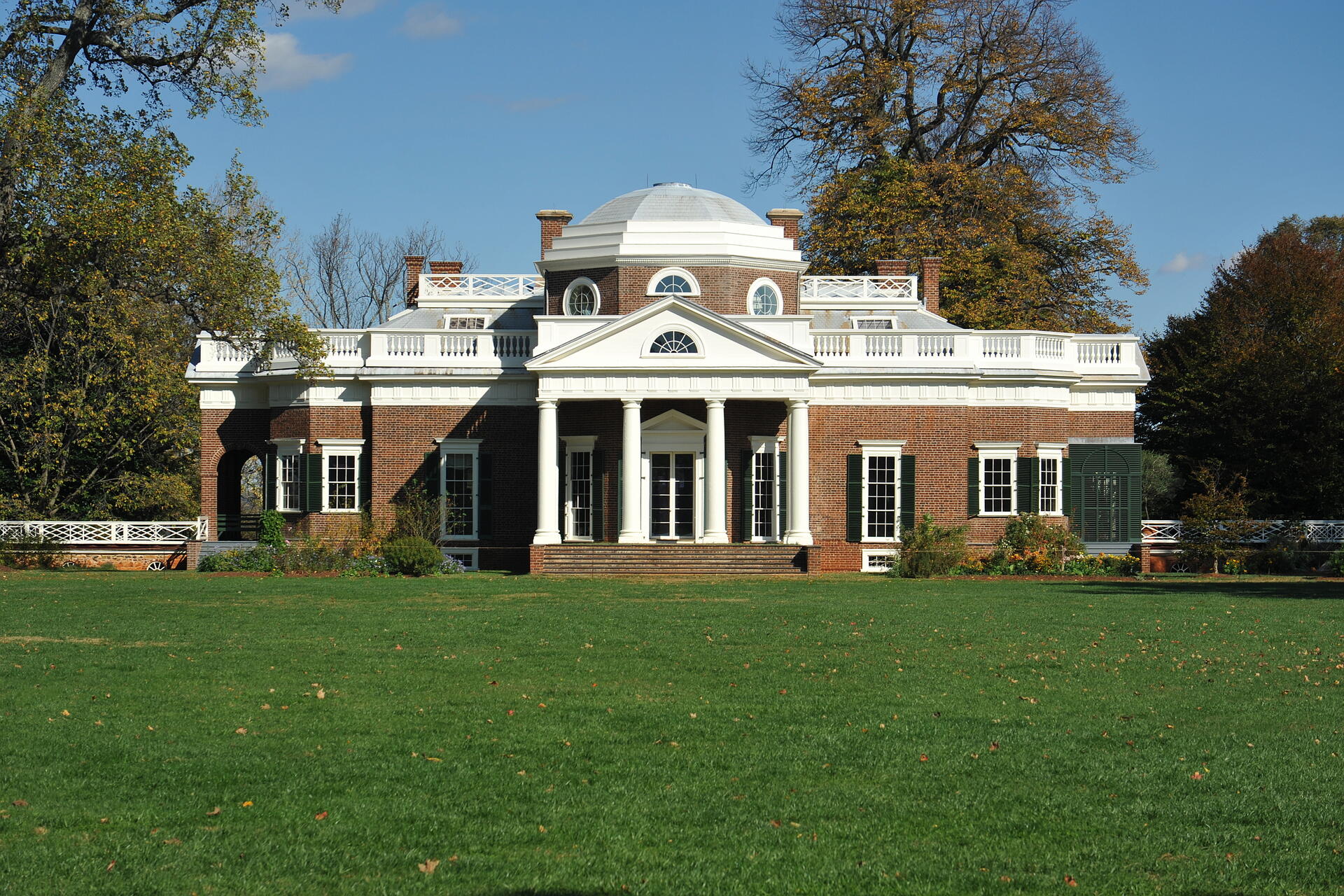
© YF12s, CC BY-SA 3.0 Resized from original. (This derivative is under the same CC BY-SA license.)
World Heritage Research
Discover scientific research and academic studies that deepen our understanding of Monticello and the University of Virginia in Charlottesville from its history and significance to its conservation, management, and contemporary challenges.
-
Jocelyn Nicole Johnson
Jocelyn Nicole Johnson's critically acclaimed debut collection, 'My Monticello,' explores the intersection of home, identity, and racial injustice through a diverse set of narratives centered on Black and Brown characters in Charlottesville, Virginia. The work, which includes a novella and short stories, examines themes of belonging, longing, and dislocation, drawing inspiration from real-life incidents such as the 2015 altercation with Martese Johnson and the 2017 white nationalist rally. Johnson's approach blends personal reflection, social commentary, and pop culture references to illuminate the challenges faced by marginalized communities in the Appalachian South. The collection, awarded the 2021 Weatherford Award for Fiction, is being adapted into a Netflix film.
Ductan, M. (2022). Jocelyn Nicole Johnson. Appalachian Review, 50(2), 45–52. https://doi.org/10.1353/aph.2022.0034
View Publication Record | Read Publication -
The Papers of Thomas Jefferson: Retirement Series, Volume 14: 1 February to 31 August 1819
A detailed examination of Thomas Jefferson's activities and correspondences between February and August 1819 reveals his multifaceted role as a founding member of the University of Virginia Board of Visitors, where he facilitated institutional development, including securing builders and establishing a classical preparatory school. The analysis also highlights Jefferson's personal routines—such as a vegetarian diet, morning foot baths, and horseback riding—as well as his intellectual pursuits, including discussions on Greek pronunciation with peers like John Adams. Additionally, the volume documents challenging events, such as financial strain due to a friend's bankruptcy, property damage at Poplar Forest, and familial conflicts involving his grandson-in-law and grandson. This comprehensive collection of 637 documents provides insight into Jefferson's leadership, personal life, and the broader social and intellectual landscape of early 19th-century Virginia.
Jefferson, T. (2018). The Papers of Thomas Jefferson: Retirement Series, Volume 14: 1 February to 31 August 1819. https://doi.org/10.1515/9781400890477
View Publication Record | Read Publication -
‘Those Who Labor for My Happiness’: Slavery at Thomas Jefferson's Monticello
Thomas Jefferson's Monticello is revealed as a complex site where the ideals of Enlightenment co-existed with the harsh reality of slavery. Lucia Stanton's 2012 study, 'Those Who Labor for My Happiness': Slavery at Thomas Jefferson's Monticello, challenges the romanticized narratives of Jefferson's life by meticulously examining the lived experiences of enslaved individuals and their contributions to the estate. Through archival research, oral histories, and archaeological evidence, Stanton reconstructs the lives of over 600 enslaved people, highlighting their labor, resistance, and agency within the Monticello community. The study underscores the duality of Monticello as both a symbol of democratic ideals and a site deeply entrenched in the institution of slavery, offering a nuanced perspective on its historical significance.
Ellis, J. J. (2013). ‘Those Who Labor for My Happiness’: Slavery at Thomas Jefferson’s Monticello. Slavery & Abolition, 34(1), 187–189. https://doi.org/10.1080/0144039x.2012.759681
View Publication Record | Read Publication -
Shaping the Body Politic: Art and Political Formation in Early America (review)
Shaping the Body Politic: Art and Political Formation in Early America reveals how early American visual and material culture played a pivotal role in defining national identity and political discourse. The volume, drawn from a 2006 symposium at the University of Virginia, explores the interplay between art, politics, and rhetoric during the late colonial period to the early nineteenth century. Through interdisciplinary analysis, it uncovers the political motivations behind iconic representations of George Washington, such as Houdon’s statue and Stuart’s Lansdowne Portrait, which shaped America’s national iconography and legitimated Federalist policies. Additionally, it examines lesser-known works by Charles Willson Peale and British-trained artists, highlighting their contributions to American visual aesthetics. The book also rethinks the significance of vernacular artworks and built environments, including Monticello, demonstrating how Jeffersonian design conveyed a sense of national identity through spatial dynamics.
Walsh, M. (2012). Shaping the Body Politic: Art and Political Formation in Early America (review). Journal of the Early Republic, 32(3), 512–515. https://doi.org/10.1353/jer.2012.0051
View Publication Record | Read Publication