World Heritage Identification Number: 198
World Heritage since: 1982
Category: Cultural Heritage
WHE Type: Archaeological Sites
Transboundary Heritage: No
Endangered Heritage: No
Country: 🇺🇸 United States of America
Continent: Americas
UNESCO World Region: Europe and North America
Map
Cahokia Mounds State Historic Site: A Preeminent Pre-Columbian Settlement in North America
The Cahokia Mounds State Historic Site, located approximately 13 kilometers northeast of St. Louis, Missouri, stands as a testament to the rich cultural heritage and architectural prowess of the indigenous peoples who inhabited the region during the Mississippian period (800–1400). Inscribed as a UNESCO World Heritage Site in 1982, this expansive archaeological park offers a unique glimpse into the lives of the ancient inhabitants who once thrived in this bustling metropolis.
More to come…UNESCO Description of the World Heritage Site
Cahokia Mounds, some 13 km north-east of St Louis, Missouri, is the largest pre-Columbian settlement north of Mexico. It was occupied primarily during the Mississippian period (800–1400), when it covered nearly 1,600 ha and included some 120 mounds. It is a striking example of a complex chiefdom society, with many satellite mound centres and numerous outlying hamlets and villages. This agricultural society may have had a population of 10–20,000 at its peak between 1050 and 1150. Primary features at the site include Monks Mound, the largest prehistoric earthwork in the Americas, covering over 5 ha and standing 30 m high.
UNESCO Justification of the World Heritage Site
Criterion (iii): Dating from the Mississippian period (800–1350 at this site), Cahokia Mounds is the largest pre-Columbian archaeological site north of Mexico; it is also the earliest of the large Mississippian settlements. It is the pre-eminent example of a cultural, religious, and economic center of the prehistoric Mississippian cultural tradition.
Criterion (iv): Cahokia graphically demonstrates the existence of a pre-urban society in which a powerful political and economic hierarchy was responsible for the organization of labor, communal agriculture, and trade. This is reflected in the size and layout of the settlement and the nature and structure of the public and private buildings.
Encyclopedia Record: Cahokia
The Cahokia Mounds is the site of a Native American city directly across the Mississippi River from present-day St. Louis. The state archaeology park lies in south-western Illinois between East St. Louis and Collinsville. The park covers 2,200 acres (890 ha), or about 3.5 square miles (9 km2), and contains about 80 manmade mounds, but the ancient city was much larger. At its apex around 1100 AD, the city covered about 6 square miles (16 km2), included about 120 earthworks in a wide range of sizes, shapes, and functions, and had a population of between 15,000 and 20,000 people.Additional Site Details
Area: 541 hectares
Number of Components: 1
(iv) — Outstanding example of a type of building or landscape
Coordinates: 38.65861111 , -90.06138889
Image
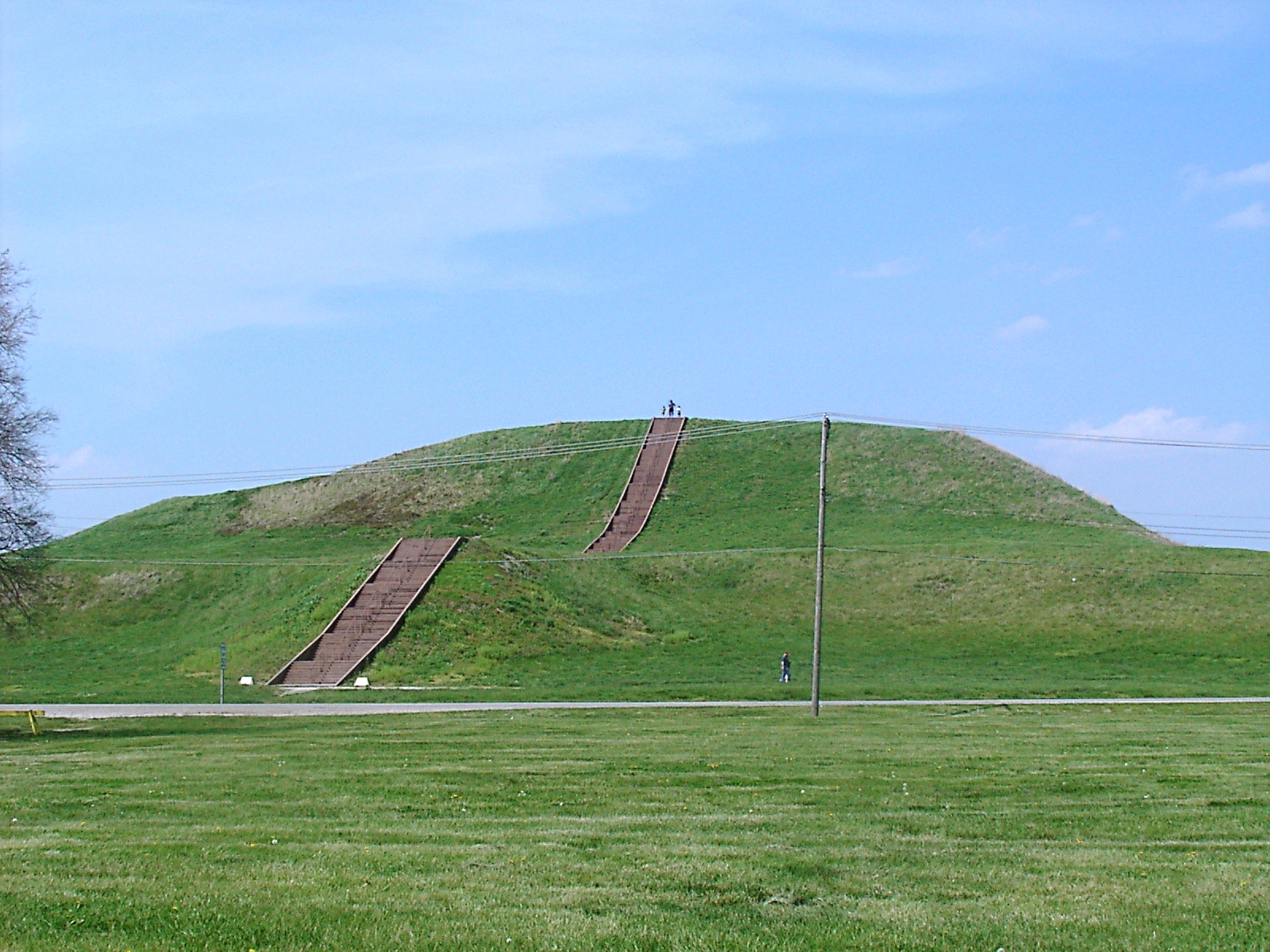
© Skubasteve834, CC BY-SA 3.0 Resized from original. (This derivative is under the same CC BY-SA license.)
World Heritage Research
Discover scientific research and academic studies that deepen our understanding of Cahokia Mounds State Historic Site from its history and significance to its conservation, management, and contemporary challenges.
-
Rivers, Rails, and Rich Soil: Agricultural Innovations in Illinois
Illinois' agricultural history, from Indigenous diversified farming systems to modern industrial innovations, highlights the state's pivotal role in shaping American food production. The region's rich biodiversity and fertile prairie soils enabled the rise of Cahokia, America's largest pre-Columbian city, while later supporting European settlers' transition to commercial agriculture. Key innovations like John Deere's steel plow and mechanized reapers revolutionized farming efficiency, fostering economic growth and infrastructure development. The state also pioneered agricultural education through land-grant universities and led global advancements in heavy equipment post-WWII. However, the shift toward industrial-scale farming raises concerns about environmental sustainability and rural depopulation. Today, Illinois remains a leader in pumpkin production and agribusiness, with ongoing efforts to preserve its agricultural heritage through museums and digitized historical records.
Barker-Devine, J. (2026). Rivers, Rails, and Rich Soil: Agricultural Innovations in Illinois. Journal of the Illinois State Historical Society (1998-), 119(1), 19–22. https://doi.org/10.5406/23283335.119.1.04
View Publication Record | Read Publication -
The Visible and Invisible Workings of Cahokia
Cahokia, the largest pre-Columbian urban center north of Mexico, was shaped by intentional engagements with its landscape—wetlands, swamps, and karst features—that were previously overlooked or misunderstood. By integrating indigenous perspectives with archaeological data, this study reveals that Cahokia’s people strategically altered their environment to draw power from specific landscape elements, embedding them within community identity and urban development. Findings at the Emerald Acropolis Shrine and other precincts underscore how locality, water, and underworld connections were central to Cahokian society, challenging traditional archaeological interpretations and highlighting the agency of non-human actors in indigenous conceptualizations.
Alt, S. M. (2025). The Visible and Invisible Workings of Cahokia. Understanding Early Large-Scale Collectives, 44–68. https://doi.org/10.4324/9781003528050-3
View Publication Record | Read Publication -
Cahokian Neighborhood Dynamics: New Geophysical Data from Rouch Mound Group and Rattlesnake West Neighborhoods
New geophysical surveys at Cahokia Mounds reveal that peripheral neighborhoods, such as the Rouch Mound Group and Rattlesnake West, mirrored the architectural and infrastructure patterns of Cahokia's densely populated Downtown Precinct. By analyzing structure length and width ratios from these areas alongside datasets from the Cahokia and East St. Louis precincts, researchers identified shifts in neighborhood density over time. This noninvasive approach provides deeper insights into how communities on the outskirts adopted and adapted Cahokia's urban planning, offering a clearer picture of its societal organization.
Baires, S. E., Malouchos, E. W., Baltus, M. R., & Skousen, B. J. (2025). Cahokian Neighborhood Dynamics: New Geophysical Data from Rouch Mound Group and Rattlesnake West Neighborhoods. American Antiquity, 90(2), 328–345. https://doi.org/10.1017/aaq.2024.62
View Publication Record | Read Publication -
High Resolution Lidar Drone Imagery Assessment of the Rattlesnake Mound Complex at Cahokia, Illinois, USA
A high-resolution lidar drone survey of the Rattlesnake Mound Complex at Cahokia Mounds State Historic Site has revealed new details about a series of low mounds surrounding the primary structure, with only two previously documented. The study also assessed erosion damage caused by unfilled trenches from Moorehead’s 1927 excavation and uncovered new findings related to bundle burials and a 'spirit house' within Rattlesnake Mound. By combining lidar imagery with aerial photographs, researchers provided unprecedented insights into the site's structure and preservation challenges.
Romain, W. F., Herrmann, E. W., Martin, H., Barefoot, E. A., & Scott, S. (2025). High Resolution Lidar Drone Imagery Assessment of the Rattlesnake Mound Complex at Cahokia, Illinois, USA. Midcontinental Journal of Archaeology, 50(1), 31–62. https://doi.org/10.5406/23274271.50.1.02
View Publication Record | Read Publication -
Correlating Late-Holocene climate change and population dynamics at Cahokia Mounds (American Bottom, USA)
A multi-decadal drought at the end of the 13th century did not significantly alter vegetative communities at Cahokia Mounds, challenging assumptions about climate-induced agricultural destabilization. Using stable carbon isotopes from paleosols, researchers found that Indigenous plant communities showed resilience to severe drought conditions, contrary to expectations. This study highlights critical gaps in understanding how plants respond to climate variability and emphasizes the need for deeper insights into the tolerance of Indigenous crops to inform future climate adaptation strategies.
Rankin, C. G., & Mueller, N. G. (2024). Correlating Late-Holocene climate change and population dynamics at Cahokia Mounds (American Bottom, USA). The Holocene, 34(9), 1194–1203. https://doi.org/10.1177/09596836241254488
View Publication Record | Read Publication -
Cultural and chronological variation in Woodland and Mississippian mortuary practices on the edge of Greater Cahokia
A reanalysis of the Kane Mounds mortuary complex, long thought to be late Mississippian, reveals it was not a mound but a natural bluff-top burial site used continuously for over a millennium. The study, leveraging legacy field records and analytical data, demonstrates significant cultural and chronological variation in Woodland and Mississippian mortuary practices on the periphery of Greater Cahokia. Findings indicate shifts from hunting-and-gathering to maize-based subsistence, increased social complexity, and diverse burial practices including in-the-flesh interments, ossuaries, excarnation, postmortem manipulations, and extensive fire use. The research highlights the site's enduring significance as an ancestral burial place, reflecting both temporal and geographic diversity.
Emerson, T. E., Hedman, K. M., & Fort, M. A. (2024). Cultural and chronological variation in Woodland and Mississippian mortuary practices on the edge of Greater Cahokia. Southeastern Archaeology, 43(3), 145–164. https://doi.org/10.1080/0734578x.2024.2380144
View Publication Record | Read Publication -
Archaeoastronomy and Landscape Archaeology at Cahokia
New research reveals that Cahokia, the largest Native American city north of Mexico during the Mississippian era, features earthen mounds strategically aligned with astronomical phenomena and landscape markers. Specifically, Monks, Rattlesnake, Powell, and other mounds are found to be oriented toward solar, lunar, and Milky Way trajectories, intersecting prominent bluffs that likely served as horizon references. This discovery was achieved using LiDAR imagery, historic documents, ethnohistoric data, and archaeological evidence, providing unprecedented insight into the sophisticated spatial planning of this ancient civilization.
Romain, W. F. (2024). Archaeoastronomy and Landscape Archaeology at Cahokia. Journal of Astronomy in Culture, 2(1). https://doi.org/10.5070/ac3.21157
View Publication Record | Read Publication