World Heritage Identification Number: 295
World Heritage since: 1984
Category: Cultural Heritage
WHE Type: Historic Cities & Urban Areas
Transboundary Heritage: No
Endangered Heritage: No
Country: 🇱🇧 Lebanon
Continent: Asia
UNESCO World Region: Arab States
Map
Byblos: An Ancient City Steeped in History and Culture
Byblos, officially known as Jebeil, Jbeil, or Jubayl, is an ancient city located within the Keserwan-Jbeil Governorate of Lebanon. This remarkable site, recognized by UNESCO as a World Heritage Site, offers a unique glimpse into the rich tapestry of human civilization that has unfolded along the shores of the Mediterranean Sea over thousands of years.
More to come…UNESCO Description of the World Heritage Site
The ruins of many successive civilizations are found at Byblos, one of the oldest Phoenician cities. Inhabited since Neolithic times, it has been closely linked to the legends and history of the Mediterranean region for thousands of years. Byblos is also directly associated with the history and diffusion of the Phoenician alphabet.
UNESCO Justification of the World Heritage Site
Criterion (iii): Byblos bears an exceptional testimony to the beginnings of Phoenician civilization.
Criterion (iv): Since the Bronze Age, Byblos provides one of the primary examples of urban organization in the Mediterranean world.
Criterion (vi): Byblos is directly and tangibly associated with the history of the diffusion of the Phoenician alphabet (on which humanity is still largely dependent today), with the inscriptions of Ahiram, Yehimilk, Elibaal and Shaphatbaal.
Encyclopedia Record: Byblos
Byblos, also known as Jebeil, Jbeil or Jubayl, is an ancient city in the Keserwan-Jbeil Governorate of Lebanon. The area is believed to have been first settled between 8800 and 7000 BC and continuously inhabited since 5000 BC. During its history, Byblos was part of numerous cultures including Egyptian, Phoenician, Assyrian, Persian, Hellenistic, Roman, Genoese, Mamluk and Ottoman. Urbanisation is thought to have begun during the third millennium BC when it developed into a city, making it one of the oldest cities in the world, if not the oldest. It is a UNESCO World Heritage Site.Additional Site Details
Area: Not available
Number of Components: 1
(iv) — Outstanding example of a type of building or landscape
(vi) — Directly associated with events or living traditions
Coordinates: 34.11917 , 35.6455555556
Image
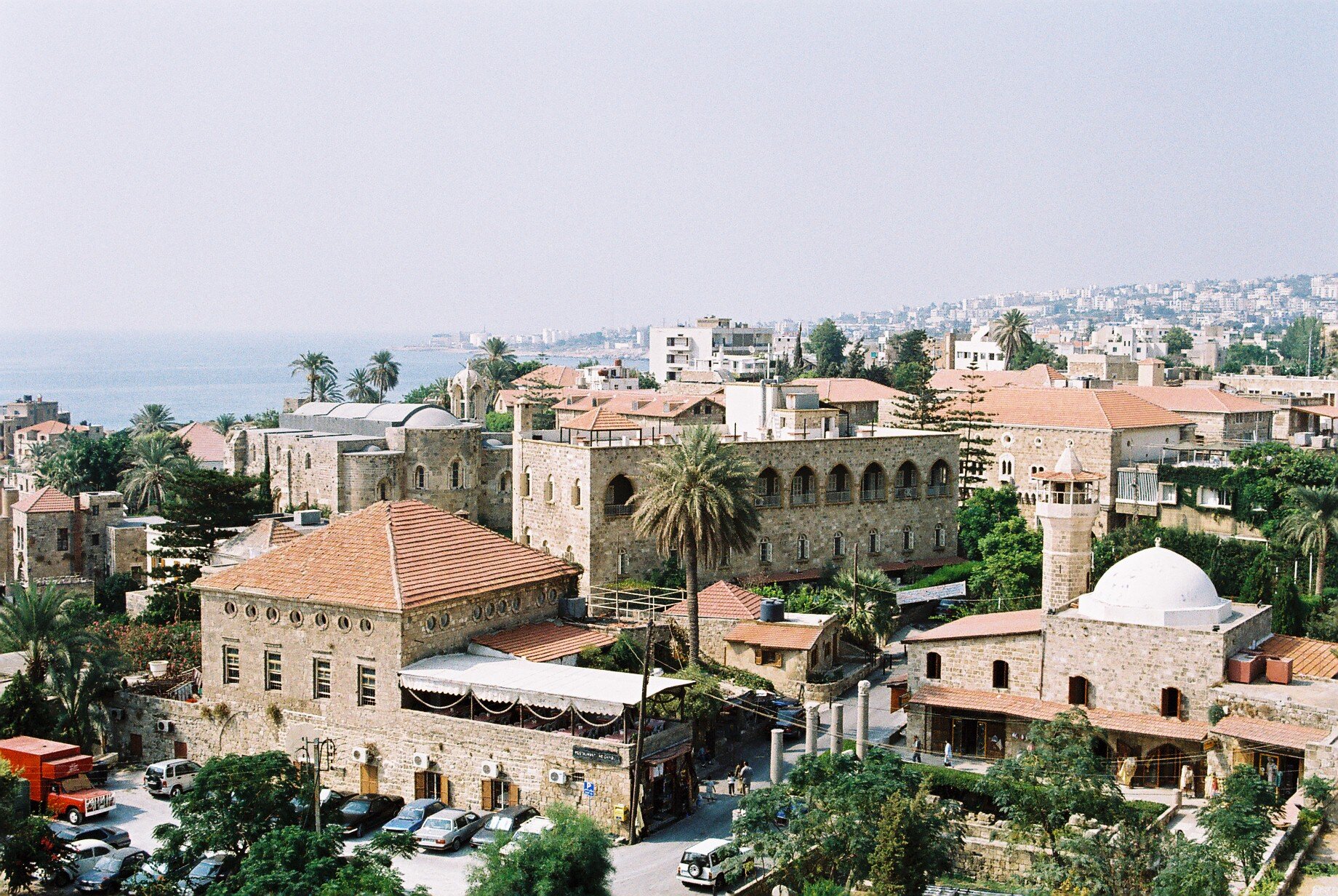
© Orient at de.wikipedia, CC BY-SA 2.0 de Resized from original. (This derivative is under the same CC BY-SA license.)
World Heritage Research
Discover scientific research and academic studies that deepen our understanding of Byblos from its history and significance to its conservation, management, and contemporary challenges.
-
Numerical and Experimental Seismic Characterization of Byblos Site in Lebanon
A seismic study of Byblos, Lebanon, reveals significant variations in ground motion due to geological and topographic site effects, with potential resonance from soft, shallow layers. Using field surveys that included ambient vibration recordings, surface waves, and 2D seismic arrays, researchers identified multiple resonant frequency peaks indicative of impedance contrasts and lateral subsurface stiffness variations. These findings were validated through a combination of numerical models and experimental observations, marking a critical step in the seismic microzoning of Byblos. The study highlights the influence of fractured rocks and anthropic deposits on seismic ground motions, offering new insights into the area's seismic hazards and contributing to enhanced resilience and sustainability efforts.
Abou Jaoude, R., Makhoul, N., Gesret, A., & Fleurisson, J.-A. (2025). Numerical and Experimental Seismic Characterization of Byblos Site in Lebanon. Geosciences, 15(3), 82. https://doi.org/10.3390/geosciences15030082
View Publication Record | Read Publication -
Evaluating the Landscape and Ecological Aspects of Urban Planning in Byblos: A Multi-Faceted Approach to Assessing Urban Forests
A multi-faceted analysis of Byblos, a UNESCO World Heritage site, reveals critical insights into its urban and peri-urban forests (UPFs), threatened by rapid urbanization. The study found that 28% of the city's canopy cover is concentrated in the northeastern region, with native tree species comprising 30% of the total. Significant variations in tree diversity were observed across different land-use types, with residential streets exhibiting the highest Shannon diversity index (H = 1.35), followed by the city center (H = 1.02) and vehicular areas (H = 0.64). A normal J-shaped distribution of tree diameters was consistent across all street types, while a silhouette perceptual test highlighted a preference for densely spreading canopies. Residential trees also showed greater structural diversity and varied blossoming seasons. This pioneering study on Byblos' urban forestry provides actionable recommendations for sustainable management and planning, ensuring the preservation of its ecological and visual value.
Hobeika, M., Dawalibi, V., Kallas, G., & Russo, A. (2024). Evaluating the Landscape and Ecological Aspects of Urban Planning in Byblos: A Multi-Faceted Approach to Assessing Urban Forests. Land, 13(4), 464. https://doi.org/10.3390/land13040464
View Publication Record | Read Publication -
Byblos. A legacy unearthed
Byblos, one of the oldest continuously inhabited cities in the world, stands out for its profound historical and cultural significance spanning nearly 8900 years. This city, renowned as a preeminent port and religious center from around 3200 BC, played a pivotal role in Mediterranean history due to its strategic location near Mount Lebanon's cedar forests and its close ties with ancient Egyptian pharaohs. Byblos is also synonymous with writing, contributing the term for 'book' to the Greek language. The anthology 'Byblos: A Legacy Unearthed' compiles extensive research from leading international experts, covering archaeological expeditions and recent discoveries that illuminate the city's history from Neolithic origins through the Medieval era. This collaborative effort between the National Museum of Antiquities (The Netherlands) and Lebanon's Ministry of Culture offers a comprehensive, lavishly illustrated exploration of Byblos' enduring legacy.
(Ed.). (2024). Byblos. A legacy unearthed. https://doi.org/10.59641/z8124cl
View Publication Record | Read Publication -
The Development of Byblos in the Geopolitical Context of the Eleventh and Tenth Centuries BC
Phoenician trade and seafaring activities in the Mediterranean, beginning around the 10th century BC, likely laid critical groundwork for later Phoenician colonization efforts in the western Mediterranean basin. This study reassesses Byblos' historical development during this period by analyzing geopolitical shifts in the Levant following the 12th century BC, which facilitated its expansion and stability. It highlights how Byblos' strategic positioning and maritime trade networks played a pivotal role in shaping its regional influence, offering new insights into the broader context of Phoenician colonization. The research draws on recent archaeological discoveries in Huelva, Spain, to contextualize these findings.
Abou Abdaleh, M. (2024). The Development of Byblos in the Geopolitical Context of the Eleventh and Tenth Centuries BC. Onoba. Revista de Arqueología Y Antigüedad, (12), 69–78. https://doi.org/10.33776/onoba.vi12.8305
View Publication Record | Read Publication -
Assessment of thermal comfort in the traditional and contemporary houses in Byblos: A comparative study
Traditional houses in Byblos, Lebanon, offer superior thermal comfort compared to contemporary ones, primarily due to their reliance on natural and passive cooling methods. This finding emerges from a comparative study that analyzed environmental parameters and conducted an occupancy survey involving 46 questions across three categories: occupant demographics, house environment, and architectural characteristics. While traditional structures demonstrated better performance in maintaining comfortable indoor temperatures, both types of houses showed potential for improved energy efficiency. The research provides actionable insights for enhancing thermal comfort while reducing energy consumption, addressing a critical issue exacerbated by climate change.
Chkeir, A., Bouzidi, Y., Akili, Z. E., Charafeddine, M., & Kashmar, Z. (2024). Assessment of thermal comfort in the traditional and contemporary houses in Byblos: A comparative study. Energy and Built Environment, 5(6), 933–945. https://doi.org/10.1016/j.enbenv.2023.07.006
View Publication Record | Read Publication -
Byblos in the Late Bronze Age: Interactions between the Levantine and Egyptian Worlds
Byblos emerged as a pivotal hub during the Late Bronze Age, bridging interactions between the Levantine and Egyptian worlds. The study reveals that while archaeological evidence provides structural insights into the city's dynamics, written sources—such as Egyptian texts, Amarna Letters, Ugaritic documents, and Hittite records—offer detailed accounts of specific events and geopolitical engagements. Notably, quantitative analyses of stratigraphy and object distribution, including Mycenaean pottery and Egyptian artifacts like scarabs, demonstrate associations between material culture and occupation phases. The research also introduces novel terms ('Terminus Sub Quo' and 'Terminus Super Quem') to model Byblos's stratigraphy, though challenges in visual clarity persist. This work synthesizes excavation histories with written evidence, positioning Byblos as a key player in the economic and ideological landscape of the Levant.
Cavriani, M. (2022). Byblos in the Late Bronze Age: Interactions between the Levantine and Egyptian Worlds. Journal of Eastern Mediterranean Archaeology and Heritage Studies, 10(2), 207–208. https://doi.org/10.5325/jeasmedarcherstu.10.2.0207
View Publication Record | Read Publication -
The Effects of Orientation and Ceiling Height on the Thermal Comfort in the Traditional and Contemporary House in Byblos City Lebanon
A significant correlation between thermal comfort and architectural parameters, particularly building height and orientation, has been identified in Byblos, Lebanon. The study found that these factors play a crucial role in maintaining indoor thermal conditions, which are vital for occupant comfort in the region's hot climate. Researchers used subjective methods, including questionnaires and sensor measurements of relative humidity, air temperature, and air velocity, to evaluate thermal perceptions during winter and summer seasons. The findings underscore the need for adapted strategies to assess thermal comfort, addressing the growing demand for cooling energy in the Middle East, which has tripled over the past 30 years.
Chkeir, A., Bouzidi, Y., El Akili, Z., Charafeddine, M., & Kashmar, Z. (2022). The Effects of Orientation and Ceiling Height on the Thermal Comfort in the Traditional and Contemporary House in Byblos City Lebanon. 2022 13th International Renewable Energy Congress (IREC), 1–6. https://doi.org/10.1109/irec56325.2022.10002118
View Publication Record | Read Publication