World Heritage Identification Number: 20
World Heritage since: 1979
Category: Cultural Heritage
WHE Type: Historic Cities & Urban Areas
Transboundary Heritage: No
Endangered Heritage: Yes
Country: 🇸🇾 Syrian Arab Republic
Continent: Asia
UNESCO World Region: Arab States
Map
The Ancient City of Damascus: A Timeless Testimony of History and Culture
The Ancient City of Damascus, located in modern-day Syria, stands as one of the oldest continually inhabited cities in the world, boasting a rich tapestry of history, culture, and architectural marvels that span over four millennia. This ancient metropolis, inscribed as a UNESCO World Heritage Site in 1979, offers a unique glimpse into the myriad civilizations that have shaped its development throughout the ages.
More to come…UNESCO Description of the World Heritage Site
Founded in the 3rd millennium B.C., Damascus is one of the oldest cities in the Middle East. In the Middle Ages, it was the centre of a flourishing craft industry, specializing in swords and lace. The city has some 125 monuments from different periods of its history – one of the most spectacular is the 8th-century Great Mosque of the Umayyads, built on the site of an Assyrian sanctuary.
UNESCO Justification of the World Heritage Site
Criterion (i): Damascus testifies to the unique aesthetic achievement of the civilizations which created it. The Great Mosque is a masterpiece of Umayyad architecture, which together with other major monuments of different periods such as the Citadel, the Azem Palace, madrasas, khans, public baths and private residences demonstrates this achievement.
Criterion (ii): Damascus, as capital of the Umayyad caliphate - the first Islamic caliphate - was of key importance in the development of subsequent Arab cities. With its Great Mosque at the heart of an urban plan deriving from the Graeco-Roman grid, the city provided the exemplary model for the Arab Muslim world.
Criterion (iii): Historical and archaeological sources testify to origins in the third millennium BC, and Damascus is widely known as among the oldest continually inhabited cities in the world. The incomparable Great Mosque is a rare and extremely significant monument of the Umayyads. The present city walls, the Citadel, some mosques and tombs survive from the Medieval period, and a large part of the built heritage of the city including palaces and private houses dates from after the Ottoman conquest of the early 16th century.
Criterion (iv): The Umayyad Great Mosque, also known as the Grand Mosque of Damascus, is one of the largest mosques in the world, and one of the oldest sites of continuous prayer since the rise of Islam. As such it constitutes an important cultural, social and artistic development.
Criterion (vi): The city is closely linked with important historical events, ideas, traditions, especially from the Islamic period. These have helped to shape the image of the city and impact of Islamic history and culture.
Encyclopedia Record: Old city of Damascus
The old city of Damascus is the historic city centre of Damascus, Syria. The old city, which is one of the oldest continuously inhabited cities in the world, contains numerous archaeological sites, including some historical churches and mosques. Many cultures have left their mark, especially Hellenistic, Roman, Byzantine and Islamic. In 1979, the historical center of the city, surrounded by walls of Roman era, was declared a World Heritage Site by UNESCO. In June 2013, UNESCO included all Syrian sites on the list of World Heritage in Danger to warn of the risks to which they are exposed because of the Syrian Civil War. Within it lies the monumental Umayyad mosque, one of the largest and oldest mosques in the world.Additional Site Details
Area: 86.12 hectares
Number of Components: 1
(ii) — Significant interchange of human values
(iii) — Unique or exceptional testimony to a cultural tradition
(iv) — Outstanding example of a type of building or landscape
(vi) — Directly associated with events or living traditions
Coordinates: 33.5108333333 , 36.3097222222
Image
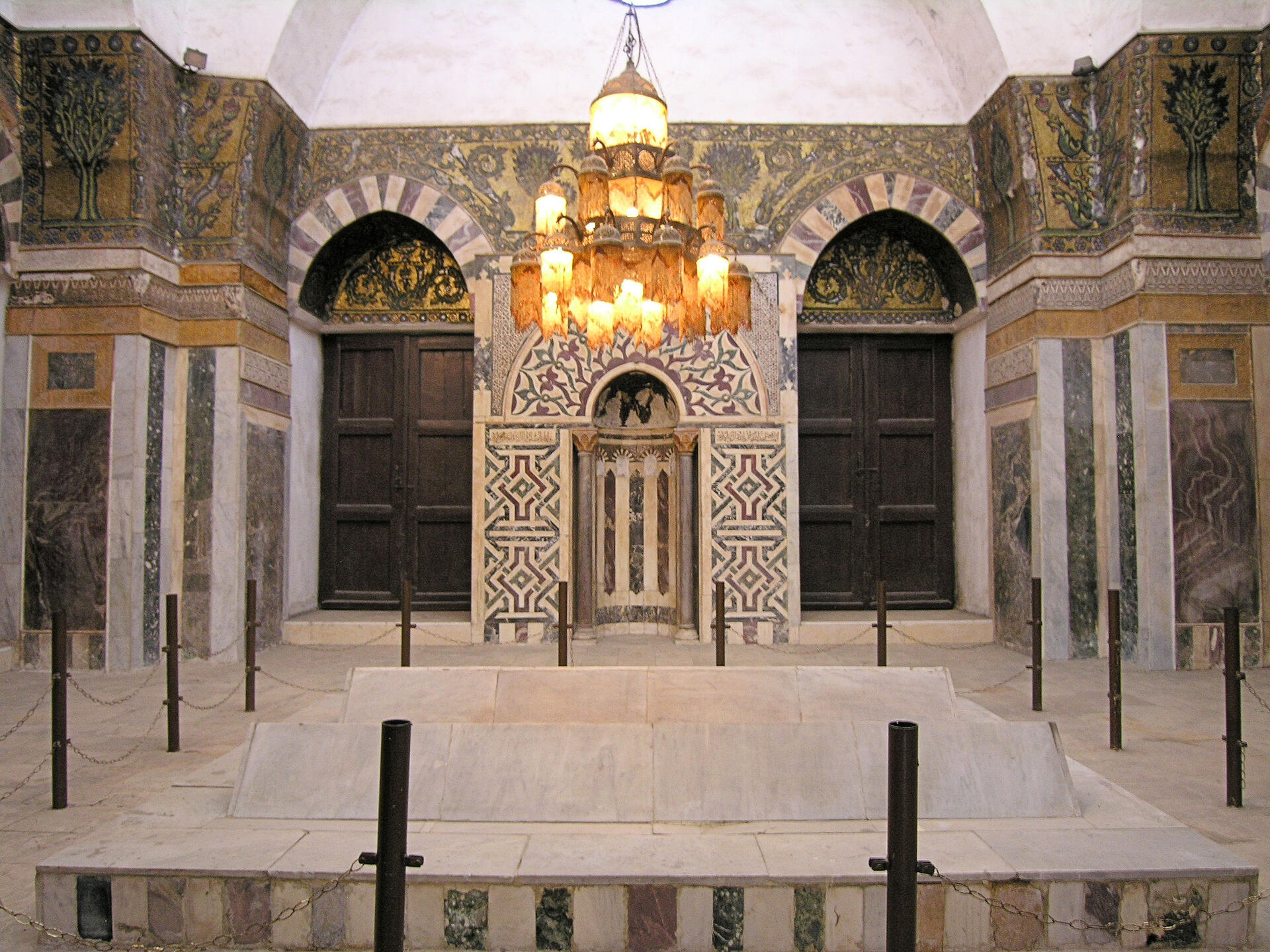
© Francesco Bandarin (Minor retouching done by Robert Prazeres), CC BY-SA 3.0 igo Resized from original. (This derivative is under the same CC BY-SA license.)
World Heritage Research
Discover scientific research and academic studies that deepen our understanding of Ancient City of Damascus from its history and significance to its conservation, management, and contemporary challenges.
-
Residents of the Cities in the Levant
The Umayyad era marked a significant transformation in the Levant, where urbanization replaced nomadic lifestyles and laid the foundation for civilization. This study reveals that the prosperity of Levantine cities was driven by economic and commercial factors, including inland and coastal trade, abundant agricultural resources, and strategic military development. The Umayyads introduced Islamic urban elements such as mosques, governor's houses, and fortified walls, while also establishing new cities like Ramla and Rusafa for both military necessity and economic benefit. The research highlights how Arab Muslims adapted existing urban structures, integrating financial institutions and tribal foundations into their city planning. This period saw the emergence of advanced human activities in political, economic, and social fields, contributing to the development of civil society institutions. The study underscores the Umayyad conquests as a pivotal factor in the evolution of urban life in the Levant.
Lababneh, A. A. (2025). Residents of the Cities in the Levant. Journal of Posthumanism, 5(2). https://doi.org/10.63332/joph.v5i2.535
View Publication Record | Read Publication -
Etymological Parallels: Mtskheta - Mashita/Masqita - Dimasq
A groundbreaking etymological analysis reveals that the name of Damascus (dimaâq) likely originates from the ancient Mushk tribe, translating to 'the abode of Mushks.' The study connects Damascus with other historical settlements—Mtskheta in Georgia and Maskhita in Syria—through linguistic parallels, suggesting a shared Indo-European or Western Asian origin. Researchers examined proper names, geographical terms, and lexical units from ancient texts, including Aramaic (dammaâq) and Hebrew (dammeâeq), to trace the evolution of these place names. The findings propose that Damascus's name reflects its historical ties to Mushks, a tribe that migrated from Asia Minor and established a kingdom in Cappadocia. This work advances our understanding of ancient migrations and linguistic continuity across Western Asia.
Chikovani, G. (2023). ETYMOLOGICAL PARALLELS: Mtskheta - mashita/masqita - dimasq. The near East and Georgia, 15, 58–72. https://doi.org/10.32859/neg/15/58-72
View Publication Record | Read Publication -
Formation of Scientific Knowledge in the Muslim East in the Early Middle Ages
The Muslim East during the early Middle Ages emerged as a pivotal center for scientific and cultural advancement, marked by the establishment of libraries, universities, and research hubs that facilitated the translation and dissemination of ancient Greek and other classical works. This intellectual synthesis spurred significant progress in mathematics, astronomy, philosophy, medicine, and literature, with notable contributions from luminaries like al-Khwarizmi, Ibn Sina, and al-Beruni. Cities such as Baghdad, Damascus, and Cordoba served as crucibles for intellectual exchange, preserving and expanding knowledge while fostering a unique blend of religious and scientific thought. This era's legacy endures in modern science, technology, and critical thinking, underscoring its profound impact on global scientific progress.
Shamsutdynova-Lebedyuk, T. (2023). FORMATION OF SCIENTIFIC KNOWLEDGE IN THE MUSLIM EAST IN THE EARLY MIDDLE AGES. Scientific Notes of the National University “Ostroh Academy”. Series: Philosophy, 1(24), 21–25. https://doi.org/10.25264/2312-7112-2023-24-21-25
View Publication Record | Read Publication -
The Kurdish presence in Damascus, and the role of the notable Ali Agha Zalfo
Damascus harbors significant Kurdish heritage and influence dating back to the era of Sultan Salah al-Din al-Ayyubi. The study highlights the enduring presence and contributions of Kurdish communities in Damascus, exemplified by the notable Ali Agha Zalfo. Zalfo's role is particularly noteworthy for his active participation in Syrian national movements, including the Great Syrian Revolution and resistance against French Mandate forces. He also played a pivotal role in supporting Kurdish immigrants in Damascus during the 1920s, offering them shelter and financial assistance. This study underscores Zalfo's patriotism and his significant impact on both Syrian society and the Kurdish diaspora, earning him widespread respect and gratitude.
SALİH, A. (2022). The Kurdish presence in Damascus, and the role of the notable Ali Agha Zalfo. Kurdiyat. https://doi.org/10.55118/kurdiyat.1040100
View Publication Record | Read Publication -
A Stronghold of Islam
The Bab Cherqi, an eastern Roman portal of Damascus dating back to the third century under Emperor Caracalla, stands as the oldest city gate. This structure, along with preserved sections of the city wall and a restored Chapel of the Latins, offers a glimpse into Damascus's layered history, spanning from its origins linked to Ur, great-grandson of Noah, to its later significance during King Ahaz's reign. The study highlights the enduring architectural heritage of Damascus, including the ill-maintained garden-square under a cupola, which gained renewed attention following Kaiser Wilhelm II's visit in 1898. The research emphasizes the city's role as both a stronghold of Islam and a repository of ancient traditions, particularly those associated with Baal worship.
Gordon, H. C. (2022). A Stronghold of Islam. Syria as It Is, 49–63. https://doi.org/10.4324/9781003325840-5
View Publication Record | Read Publication -
Caliphs and Merchants: Cities and Economies of Power in the Near East (700–950)
The book 'Caliphs and Merchants: Cities and Economies of Power in the Near East (700–950)' presents a fresh perspective on the economic development of the Near East during the late Umayyad and early ‘Abbasid periods, challenging long-held myths about the decline of the Eastern world. It argues that the region experienced remarkable prosperity, surpassing Europe, due to the continuity of Roman and Sasanian economic institutions. The study integrates historical, literary, textual, and archaeological evidence, focusing on artisanal craft industries such as pottery, glassmaking, textiles, and food processing. It also explores the transformation of marketplaces and labor patterns, highlighting the rise of a new entrepreneurial class, the tuğğār. The research emphasizes the reliance on late antique economic urban institutions and the Islamification of the economy, providing a comprehensive analysis of the region's economic success.
St. Laurent, B. (2022). Caliphs and Merchants: Cities and Economies of Power in the Near East (700–950). Journal of Eastern Mediterranean Archaeology and Heritage Studies, 10(3-4), 379–386. https://doi.org/10.5325/jeasmedarcherstu.10.3-4.0379
View Publication Record | Read Publication -
Mapping Damascus during the First World War. A German-Ottoman Cooperation of Cartography, Archaeology and Military?
During the First World War, German and Ottoman experts collaborated to map Damascus, revealing a complex interplay of archaeological preservation and military objectives. The study finds that while the mapping efforts were ostensibly aimed at preserving ancient sites, they also served strategic military purposes under the guise of cultural heritage protection. Researchers used trigonometrical surveys and aerial photographs to document the city's structures, blending scientific inquiry with wartime logistics. This dual-purpose approach highlights the paradoxical nature of German-Ottoman cooperation, where archaeology and cartography intersected with military strategy.
Willert, S. (2021). Mapping Damascus during the First World War. A German-Ottoman Cooperation of Cartography, Archaeology and Military? Proceedings of the ICA, 3, 1–16. https://doi.org/10.5194/ica-proc-3-12-2021
View Publication Record | Read Publication