World Heritage Identification Number: 217
World Heritage since: 1983
Category: Cultural Heritage
WHE Type: Historic Cities & Urban Areas
Transboundary Heritage: No
Endangered Heritage: No
Country: 🇧🇬 Bulgaria
Continent: Europe
UNESCO World Region: Europe and North America
Map
The Ancient City of Nessebar: A Historical Gem on the Black Sea
The Ancient City of Nessebar, situated on a picturesque peninsula along the Black Sea, offers a captivating glimpse into the rich tapestry of human history that spans more than three millennia. This remarkable city-museum, often referred to as the "Pearl of the Black Sea," is a treasure trove of architectural and cultural relics that have been shaped by various civilizations throughout its long existence.
More to come…UNESCO Description of the World Heritage Site
Situated on a rocky peninsula on the Black Sea, the more than 3,000-year-old site of Nessebar was originally a Thracian settlement (Menebria). At the beginning of the 6th century BC, the city became a Greek colony. The city’s remains, which date mostly from the Hellenistic period, include the acropolis, a temple of Apollo, an agora and a wall from the Thracian fortifications. Among other monuments, the Stara Mitropolia Basilica and the fortress date from the Middle Ages, when this was one of the most important Byzantine towns on the west coast of the Black Sea. Wooden houses built in the 19th century are typical of the Black Sea architecture of the period.
UNESCO Justification of the World Heritage Site
Criterion (iii): The Ancient City of Nessebar is an outstanding testimony of multilayered cultural and historical heritage. It is a place where many civilizations left their tangible traces: archaeological structures from the Second millennium BC, a Greek Black Sea colony with surviving remains of fortifications, a Hellenistic villa and religious buildings from the Antiquity, preserved churches (in some of them preserved only parts of archaeological structures) from the Middle Ages. Nessebar has demonstrated its historical importance as a frontier city on numerous occasions. Having been a remarkable spiritual centre of Christianity for a thousand years, today it is a developing and vibrant urban organism.
Criterion (iv): The Ancient City of Nessebar is a unique example of an architectural ensemble with preserved Bulgarian Renaissance structure, and forms a harmonious homogenous entity with the outstanding natural configuration of the rocky peninsular, linked with the continent by a long narrow stretch of land. Its nature and existence is a result of synthesis of long-term human activity, which has witnessed significant historic periods - an urban structure with elements from 2nd millennium BC, classical antiquity, and the Middle Ages; the development of medieval religious architecture with rich plastic and polychrome decoration on its facades in the form of ceramic ornamentation typical for the period; the different stages in the development of the characteristic residential vernacular architecture, which testify to the supreme mastery of the architecture of the Balkans as well as the East Mediterranean region. The vernacular architecture of the urban ensemble, dominated by medieval churches and archaeology, together with the unique coastal relief, combine to produce an urban fabric of the high quality.
Encyclopedia Record: Nesebar
Nesebar is an ancient city and one of the major seaside resorts on the Bulgarian Black Sea Coast, located in Burgas Province. It is the administrative centre of the homonymous Nesebar Municipality. Often referred to as the "Pearl of the Black Sea", Nesebar is a rich city-museum defined by more than three millennia of ever-changing history. The small city exists in two parts separated by a narrow human-made isthmus with the ancient part of the settlement on the peninsula, and the more modern section on the mainland side. The older part bears evidence of occupation by a variety of different civilisations over the course of its existence.Additional Site Details
Area: 34.71 hectares
Number of Components: 1
(iv) — Outstanding example of a type of building or landscape
Coordinates: 42.6591111111 , 27.7360277778
Image
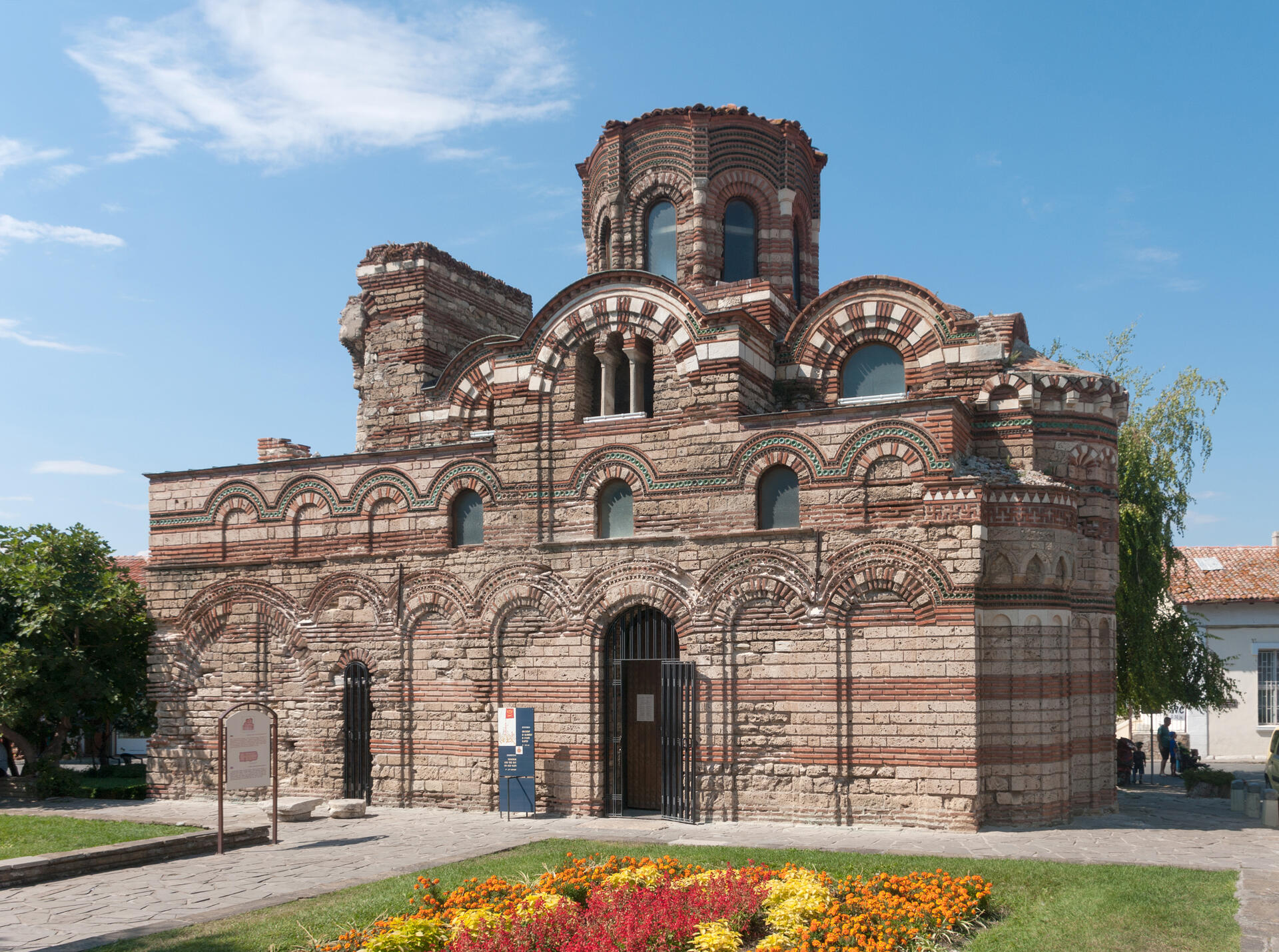
© Chrumps, CC BY-SA 4.0 Resized from original. (This derivative is under the same CC BY-SA license.)
World Heritage Research
Discover scientific research and academic studies that deepen our understanding of Ancient City of Nessebar from its history and significance to its conservation, management, and contemporary challenges.
-
Tourism and Intangible Heritage: Challenges and Strategic Responses in a UNESCO World Heritage Context
A UNESCO World Heritage Site, the Ancient City of Nessebar, faces significant challenges from seasonal mass tourism that threaten its intangible cultural heritage. The study highlights that craft heritage and creative tourism can serve as powerful tools for community development, preserving local traditions while fostering economic growth. By analyzing municipal and national policies, researchers emphasize the importance of a 'living heritage' approach, where artisanal skills and cultural expressions are both economic resources and identity-strengthening mechanisms. The findings underscore the need for participatory governance to balance tourism growth with the resilience of living traditions, ensuring the safeguarding of Nessebar's Outstanding Universal Value (OUV).
Mileva, S., & Krachanova, M. (2026). Tourism and Intangible Heritage: Challenges and Strategic Responses in a UNESCO World Heritage Context. Community Development through Craft Heritage and Creative Tourism, 17–30. https://doi.org/10.1108/978-1-80686-367-920261002
View Publication Record | Read Publication -
In Search of New Dimensions for Religious Tourism: The Case of the Ancient City of Nessebar
Despite its rich religious heritage and UNESCO World Heritage status, the Ancient City of Nessebar remains underutilized for religious tourism. A study by Mileva and Krachanova (2024) reveals a complex interplay between mass tourism, cultural preservation, and the waning influence of traditional religious practices in the region. Using mixed-methods approaches—including documentary analysis and case study methodology—the research highlights the untapped potential of Nessebar’s religious sites to enhance tourism experiences while preserving their historical significance.
Mileva, S., & Krachanova, M. (2024). In Search of New Dimensions for Religious Tourism: The Case of the Ancient City of Nessebar. Heritage, 7(10), 5373–5389. https://doi.org/10.3390/heritage7100253
View Publication Record | Read Publication -
Lost in Transition? Historical Geographies of World Heritage and Tourism in Bulgaria
Bulgaria's transition from socialism has left its UNESCO-listed Ancient City of Nessebar in a governance limbo, where outdated state-centric models persist despite political upheaval. A qualitative study combining interviews and archival research reveals that heritage tourism remains inefficiently managed, plagued by funding gaps, weak protection mechanisms, and uncertain policies. While the 1989 fall of socialism reshaped global power dynamics, its cultural legacy—particularly in heritage politics—has been overlooked. The findings underscore an urgent need for a new strategy to balance tourism growth with sustainable preservation, challenging post-socialist nations to redefine their approach to World Heritage conservation.
Naumov, N.,. (2024). LOST IN TRANSITION? HISTORICAL GEOGRAPHIES OF WORLD HERITAGE AND TOURISM IN BULGARIA. The 5th Congress of Slavic Geographers and Ethnographers, 81. https://doi.org/10.46793/csge5.51nn
View Publication Record | Read Publication -
Postglacial Black Sea level rising, urban development and adaption of historic places. The case-study of the city-peninsula of Nesebar (Bulgaria)
Rising Black Sea levels have significantly reshaped the coastal dynamics of Nessebar, Bulgaria, threatening its historic urban structures. The study reveals that ancient fortifications and buildings, particularly those from the 8th to 13th centuries, were strategically positioned near the base of the peninsular slope rather than along the ancient coastline, likely as an adaptive response to rising sea levels. The research identifies destructive hydrodynamic forces—waves, currents, wind, and sediment transport—as key factors contributing to coastal erosion, which has exposed and damaged historic structures. The study combines geological analysis of Miocene limestone formations with underwater surveys to trace the extent of coastal abrasion, providing critical insights into the vulnerability of UNESCO World Heritage Sites to climate-induced changes.
Preshlenov, H. (2022). Postglacial Black Sea level rising, urban development and adaption of historic places. The case-study of the city-peninsula of Nesebar (Bulgaria). Internet Archaeology, (60). https://doi.org/10.11141/ia.60.5
View Publication Record | Read Publication -
Living with the world heritage. An ethnographic study of the ancient city of Nessebar, Bulgaria
The Ancient City of Nessebar, Bulgaria, faces significant challenges due to the interplay between tourism development and its status as a UNESCO World Heritage Site. An ethnographic study reveals that post-1989 economic liberalization has intensified pressures on heritage conservation, with private investors and corrupt practices undermining safeguarding efforts. Residents grapple with complex issues such as trust in institutions, property rights, social justice, local identity, and the transformation of cultural heritage into economic capital. The study highlights conflicting dynamics between tourism interests and heritage preservation, offering insights into the broader tensions surrounding World Heritage Sites.
Luleva, A. (2015). Living with the world heritage. An ethnographic study of the ancient city of Nessebar, Bulgaria. Bulletin de l’Institut Etnographique, 63(1), 19–33. https://doi.org/10.2298/gei1501019l
View Publication Record | Read Publication