World Heritage Identification Number: 219
World Heritage since: 1983
Category: Natural Heritage
WHE Type: Protected Areas & National Parks
Transboundary Heritage: No
Endangered Heritage: No
Country: 🇧🇬 Bulgaria
Continent: Europe
UNESCO World Region: Europe and North America
Map
Srebarna Nature Reserve: A Haven for Endangered Bird Species
The Srebarna Nature Reserve, situated in northeastern Bulgaria, offers a unique sanctuary for numerous rare and endangered bird species. This significant wetland, spanning approximately 600 hectares, lies just 18 kilometers west of Silistra and two kilometers south of the Danube River.
More to come…UNESCO Description of the World Heritage Site
The Srebarna Nature Reserve is a freshwater lake adjacent to the Danube and extending over 600 ha. It is the breeding ground of almost 100 species of birds, many of which are rare or endangered. Some 80 other bird species migrate and seek refuge there every winter. Among the most interesting bird species are the Dalmatian pelican, great egret, night heron, purple heron, glossy ibis and white spoonbill.
UNESCO Justification of the World Heritage Site
Criterion (x): Srebarna Nature Reserve protects an important example of a type of wetland that was widespread in Bulgaria in the past. It shelters a diversity of plant and animal species, which are increasingly threatened. The wetland is an important breeding, staging and wintering site for a large number of birds. Floating reedbed islands and flooded willow woodlands provide important bird breeding areas. In the lake's northern end the reedbeds gradually give way to wet meadows. In the north-western end of the lake and along the Danube there are belts of riverine forest with single old trees of White Willow. The rich bird life supported by Srebarna Nature Reserve is the basis for its international significance. The property holds populations of birds that are considered critical to species survival. It hosts the only colony of Dalmatian Pelican in Bulgaria, as well as the largest breeding populations of four more globally threatened species: Pygmy Cormorant, Ferruginous Duck, White-tailed Eagle and Corncrake. Srebarna is also of European value importance in supporting Little Bittern Night Heron, Squacco Heron, Little Egret, Great White Egret, Purple Heron, Glossy lbis, Spoonbill and Ruddy Shelduck. Three species of terns also occur here. Globally threatened Pygmy Cormorant and Red-breasted Goose winter in the Reserve, and the wintering populations of White-fronted Goose, Greylag Goose and Fieldfare are also notable. In total the property provides critical habitat that supports 173 bird species, 78 species of which are of European conservation concern, and nine being listed as globally threatened.
Encyclopedia Record: Srebarna Nature Reserve
The Srebarna Nature Reserve is a nature reserve in northeastern Bulgaria, near the village of the same name, 18 kilometers (11 mi) west of Silistra and two kilometers (1.2 mi) south of the Danube. It comprises Lake Srebarna and its surroundings, and is an important wetland located on the Via Pontica, a bird migration route between Europe and Africa. As a result, it provides nesting and migratory habitat for many endangered bird species.Additional Site Details
Area: 638 hectares
Number of Components: 1
Coordinates: 44.11444 , 27.07806
IUCN World Heritage Outlook
The 2025 Conservation Outlook on Srebarna Nature Reserve reports the following assessment:
Source: International Union for Conservation of Nature (IUCN) · View assessment
Image
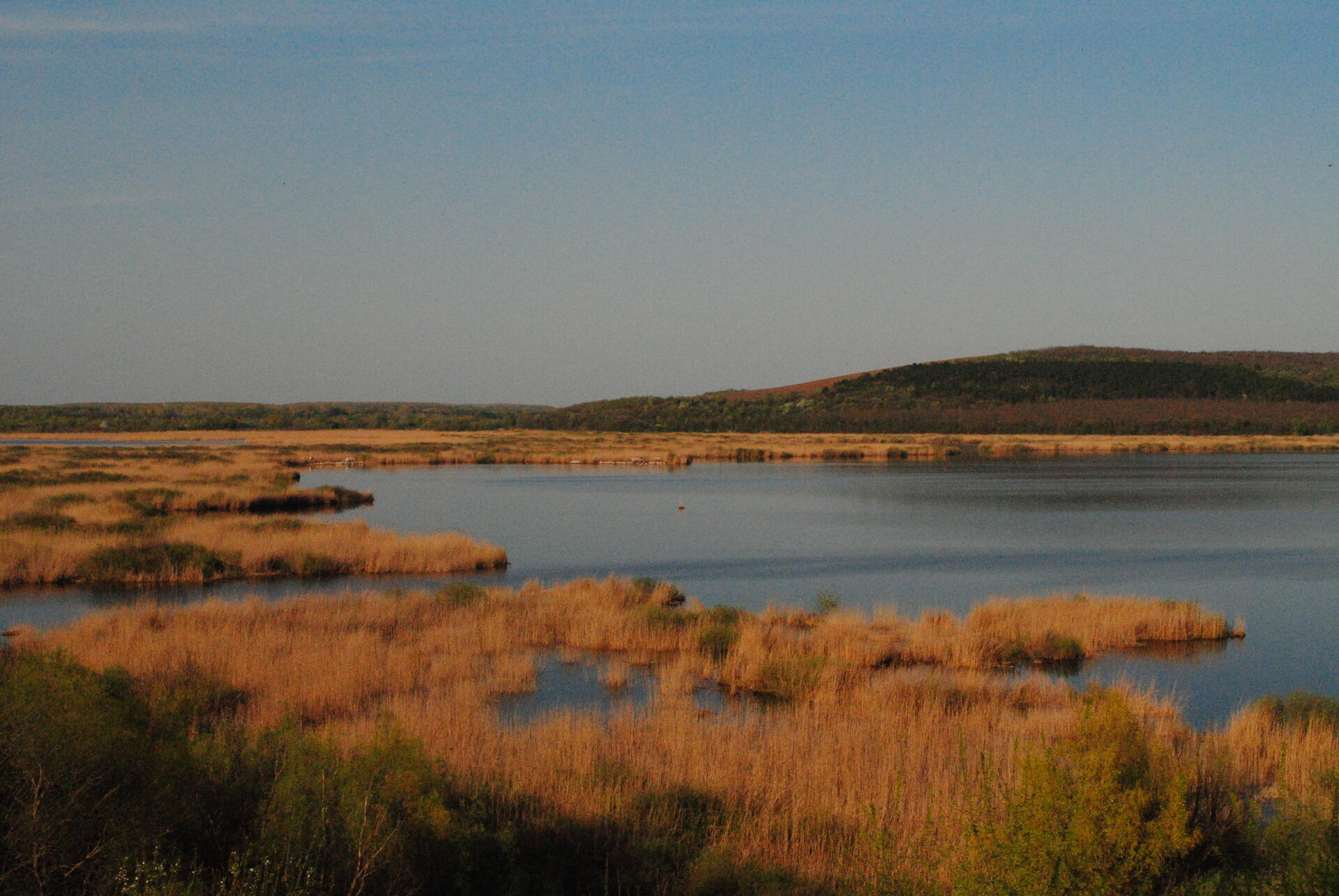
© Zhivko77, CC BY-SA 4.0 Resized from original. (This derivative is under the same CC BY-SA license.)
World Heritage Research
Discover scientific research and academic studies that deepen our understanding of Srebarna Nature Reserve from its history and significance to its conservation, management, and contemporary challenges.
-
Integrated Remote Sensing for Mapping and Monitoring Srebarna Lake Ecosystem, Bulgaria.
Srebarna Lake, a UNESCO World Heritage Site and Ramsar wetland of international importance, faces significant ecological challenges including eutrophication, invasive species proliferation, and climate-induced desiccation. Despite these pressures, conservation efforts in 2022–2023—such as sediment excavation, canal unblocking, and reed harvesting—aimed to restore water quality and habitat heterogeneity. Advanced remote sensing techniques, including UAS-based LiDAR scanning and photogrammetry during low-water seasons, along with sonar bathymetry, were employed to monitor these interventions. The study generated high-resolution digital elevation models (DEMs) and orthomosaics, enabling precise tracking of hydrological changes, sediment dynamics, and vegetation shifts across the 981.5-ha lake and floodplains. These methods provide a robust framework for assessing restoration effectiveness and long-term ecosystem resilience.
Dimov, P., Kazakov, S., Isheva, T., & Ivanova, N. (2025). Integrated Remote Sensing for Mapping and Monitoring Srebarna Lake Ecosystem, Bulgaria. ARPHA Conference Abstracts, 8. https://doi.org/10.3897/aca.8.e155196
View Publication Record | Read Publication -
Long-Term Changes in the Breeding Success of the Dalmatian Pelican Colony in the Srebarna Nature Reserve (NE Bulgaria) and Conservation Measures Over the Years
A long-term study (1955–2024) of the Dalmatian pelican colony in Srebarna Nature Reserve, Bulgaria, reveals a significant improvement in breeding success over decades despite recent declines. The number of nests fluctuated between 7 and 150, with a notable downward trend in the last five years. Conservation measures, such as raised wooden platforms and protective fences, have proven effective in maintaining the colony's viability. However, external factors like human disturbance, predation by invasive species, and competition from alternative nesting sites pose growing threats. The study underscores the need for continued conservation efforts to ensure the long-term survival of this vulnerable population.
Ivanova, N., Simeonov, P., Petrov, M., Marinov P., M., & Michev T., B. (2025). Long-Term Changes in the Breeding Success of the Dalmatian Pelican Colony in the Srebarna Nature Reserve (NE Bulgaria) and Conservation Measures Over the Years. Acta Zoologica Bulgarica. https://doi.org/10.71424/azb77.4.002835
View Publication Record | Read Publication -
Local Conservation of Nature Heritage as an Important Component in the Water-Energy-Food Nexus Approach. A Case Study of Srebarna Lake, Bulgaria
Lake Srebarna, a UNESCO-listed wetland and biosphere reserve in Bulgaria, faces significant threats to its water quality due to excessive exploitation, pollution, hydromorphological changes, and climate impacts. This study clarifies the interdependencies within the Water-Energy-Food (WEF) nexus and assesses the current physico-chemical state of the lake. By analyzing these pressures, researchers aim to highlight the critical role of local conservation efforts in preserving Srebarna's ecological integrity while addressing global challenges related to resource scarcity and sustainability. The findings underscore the need for integrated management strategies that balance water quality protection with sustainable development, offering insights applicable to other protected sites worldwide.
GARTSIYANOVA, K., KITEV, A.,. (2023). Local Conservation of Nature Heritage as an Important Component in the Water-Energy-Food Nexus Approach. A Case Study of Srebarna Lake, Bulgaria. International Journal of Conservation Science, 14(3), 1033–1044. https://doi.org/10.36868/ijcs.2023.03.16
View Publication Record | Read Publication -
It is raining bugs: summer dispersal of aquatic bugs (Hemiptera, Heteroptera: Nepomorpha) in Srebarna Nature Reserve (Bulgaria)
A study on the Srebarna Nature Reserve, a wetland of significant conservation value, reveals that aquatic bugs, particularly Corixidae (water boatmen), exhibit peak dispersal activity during the first hour after sunset. The research, conducted over 11 nights using UV light traps, collected 4589 individuals, including 13 species not previously recorded in the reserve. This finding sheds light on the dispersal behavior of these insects, with female dominance observed in the most abundant species. Environmental factors such as air temperature, atmospheric pressure, and wind speed were found to influence the dispersal activity of Sigara striata, a common species. The study provides critical data for future research on the phenology and fauna of aquatic bugs in this unique ecosystem.
Stoianova, D. (2018). It is raining bugs: summer dispersal of aquatic bugs (Hemiptera, Heteroptera: Nepomorpha) in Srebarna Nature Reserve (Bulgaria). Zenodo. https://doi.org/10.5281/ZENODO.4044002
View Publication Record | Read Publication -
Terrestrial gastropods of Srebarna Nature Reserve, North-Eastern Bulgaria (Gastropoda)
A pioneering investigation into the terrestrial gastropod fauna of Srebarna Nature Reserve, North-Eastern Bulgaria, revealed 27 species, with 23 representing new observations for the site. This study marks the first comprehensive assessment of land snails in this UNESCO-listed wetland, providing critical data on biodiversity within a protected area. Researchers employed extensive field surveys across 23 localities to document species diversity and distribution patterns. The findings highlight the reserve's ecological significance as a habitat for diverse gastropod communities, contributing valuable baseline information for conservation efforts.
Dedov, I., & Antonova, V. (2015). Terrestrial gastropods of Srebarna Nature Reserve, North-Eastern Bulgaria (Gastropoda). Biodiversity Data Journal, 3. https://doi.org/10.3897/bdj.3.e4306
View Publication Record | Read Publication