World Heritage Identification Number: 168
World Heritage since: 1981
Category: Cultural Heritage
WHE Type: Religious Sites & Sacred Architecture
Transboundary Heritage: No
Endangered Heritage: No
Country: 🇩🇪 Germany
Continent: Europe
UNESCO World Region: Europe and North America
Map
Speyer Cathedral: A Glimpse into the History of the Holy Roman Empire
The Speyer Cathedral, formally known as the Imperial Cathedral Basilica of the Assumption and St. Stephen, stands tall in the heart of Speyer, Germany. This architectural marvel, dedicated to St. Mary and St. Stephen, is a significant testament to the rich history of the Holy Roman Empire.
Founded by Conrad II, also known as Conrad the Salian, in 1030, the cathedral underwent extensive remodeling at the end of the 11th century, transforming it into one of the most important Romanesque monuments from the era of the Holy Roman Empire. Inscribed as a UNESCO World Heritage Site in 1981, the Speyer Cathedral continues to captivate visitors with its grandeur and historical significance.
The cathedral's unique design features four towers and two domes, giving it a distinctive silhouette against the skyline. The domes—one over the crossing and another at the western end—are supported by massive piers that create a monumental spatial effect, underscoring the cathedral’s status as a symbol of imperial authority during the Middle Ages.
The Speyer Cathedral served as the burial place for German emperors for nearly three centuries, primarily from the Salian, Staufer, and Habsburg dynasties. Notable figures interred within include Emperor Henry IV, who famously sought reconciliation with Pope Gregory VII, and Philipp of Swabia, a son of Emperor Frederick Barbarossa. This royal connection has earned the cathedral the nickname "Kaiserdom zu Speyer."
In addition to its historical significance, the Speyer Cathedral holds religious importance as the seat of the Roman Catholic Bishop of Speyer. The bishopric is a suffragan to the Roman Catholic Archdiocese of Bamberg. Pope Pius XI elevated the cathedral to the rank of a minor basilica of the Roman Catholic Church in 1925.
Today, the Speyer Cathedral remains an essential pilgrimage site for Catholics and a popular tourist destination. Its intricate carvings, stunning stained-glass windows, and ornate interior offer a glimpse into the artistry and craftsmanship of the Middle Ages. Visitors can also explore the crypt, where many of the former emperors are buried, adding another layer of historical intrigue to this remarkable structure.
In conclusion, the Speyer Cathedral is more than just a beautiful piece of architecture; it is a living testament to the power, culture, and faith of the Holy Roman Empire. Its enduring presence serves as a reminder of the empire's influence and legacy, making it a must-visit destination for anyone interested in medieval history and European culture.
UNESCO Description of the World Heritage Site
Speyer Cathedral, a basilica with four towers and two domes, was founded by Conrad II in 1030 and remodelled at the end of the 11th century. It is one of the most important Romanesque monuments from the time of the Holy Roman Empire. The cathedral was the burial place of the German emperors for almost 300 years.
UNESCO Justification of the World Heritage Site
Criterion (ii): The Speyer Cathedral has exerted a considerable influence not only on the development of Romanesque architecture in the 11th and 12th centuries, but as well on the evolution of the principles of restoration in Germany, in Europe and in the world from the 18th century to the present.
Encyclopedia Record: Speyer Cathedral
Speyer Cathedral, officially the Imperial Cathedral Basilica of the Assumption and St Stephen, in Latin: Domus sanctae Mariae Spirae in Speyer, Germany, is the seat of the Roman Catholic Bishop of Speyer and is suffragan to the Roman Catholic Archdiocese of Bamberg. The cathedral, which is dedicated to St. Mary, patron saint of Speyer and St. Stephen is generally known as the Kaiserdom zu Speyer. Pope Pius XI raised Speyer Cathedral to the rank of a minor basilica of the Roman Catholic Church in 1925.Additional Site Details
Area: 0.558 hectares
Number of Components: 1
Coordinates: 49.3172222222 , 8.4423888889
Image
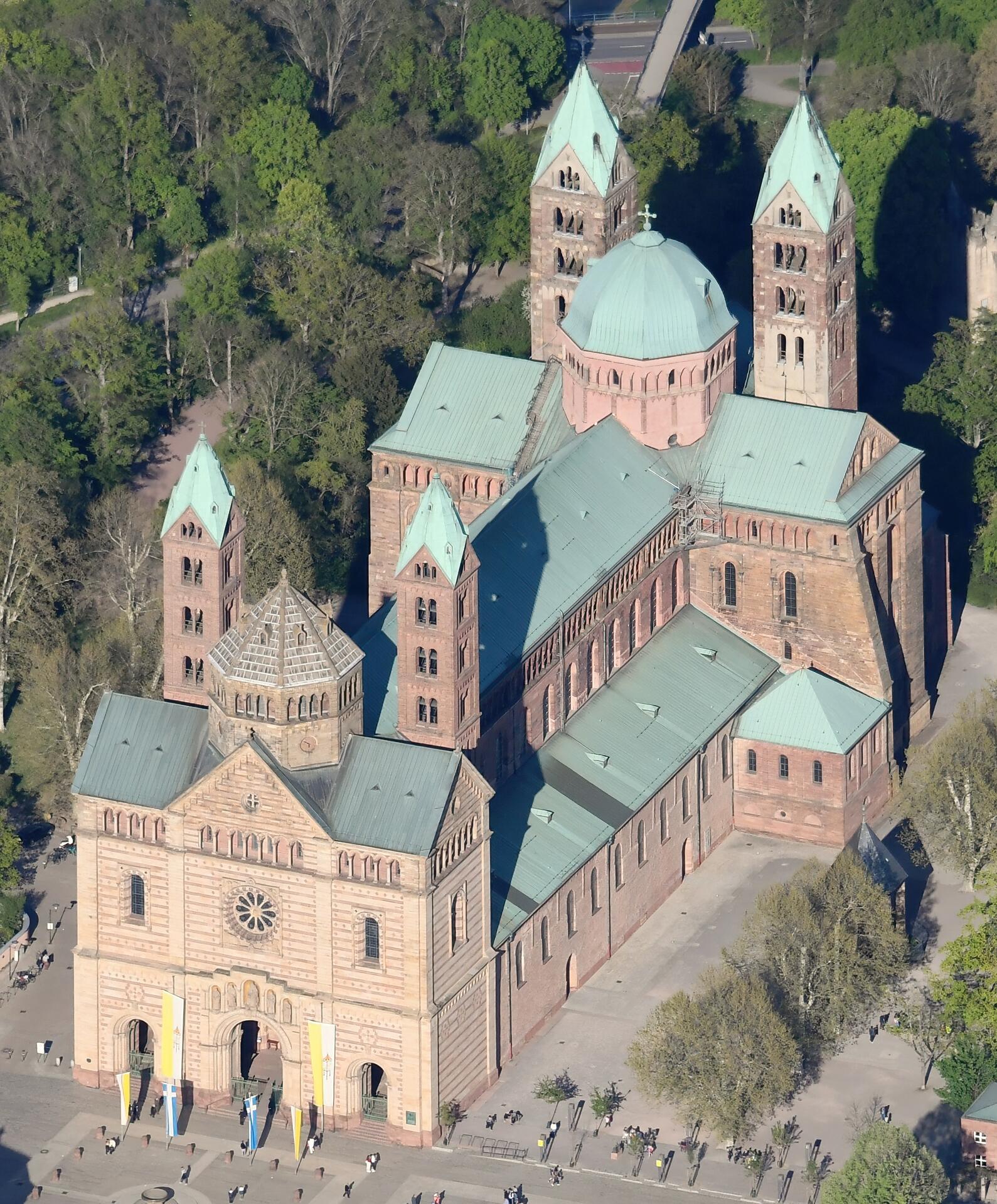
© Carsten Steger, CC BY-SA 4.0 Resized from original. (This derivative is under the same CC BY-SA license.)
World Heritage Research
Discover scientific research and academic studies that deepen our understanding of Speyer Cathedral from its history and significance to its conservation, management, and contemporary challenges.
-
The Imperial Cathedrals of Speyer, Mainz and Worms: The Current State of Research
Speyer Cathedral, as the sole authentic 'Kaiserdom' (imperial cathedral), stands out for its historical significance as an imperial mausoleum where four Holy Roman emperors and five German kings were buried between the 10th and 14th centuries. Unlike Mainz and Worms cathedrals, which lack direct imperial ties, Speyer's role was comparable to that of Westminster Abbey or St-Denis in France. The term 'Kaiserdom' now extends to all three due to their striking stylistic similarities—low octagonal central towers flanked by four slender stair-towers—though Mainz later altered its appearance by raising its central tower. This study clarifies the distinction between Speyer's imperial legacy and the architectural relationships among these cathedrals, emphasizing their collective medieval significance.
von Winterfeld, D. (2024). The Imperial Cathedrals of Speyer, Mainz and Worms: The Current State of Research. Mainz and the Middle Rhine Valley: Medieval Art, Architecture and Archaeology: Volume 30, 14–32. https://doi.org/10.4324/9781003580263-2
View Publication Record | Read Publication -
Year Zero to Economic Miracle: Hans Schwippert and Sep Ruf in Postwar West German Building Culture by Lynette Widder (review)
Lynette Widder's book, 'Year Zero to Economic Miracle: Hans Schwippert and Sep Ruf in Postwar West German Building Culture,' highlights the pivotal role of two architects in shaping West Germany's architectural landscape post-World War II. The study focuses on five iconic public buildings designed by Schwippert and Ruf between 1948 and 1963, including Speyer Cathedral, which straddles the divided Germany. Widder situates their work within broader debates about modern architecture in West Germany, emphasizing the transition from improvised designs to serialized, standardized building practices as the industry recovered. Through meticulous archival analysis and evocative descriptions, she brings to life the materiality of these buildings and the architects' collaborative processes, offering a nuanced narrative that connects East and West German architectural histories.
(Ed.). (2023). Year Zero to Economic Miracle: Hans Schwippert and Sep Ruf in Postwar West German Building Culture by Lynette Widder (review). German Studies Review, 46(3), 509–511. https://doi.org/10.1353/gsr.2023.a910194
View Publication Record | Read Publication -
Christian and Literary Rhetorics of the Early Middle Ages
A key insight from the study is the 'naturalization' of ethical defenses in rhetorical traditions, particularly evident in monastic and clerical rhetorics from the 6th to the 12th centuries. This shift weakened the explicit articulation of ethical dimensions in stylistic teaching about emotion, as seen in works by Isidore of Seville, Bede, Rupert of Deutz, and Onulf of Speyer. The research traces this evolution through a comparative analysis of late antique and early Christian texts, including Augustine’s De doctrina christiana, Macrobius’ Saturnalia, and Cassiodorus’ psalm commentary. By examining how ethical values were either overtly stated or implicitly assumed, the study highlights the diminishing force of rhetorical ethics over time, contributing to a deeper understanding of medieval literary and religious discourse.
Copeland, R. (2021). Christian and Literary Rhetorics of the Early Middle Ages. Emotion and the History of Rhetoric in the Middle Ages, 58–103. https://doi.org/10.1093/oso/9780192845122.003.0003
View Publication Record | Read Publication -
Envisaging Eternity
Salian women played a pivotal role in the foundation of Speyer Cathedral and the establishment of their dynasty's legitimacy through their interactions with the church. Their contributions, including cathedral founding, monastery establishment, and charitable donations, are documented in charters and chronicles, highlighting their influence on imperial burial practices in the cathedral's crypt. Notably, Agnes of Poitou's deathbed donations underscore the women's active participation in shaping family identity and memory. This study reveals how Salian queens leveraged traditional queenly activities to solidify their dynasty's position within the German realm.
Verbanaz, N. (2017). Envisaging Eternity. Historical Reflections/Réflexions Historiques, 43(1). https://doi.org/10.3167/hrrh.2017.430104
View Publication Record | Read Publication