World Heritage Identification Number: 1467
World Heritage since: 2015
Category: Cultural Heritage
WHE Type: Historic Cities & Urban Areas
Transboundary Heritage: No
Endangered Heritage: No
Country: 🇩🇪 Germany
Continent: Europe
UNESCO World Region: Europe and North America
Map
A Historical Overview of Speicherstadt and Kontorhaus District with Chilehaus
The Speicherstadt and Kontorhaus District with Chilehaus, located in the heart of Hamburg, Germany, are significant examples of urban planning and architectural development that have shaped the city's skyline since the late 19th century. These districts, inscribed as a UNESCO World Heritage Site in 2015, offer a unique blend of history, architecture, and commerce, making them a must-visit destination for tourists and historians alike.
More to come…UNESCO Description of the World Heritage Site
Speicherstadt and the adjacent Kontorhaus district are two densely built urban areas in the centre of the port city of Hamburg. Speicherstadt, originally developed on a group of narrow islands in the Elbe River between 1885 and 1927, was partly rebuilt from 1949 to 1967. It is one of the largest coherent historic ensembles of port warehouses in the world (300,000 m2). It includes 15 very large warehouse blocks as well as six ancillary buildings and a connecting network of short canals. Adjacent to the modernist Chilehaus office building, the Kontorhaus district is an area of over five hectares featuring six very large office complexes built from the 1920s to the 1940s to house port-related businesses. The complex exemplifies the effects of the rapid growth in international trade in the late 19th and early 20th centuries.
UNESCO Justification of the World Heritage Site
Criterion (iv): Speicherstadt and Kontorhaus District with Chilehaus contains outstanding examples of the types of buildings and ensembles that epitomize the consequences of the rapid growth in international trade in the late 19th and early 20th centuries. Their high-quality designs and functional construction, in the guise of historicism and Modernism, respectively, make this an exceptional ensemble of maritime warehouses and Modernist office buildings.
Encyclopedia Record: Speicherstadt
The Speicherstadt in Hamburg, Germany, is the largest warehouse district in the world where the buildings stand on timber-pile foundations—oak logs, in this particular case. It is located in the port of Hamburg, in the HafenCity quarter, and was built from 1883 to 1927.Additional Site Details
Area: 26.08 hectares
Number of Components: 1
Coordinates: 53.5455555556 , 9.9994444444
Image
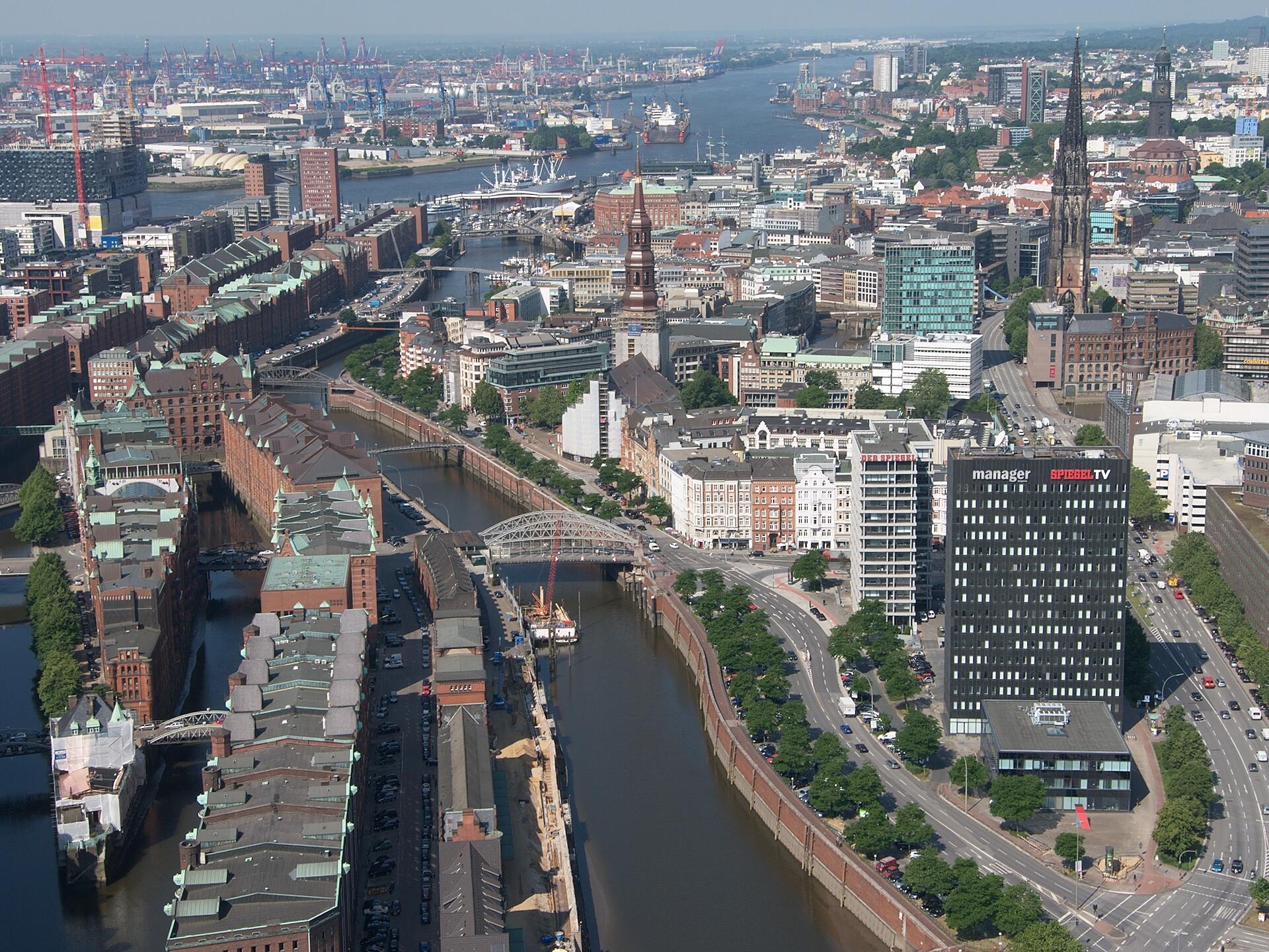
© User:Wmeinhart - Wolfgang Meinhart, Hamburg, CC BY-SA 3.0 Resized from original. (This derivative is under the same CC BY-SA license.)
World Heritage Research
Discover scientific research and academic studies that deepen our understanding of Speicherstadt and Kontorhaus District with Chilehaus from its history and significance to its conservation, management, and contemporary challenges.
-
Verbundvorhaben: CO2-neutrales Welterbe Speicherstadt Hamburg - Phase I - Umsetzung und Begleitung der Konzepterstellung und des Großdemonstrators im Rahmen der energie- und umweltgerechten Sanierung des Block H der Speicherstadt Hamburg (0-CO2-WSHH)
Integrated energy-efficient renovation strategies for heritage sites can significantly reduce emissions and energy consumption, but their success depends on adaptive operational strategies and real-world validation. The project 'CO₂-neutrales Welterbe Speicherstadt Hamburg' demonstrated this by developing a holistic approach for the historic Block H in Hamburg's Speicherstadt, combining denkmal-compliant interior insulation, thermally/electrically activated roofs, hybrid thermal storage, and low-temperature heat distribution systems. Using a digital Building Information Model (BIM) coupled with simulation tools, researchers found that only systematic validation through measurement, simulation, and real operation yields reliable performance assessments. While the study identified substantial decarbonization potential, it also highlighted the critical role of occupancy patterns and dynamic control strategies in achieving energy savings.
Garrecht, Harald, Modlich, Peter, Bögle, Annette, & Müller, Dirk. (2026). Verbundvorhaben: CO2-neutrales Welterbe Speicherstadt Hamburg - Phase I - Umsetzung und Begleitung der Konzepterstellung und des Großdemonstrators im Rahmen der energie- und umweltgerechten Sanierung des Block H der Speicherstadt Hamburg (0-CO2-WSHH). München : oekom verlag. https://doi.org/10.34657/29029
View Publication Record | Read Publication -
CO2-neutrales Welterbe Speicherstadt Hamburg - Phase I - Umsetzung und Begleitung der Konzepterstellung und des Großdemonstrators im Rahmen der energie- und umweltgerechten Sanierung des Block H der Speicherstadt Hamburg (0-CO2-WSHH)
A groundbreaking study demonstrates that integrated, energy-efficient renovation strategies can significantly reduce carbon emissions and energy consumption in historic buildings while preserving their cultural heritage. The research, conducted on Block H of Hamburg's Speicherstadtshowed substantial potential for decarbonization through a combination of conservation-compatible interior insulation, locally sourced renewable energy systems (such as thermally and electrically activated rooftops), hybrid thermal storage solutions, and low-temperature heat distribution. Crucially, the study revealed that reliable performance assessments require systematic validation against real-world measurements and simulations, highlighting the importance of adaptive control strategies and flexible operational models. By leveraging digital tools like Building Information Modeling (BIM) coupled with energetic and fluid dynamic simulations, the project provides actionable insights for planning climate-neutral renovations in heritage districts, bridging research and practical application.
Garrecht, Harald, Modlich, Peter, Bögle, Annette, & Müller, Dirk. (2026). CO2-neutrales Welterbe Speicherstadt Hamburg - Phase I - Umsetzung und Begleitung der Konzepterstellung und des Großdemonstrators im Rahmen der energie- und umweltgerechten Sanierung des Block H der Speicherstadt Hamburg (0-CO2-WSHH). München : oekom verlag. https://doi.org/10.34657/29909
View Publication Record | Read Publication -
Revitalisation through culture on the example of Hamburg, Grudziądz and Bydgoszcz
Historic granary complexes, often located in prime urban areas but left to decay due to their lack of modern functionality, present unique challenges for revitalization. The Speicherstadt in Hamburg stands out as a successful model, transforming a former inner periphery into a vibrant center for creative and cultural activities through strategic urban planning and development, including the adjacent HafenCity project. This study extends the analysis to lesser-known complexes in Grudziądz and Bydgoszcz, Poland, which differ significantly in scale and age from Hamburg's. By employing source analysis, case studies, and field observations, the research investigates whether the solutions applied in Hamburg can be universally adapted to support social and cultural functions in other historic granary districts. The findings aim to provide insights into the potential for cultural revitalization as a sustainable approach to urban renewal.
Chylińska, D., & Krzysztof. (2026). Revitalisation through culture on the example of Hamburg, Grudziądz and Bydgoszcz. Turystyka Kulturowa, 139((2)), 7–52. https://doi.org/10.62875/ff09ba90
View Publication Record | Read Publication -
Verbundvorhaben, Schlussbericht im Rahmen des 7. Energieforschungsprogramms der Bundesregierung "Gebäude und Quartiere"
Integrated energy renovation and supply strategies for heritage buildings can significantly reduce emissions, but their effectiveness depends on adaptive operational approaches. The 0-CO2-WSHH project demonstrated that combining denkmal-compliant insulation, renewable energy systems (e.g., thermally activated roofs), hybrid thermal storage, and low-temperature heat distribution in a UNESCO-listed warehouse block achieved substantial decarbonization—though real-world performance hinged on occupancy patterns and dynamic control. A digital BIM platform linked with simulations further optimized outcomes by bridging data gaps between modeling and reality. The study underscores the need for systematic validation of complex systems in heritage contexts, offering scalable methods to balance conservation, energy efficiency, and climate neutrality.
Garrecht, Harald, Modlich, Peter, Bögle, Annette, & Müller, Dirk. (2026). CO2-neutrales Welterbe Speicherstadt Hamburg - Phase I - Umsetzung und Begleitung der Konzepterstellung und des Großdemonstrators im Rahmen der energie- und umweltgerechten Sanierung des Block H der Speicherstadt Hamburg (0-CO2-WSHH). München : oekom verlag. https://doi.org/10.34657/29909
View Publication Record | Read Publication -
Title Pending
A critical review of Chilehaus: Atacama/Hamburg, an exhibition curated by Alfredo Thiermann, Pedro Correa, Ella Neumaier, and Xavier Nueno, reveals the architectural significance and cultural impact of the UNESCO-listed Speicherstadt and Kontorhaus District with Chilehaus. The exhibition, held at the Heritage Gallery in Santiago, Chile from September 27, 2024 to January 26, 2025, explores the intersection of modernist architecture, heritage conservation, and urban identity. Through a comparative analysis of Chilehaus's design in Hamburg and its counterparts in the Atacama region, the study highlights the enduring influence of expressionist architecture on global cultural landscapes. The research employs qualitative methods, including visual and textual analysis, to assess the exhibition's role in shaping public perception of architectural heritage.
Quintana-Guerrero, I., & Díaz, F. (2025). Title Pending. Architectural Histories. https://doi.org/10.16995/ah.25866
View Publication Record | Read Publication -
Office Work: Architecture and Extraction Between Atacama and Hamburg
UNESCO World Heritage Site designation often highlights certain aspects of buildings while obscuring others, as demonstrated by the Chilehaus in Hamburg. This study reveals that the memorialization process overlooks critical historical and material connections between the building's rise as a symbol of intellectual office work and the industrialization of mining in Chile's Atacama Desert. By analyzing traces stored in the desert—a durable storage device due to its environmental conditions—the research reconstructs an alternative understanding of modernity, linking the Chilehaus's functional and aesthetic qualities to global extraction networks, histories of dispossession, and the planetary transformation driven by the fertilizer industry. The paper advocates for a politics of memorialization that questions the commemoration of isolated buildings and considers the broader scale of industrial capitalism's history.
Thiermann, A., Correa, P., Neumaier, E., & Nueno, X. (2025). Office Work: Architecture and Extraction Between Atacama and Hamburg. Future Anterior: Journal of Historic Preservation History, Theory, and Criticism, 22(1), 54–74. https://doi.org/10.1353/fta.2025.a982229
View Publication Record | Read Publication -
An Imperial Adventus into a City of Warehouses: History, Modernity, and Urbanity in the Symbolic and Material Construction of Hamburg's Free Port
Hamburg's Speicherstadt, a commercial district devoid of inhabitants, was symbolically constructed as a 'city' during its 1888 opening ceremony featuring Kaiser Wilhelm II. This study reveals that the district's neo-Gothic architecture and imperial adventus were designed to evoke premodern urbanity, countering fears of working-class dominance. The research argues that the Speicherstadt served as a modern reimagining of Hamburg's historical urban trade privileges, symbolically rebuilding the city's walls. By analyzing material, political, and symbolic elements, the study demonstrates how late-nineteenth-century political imaginaries framed urbanization processes, offering insights into the intersection of history, modernity, and urbanity.
Heerten, L. (2024). An Imperial Adventus into a City of Warehouses: History, Modernity, and Urbanity in the Symbolic and Material Construction of Hamburg’s Free Port. Central European History, 57(3), 311–337. https://doi.org/10.1017/s0008938923000845
View Publication Record | Read Publication