World Heritage Identification Number: 1553
World Heritage since: 2018
Category: Cultural Heritage
WHE Type: Archaeological Sites
Transboundary Heritage: No
Endangered Heritage: No
Country: 🇩🇪 Germany
Continent: Europe
UNESCO World Region: Europe and North America
Map
The Archaeological Border Complex of Hedeby and the Danevirke: A Key Site for Understanding Viking Age Trade and Society
The Archaeological Border Complex of Hedeby and the Danevirke, inscribed as a UNESCO World Heritage Site in 2018, offers a unique insight into the economic, social, and historical developments in Europe during the Viking Age. Located in the Schleswig-Flensburg district of Schleswig-Holstein, Germany, this site consists of two distinct but interconnected components: the ancient trading town of Hedeby and the Danevirke, a line of fortifications that once separated the Jutland Peninsula from the rest of the European mainland.
More to come…UNESCO Description of the World Heritage Site
The archaeological site of Hedeby consists of the remains of an emporium – or trading town – containing traces of roads, buildings, cemeteries and a harbour dating back to the 1st and early 2nd millennia CE. It is enclosed by part of the Danevirke, a line of fortification crossing the Schleswig isthmus, which separates the Jutland Peninsula from the rest of the European mainland. Because of its unique situation between the Frankish Empire in the South and the Danish Kingdom in the North, Hedeby became a trading hub between continental Europe and Scandinavia and between the North Sea and the Baltic Sea. Because of its rich and well preserved archaeological material, it has become a key site for the interpretation of economic, social and historical developments in Europe during the Viking age.
UNESCO Justification of the World Heritage Site
Criterion (iii): Hedeby in conjunction with the Danevirke were at the centre of the networks of mainly maritime trade and exchange between Western and Northern Europe as well as at the core of the borderland between the Danish kingdom and the Frankish empire over several centuries. They bear outstanding witness to exchange and trade between people of various cultural traditions in Europe in the 8th to 11th centuries. Because of their rich and extremely well preserved archaeological material they have become key scientific sites for the interpretation of a broad variety of economic, social and historic developments in Viking Age Europe.
Criterion (iv): Hedeby facilitated exchange between trading networks spanning the European continent, and – in conjunction with the Danevirke – controlled trading routes, the economy and the territory at the crossroads between the emerging Danish kingdom and the kingdoms and peoples of mainland Europe. The archaeological evidence highlights the significance of Hedeby and the Danevirke as an example of an urban trading centre connected with a large-scale defensive system in a borderland at the core of major trading routes over sea and land from the 8th to 11th centuries.
Encyclopedia Record: Hedeby
Hedeby was an important Danish Viking Age trading settlement near the southern end of the Jutland Peninsula, now in the Schleswig-Flensburg district of Schleswig-Holstein, Germany. Around 965, chronicler Ibrahim ibn Yaqub visited Hedeby and described it as "a very large city at the very end of the world's ocean."Additional Site Details
Area: 227.55 hectares
Number of Components: 22
(iv) — Outstanding example of a type of building or landscape
Coordinates: 54.4619444444 , 9.4541111111
Image
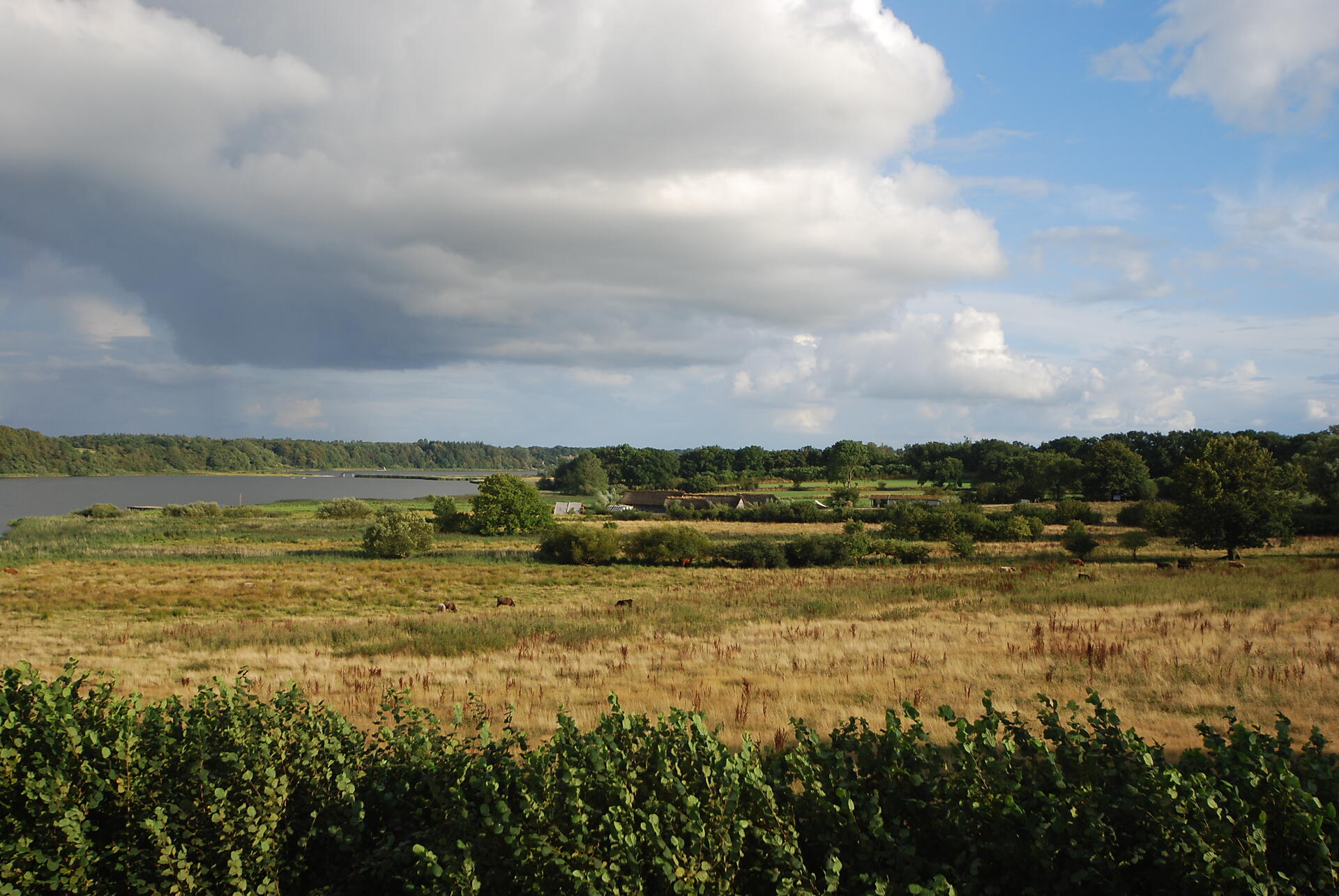
© Matthias Böhm, CC BY-SA 4.0 Resized from original. (This derivative is under the same CC BY-SA license.)
World Heritage Research
Discover scientific research and academic studies that deepen our understanding of Archaeological Border complex of Hedeby and the Danevirke from its history and significance to its conservation, management, and contemporary challenges.
-
Outland exploitation and resource colonisation in early Medieval Scandinavia
New archaeological evidence reveals that the exploitation of marginal zones, or outlands, played a central and dynamic role in early medieval Scandinavian societies, predating and extending beyond the Viking Age. Contrary to traditional views, resource extraction—such as iron and furs—in forests, wetlands, and mountainous regions was not merely supplementary but a core economic strategy shaping settlement patterns, social organization, and long-distance trade networks. This study challenges the notion that outland activities were peripheral, demonstrating their significance in economic intensification and regional interaction from at least the 4th–7th centuries. The findings are supported by advanced analytical methods and expanded datasets, offering a reinterpretation of marginal zones as integral to the emergence of complex socio-economic systems in early medieval Scandinavia.
Hennius, A. (2026). Outland exploitation and resource colonisation in early Medieval Scandinavia. Terra Fertilis, Terra Deserta. Exploitation of Marginal Zones, 41–45. https://doi.org/10.33547/terra.fertilis03
View Publication Record | Read Publication -
Finding Sliesthorp?
A previously unknown Viking Age settlement, discovered at Füsing in Northern Germany, is believed to be the elusive Sliesthorp, a power center of early Danish kings. This site, thriving from around 700 to the end of the 10th century, likely served as a seasonal garrison and naval base within the defensive system of the Danevirke, offering strategic significance due to its proximity to Hedeby/Schleswig. The study, based on archaeological finds and building features, suggests that Füsing's high-status estate center functioned as an assembly place, providing new insights into Viking Age governance and military organization in this disputed border region.
Dobat, A. S. (2022). Finding Sliesthorp? Danish Journal of Archaeology, 11, 1–22. https://doi.org/10.7146/dja.v11i.127759
View Publication Record | Read Publication -
Timeline
A detailed timeline of significant events from the 8th to 9th centuries sheds light on the political, military, and economic dynamics of Viking-era Scandinavia. Key milestones include the construction of defensive structures like the Kanhave Canal (726) and Nordvollen in Danevirke (737), as well as pivotal moments such as the destruction of Reric (808) and the beginning of Danish coinage minting in Hedeby (c. 825). The timeline also highlights Viking raids, including the attack on the Isle of Portland (c. 789) and the plundering of Lindisfarne (793), alongside broader geopolitical shifts, such as Charlemagne's defense efforts against Vikings (800) and Archbishop Ebo's mission to Denmark (822-823). This chronology provides a comprehensive framework for understanding the complex interactions between Scandinavian societies, Viking expansion, and early medieval Europe.
(Ed.). (2022). Timeline. Scandinavia in the Age of Vikings, xiii–xixx. https://doi.org/10.1515/9781501760495-003
View Publication Record | Read Publication -
Identification of materials used for earthwork construction: the semi-circular fortification rampart of Hedeby, Northern Germany
Researchers developed a novel method to classify and identify materials used in earthwork construction, addressing the challenges posed by minimally invasive coring techniques. The study focused on the semi-circular fortification rampart of Hedeby, an early medieval Viking settlement and UNESCO World Heritage Site. By analyzing physicochemical properties—such as grain size distribution, weight percentages, loss on ignition, magnetic susceptibility, and element concentrations—of 139 samples from three cores, the team applied statistical methods like principal component analysis and cluster analysis to distinguish material clusters. The findings revealed that the rampart was constructed using a mix of soil horizons, cultural deposits, and Pleistocene materials in varying proportions along its length. This method significantly enhances the objectivity and efficiency of geoarchaeological investigations, particularly for large-scale earthworks where complete excavation is impractical.
Kurgaeva, A., Khamnueva-Wendt, S., & Bork, H.-R. (2022). Identification of materials used for earthwork construction: the semi-circular fortification rampart of Hedeby, Northern Germany. Boletín de La Sociedad Geológica Mexicana, 74(3), A040422. https://doi.org/10.18268/bsgm2022v74n3a040422
View Publication Record | Read Publication