
World Heritage Identification Number: 697
World Heritage since: 1994
Category: Cultural Heritage
WHE Type: Archaeological Sites
Transboundary Heritage: No
Endangered Heritage: No
Country: 🇩🇰 Denmark
Continent: Europe
UNESCO World Region: Europe and North America
Map
Jelling Mounds, Runic Stones, and Church: A Testament to the Transition from Paganism to Christianity in Denmark
The Jelling Mounds, Runic Stones, and Church, located in the small town of Jelling in Denmark, stand as a significant testament to the transition from paganism to Christianity in the region during the Viking Age. Inscribed as a UNESCO World Heritage Site in 1994, this collection of historical artifacts offers a unique insight into the cultural, political, and religious changes that took place in Denmark during the reign of King Gorm the Old and his son, Harald Bluetooth.
More to come…UNESCO Description of the World Heritage Site
The Jelling burial mounds and one of the runic stones are striking examples of pagan Nordic culture, while the other runic stone and the church illustrate the Christianization of the Danish people towards the middle of the 10th century.
UNESCO Justification of the World Heritage Site
Criterion (iii): The Jelling complex, and especially the pagan burial mounds and the two runic stones, are outstanding examples of the pagan Nordic culture.
Encyclopedia Record: Jelling stones
The Jelling stones are massive carved runestones from the 10th century, found at the town of Jelling in Denmark. The older of the two Jelling stones was raised by King Gorm the Old in memory of his wife Thyra. The larger of the two stones was raised by King Gorm's son, Harald Bluetooth, in memory of his parents, celebrating his conquest of Denmark and Norway, and his conversion of the Danes to Christianity.Additional Site Details
Area: 12.7 hectares
Number of Components: 1
Coordinates: 55.75638889 , 9.42
Image
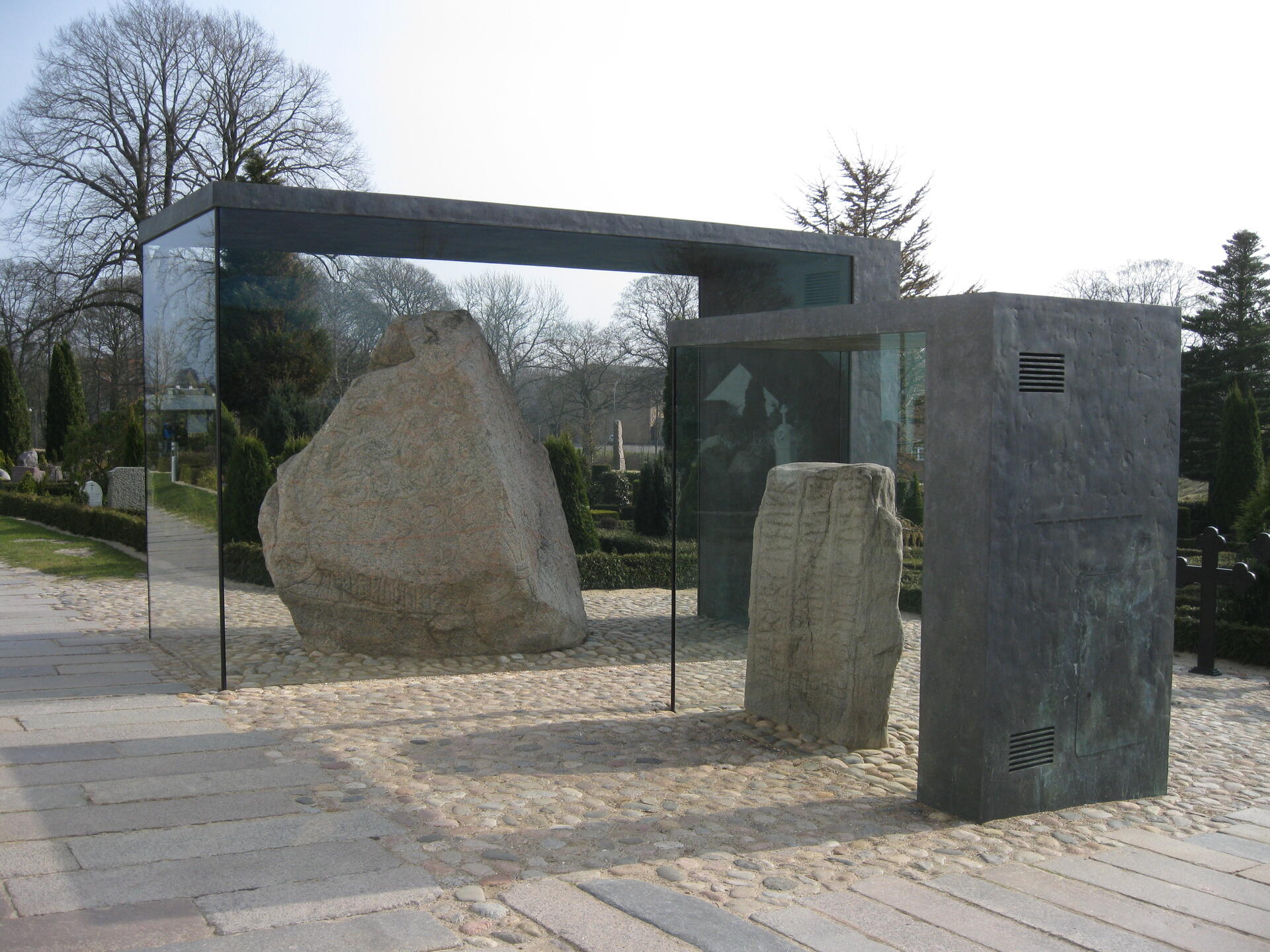
© Alicudi, CC BY-SA 3.0 Resized from original. (This derivative is under the same CC BY-SA license.)
World Heritage Research
Discover scientific research and academic studies that deepen our understanding of Jelling Mounds, Runic Stones and Church from its history and significance to its conservation, management, and contemporary challenges.
-
Spatial aspects of the interpretation of cultural heritage
Exhibitions on cultural heritage benefit from strategic spatial design that enhances educational quality through subconscious viewer engagement. Key factors include site context, authenticity, narrative-driven scenarios, and atmospheric 'warm-up' and 'cool-down' spaces. A comparative analysis of three exhibitions—Hardangervidda National Park (Norway), Kongernes Jelling visitor center (Denmark), and the Scottish National Museum’s Wester Kittochside site—revealed that powerful storytelling and spatial continuity improve interpretive outcomes. These findings guide professionals in crafting exhibition spaces that blend architectural form with informative content, aligning with broader trends toward immersive heritage presentation.
Sedlacek, J., Matějka, D., Fialová, Z., & Klepárník, R. (2022). Spatial aspects of the interpretation of cultural heritage. Muzeológia a Kultúrne Dedičstvo, 10(4), 89–113. Internet Archive. https://doi.org/10.46284/mkd.2021.10.4.6
View Publication Record | Read Publication -
Sacred but not holy: Awe, spectacle, and the heritage gaze in Danish religious heritage contexts
This study reveals that the heritagisation of religious sites, such as Jelling Mounds, Runic Stones and Church in Denmark, transforms them from places of religious awe into spectacles for a secular audience. It demonstrates how these sites, when designated as UNESCO World Heritage Sites, shift from inspiring piety to evoking ontological pride or vicarious nostalgia among tourists and cultural experts. The research argues that this 'heritage gaze' inadvertently frames religion as cultural heritage through a secular lens, hybridizing religious experience with heritage values. The study employs an ideal-typical distinction between the 'holy' and the 'sacred' to analyze this phenomenon across three Danish World Heritage sites: Jelling, Roskilde, and Christiansfeld.
Salemink, O., Rask Poulsen, R., & Isager Ahl, S. (2020). Sacred but not holy: Awe, spectacle, and the heritage gaze in Danish religious heritage contexts. Zenodo. https://doi.org/10.5281/ZENODO.4604148
View Publication Record | Read Publication -
UNESCO and World Heritage Management in Jelling – Opportunities and Challenges
Recent excavations at Jelling Mounds, Runic Stones and Church—a UNESCO World Heritage Site since 1994—revealed significant new structures that have transformed the understanding of this historic Danish site. Discoveries included a large palisade encircling the area, three Trelleborg-type houses, and the largest Viking Age ship setting in the Nordic region. These findings led to a boundary modification of the original inscription in 2018, highlighting their archaeological significance. The study also explores the challenges and opportunities of managing cultural heritage outside major urban centers, drawing on insights from a 2017 conference in Poland. Jelling's status as one of Denmark's most visited historical sites underscores its importance in both research and heritage preservation.
Lindblom, C. (2018). UNESCO and World Heritage Management in Jelling – Opportunities and Challenges. AnaLecta ArchaEoloGica RessoViensia, 13, 243–256. https://doi.org/10.15584/anarres.2018.13.12
View Publication Record | Read Publication
