
World Heritage Identification Number: 695
World Heritage since: 1995
Category: Cultural Heritage
WHE Type: Religious Sites & Sacred Architecture
Transboundary Heritage: No
Endangered Heritage: No
Country: 🇩🇰 Denmark
Continent: Europe
UNESCO World Region: Europe and North America
Map
A Historical Overview of Roskilde Cathedral: A Gothic Masterpiece and Royal Mausoleum
Roskilde Cathedral, located in the city of Roskilde on the island of Zealand (Sjælland) in eastern Denmark, stands as a testament to the rich history, architectural prowess, and cultural significance of medieval Scandinavia. Inscribed as a UNESCO World Heritage Site in 1995, this cathedral offers a unique insight into the evolution of Gothic architecture across Europe.
More to come…UNESCO Description of the World Heritage Site
Built in the 12th and 13th centuries, this was Scandinavia's first Gothic cathedral to be built of brick and it encouraged the spread of this style throughout northern Europe. It has been the mausoleum of the Danish royal family since the 15th century. Porches and side chapels were added up to the end of the 19th century. Thus it provides a clear overview of the development of European religious architecture.
UNESCO Justification of the World Heritage Site
Criterion (ii): Roskilde Cathedral is an outstanding example of the earliest major ecclesiastical building in brick in Northern Europe and had a profound influence on the spread of brick for this purpose over the whole region.
Criterion (iv): Both in its form and setting, Roskilde Cathedral is an outstanding example of a North European Cathedral complex especially noteworthy for the successive architectural styles used in ancillary chapels and porches added in the course of the centuries during which it has served as the mausoleum of the Danish royal family.
Encyclopedia Record: Roskilde Cathedral
Roskilde Cathedral, in the city of Roskilde on the island of Zealand (Sjælland) in eastern Denmark, is a cathedral of the Lutheran Church of Denmark.Additional Site Details
Area: 0.4 hectares
Number of Components: 1
(iv) — Outstanding example of a type of building or landscape
Coordinates: 55.6426654094 , 12.0798998457
Image
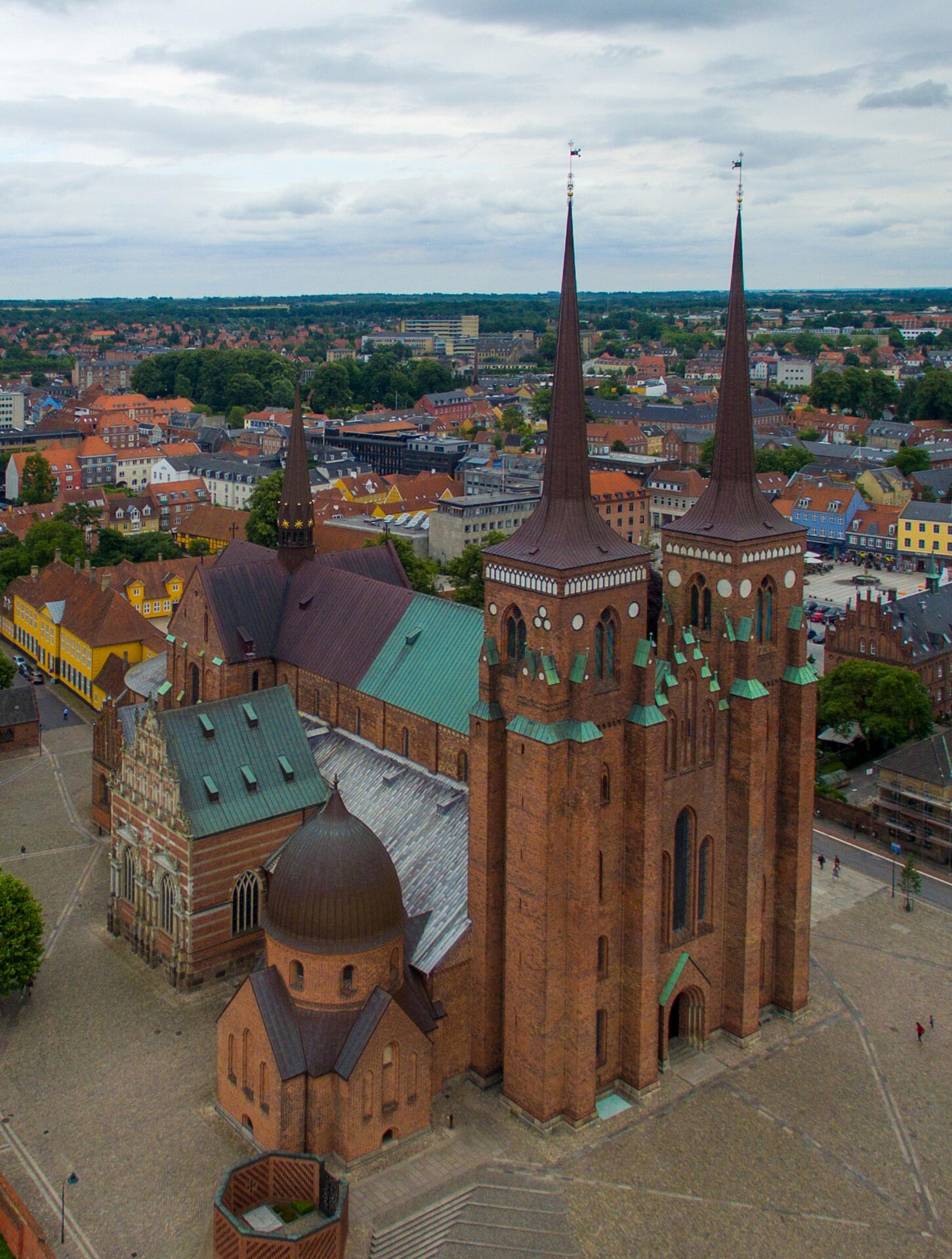
© CucombreLibre from New York, NY, USA, CC BY-SA 4.0 Resized from original. (This derivative is under the same CC BY-SA license.)
World Heritage Research
Discover scientific research and academic studies that deepen our understanding of Roskilde Cathedral from its history and significance to its conservation, management, and contemporary challenges.
-
Materiality and Religious Practice in Medieval Denmark ed. by Sarah Croix and Mads Vedel Heilskov (review)
A key insight from the edited volume 'Materiality and Religious Practice in Medieval Denmark' is that medieval Scandinavian religious culture was characterized by performed ritual piety, where devotional acts imbued material objects with sacred significance, fusing the worldly and divine through codified rituals, bodily enactments, and the translation of matter. The study employs an interdisciplinary approach to explore how materiality served as a focus for ritualistic and devotional practices, embodying faith and authority. It examines the agency of practitioners, the interconnectedness of people with things, and the potency embodied in objects, drawing on examples from liturgy, cults of saints, personal devotion, and memory. The volume emphasizes the importance of considering religion as an integrated part of society rather than an isolated subsystem.
McDonald, R. (2023). Materiality and Religious Practice in Medieval Denmark ed. by Sarah Croix and Mads Vedel Heilskov (review). Parergon, 40(1), 248–249. https://doi.org/10.1353/pgn.2023.a905428
View Publication Record | Read Publication -
Roskilde Domkirke. Styring af sognekirke og turistattraktion
A new governance model for UNESCO World Heritage Sites, exemplified by Roskilde Cathedral, emerges as a potential trend balancing religious and cultural heritage functions. The 2013 reorganization of the cathedral's governance network, including the establishment of a new foundation, reflects an adaptive approach to managing sites that straddle the intersection of Denmark's religious and museum sectors. This study highlights how such structures can navigate the dual demands of preserving historical significance while accommodating tourist attractions, offering insights into sustainable heritage management for similar globally recognized landmarks.
Christoffersen, L. (2015). Roskilde Domkirke. Styring af sognekirke og turistattraktion. Religionsvidenskabeligt Tidsskrift, (62), 77–89. https://doi.org/10.7146/rt.v0i62.22570
View Publication Record | Read Publication -
Roskilde – En bygrundlæggelse i vanskeligt terræn
Roskilde Cathedral's location, founded around AD 1000, was strategically chosen to reinforce the monarchy and Church as dominant ideological forces during the transition from Viking Age society. Unlike other towns that emerged from trade or urban development, Roskilde's establishment in challenging terrain—characterized by wetland, bogs, and a high water table—was driven by its sacred significance, particularly tied to the area's numerous springs. These springs, with their mythological and Christian symbolism, likely served as focal points for pre-Christian rituals and continued to hold religious importance in the new Christian kingdom. Archaeological evidence suggests that the site's selection was not due to practical considerations but rather its symbolic and spiritual value, positioning the cathedral on a slope where powerful springs emerged, creating a visually striking landscape. This intentional placement mirrors patterns seen at other contemporary towns like Lund and Viborg, indicating a broader plan to bridge pagan traditions with emerging Christian practices.
Ulriksen, J., Krause, C., & Jensen, N. (2014). Roskilde – En bygrundlæggelse i vanskeligt terræn. Kuml, 63(63), 145–185. https://doi.org/10.7146/kuml.v63i63.24464
View Publication Record | Read Publication -
The beginnings of Gothic ivory sculpture: recent discoveries in a group of Danish ivories
A recent study reveals that exquisite ivories found in Denmark, characterized by the 'year 1200 style,' are likely the work of a French or French-managed team of artisans. This group, summoned to Denmark around 1220, played a pivotal role in introducing Gothic elements to Danish polychrome wooden sculpture. The research identifies two key discoveries: an Adoration group linked to Archbishop Anders Sunesen, who studied in Paris and Bologna, and the Herlufsholm crucifix figure, which is connected to a large crucifixion group once housed in Roskilde Cathedral. Stylistic evidence and written records suggest a significant French influence on Danish art during this period, highlighting well-documented elite exchanges between France and Denmark.
Nyborg, E. (2014). The beginnings of Gothic ivory sculpture: recent discoveries in a group of Danish ivories. Sculpture Journal, 23(1), 31–39. https://doi.org/10.3828/sj.2014.4
View Publication Record | Read Publication
